 TripMyChinaJOURNEYS THROUGH REAL CHINA✦ AI Trip✦ Plan My Trip
English
简体中文
繁體中文
日本語
한국어
ไทย
Tiếng Việt
Bahasa Indonesia
Italiano
Español
العربية
Русский
Deutsch
Français
Bahasa Malaysia
TripMyChinaJOURNEYS THROUGH REAL CHINA✦ AI Trip✦ Plan My TripHohhot · Attractions
Islamic Style Street is the most colourful few hundred metres in Hohhot: a thoroughfare in the old Muslim quarter where shops, restaurants and apartment facades have been dressed in domes, arches and green-and-white tilework, all crowned by the minaret of the city's ancient Great Mosque nearby. The architecture is playful rather than ancient, but the food is utterly real, with halal roast lamb, steamed dumplings and baked buns drawing locals from across the city, especially after dark. Combined with the mosque and the old quarter's lanes, it makes an easy, delicious evening excursion. This guide covers what to see, eat and skip.
Hohhot's Hui community has shaped the city since its founding in the Ming dynasty, when the Great Mosque was established near the commercial heart of the new town. The quarter around it grew into a dense district of halal butchers, noodle shops and spice sellers, and in recent decades the main street was refashioned with Islamic-style facades, domes and archways to celebrate that heritage, giving the area its tourist-friendly name. Beneath the decorative surface, the district remains a living neighbourhood of the city's oldest trading streets.
Visitors come primarily to eat and to see the Great Mosque, whose Chinese-style courtyards and brick minaret date back over three centuries. Along the street, the evening is the time to arrive: grill smoke drifts from lamb skewers, bakeries pull flatbread and stuffed buns from tandoor ovens, and dessert shops ladle out local dairy treats that reflect Inner Mongolia's herding traditions. The area sits within walking distance of the old monasteries, so a day that begins at Dazhao Temple can end with skewers and sweet tea here, a satisfying loop through Hohhot's layered cultures.
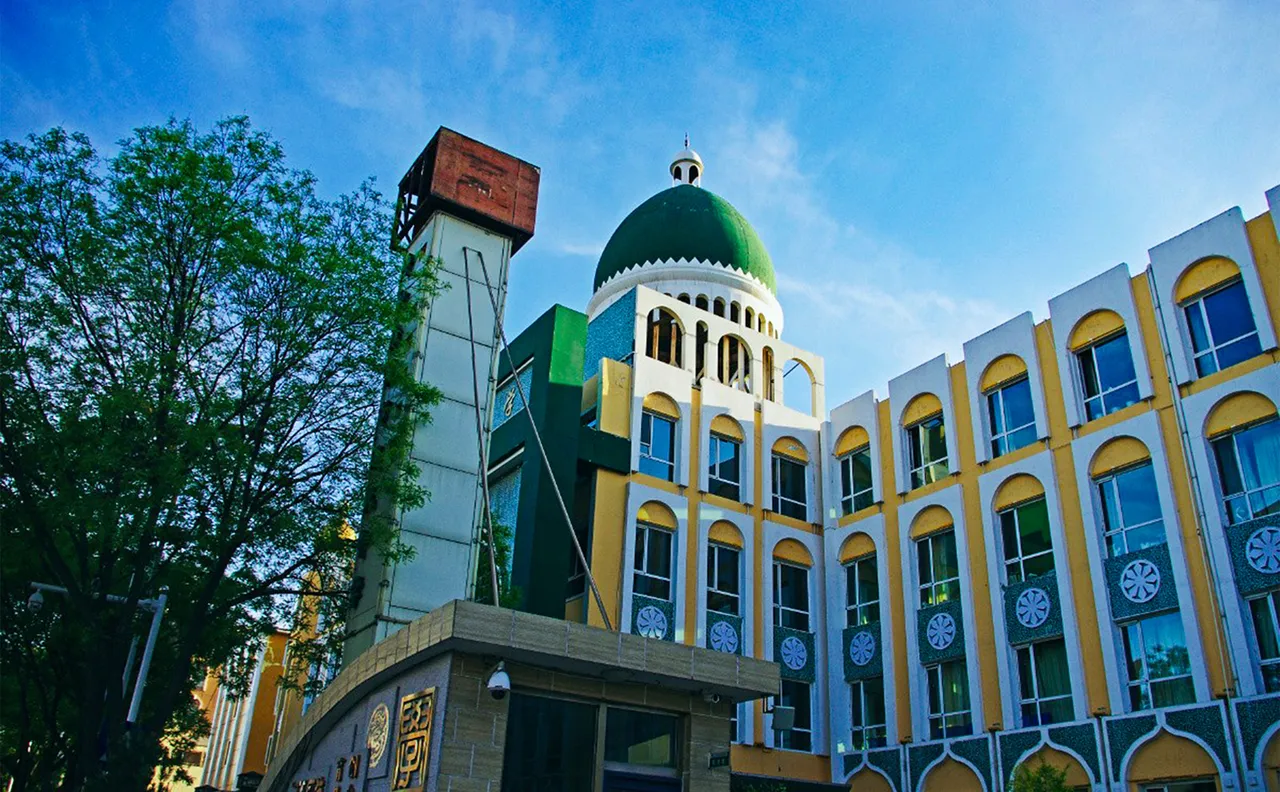
There is no ticket and no gate: the street is a public thoroughfare, open and lively at all hours, though it is at its best from late afternoon through the evening. The only paid sight nearby is the Great Mosque, which has charged a small admission fee in recent years, with hours generally aligned to daylight and reduced access around prayer times; check locally on the day. Bring cash or mobile payment for the food stalls, most of which are small family operations, and carry small notes for quicker service. Hygiene standards are generally good at the busy stalls, but as with any street-food district, follow the queues: the busiest grills and bakeries are busy for a reason.
Islamic Style Street runs through the Muslim quarter of Hohhot's old Yuquan district, a few minutes' walk from the Great Mosque and about 20 minutes on foot from Dazhao Temple. City buses stop along the surrounding main roads, taxis and ride-hail cars are inexpensive from anywhere downtown, and from Hohhot railway station the ride takes about 15 to 20 minutes. The street itself is best explored entirely on foot, weaving between the food stalls, the mosque quarter's lanes and the old shopfronts. A natural evening plan pairs dinner here with a stroll past the mosque's lit facade, and the old monasteries make an ideal late-afternoon prelude within walking distance.
The street is a year-round attraction, but the experience peaks in the warm evenings of late spring through early autumn, from May to September, when outdoor grills run and the lanes fill with strollers; winter evenings are colder but the indoor restaurants and bakeries are cosier, and steam rising into the cold air has its own charm. Within the day, arrive around 17:30 to 18:30 to catch the stalls firing up, and stay through the evening when the neighbourhood is at its fullest. Ramadan and major Muslim festivals change rhythms and some openings, so check dates if your trip coincides. Two to three hours covers dinner, the mosque and a wander through the lanes comfortably.
It is the main food street of Hohhot's old Muslim quarter, refashioned with Islamic-style domes and archways, famous for halal lamb dishes and its location beside the city's ancient Great Mosque.
The street's domes and facades are a modern decorative treatment rather than centuries-old buildings. The genuinely historic sight nearby is the Great Mosque, which dates back over three centuries.
Priorities are halal roast lamb and skewers, baked flatbreads and stuffed buns, hand-pulled noodles, and the local dairy desserts and milk tea that reflect Inner Mongolia's herding traditions.
Late afternoon into the evening, roughly from 17:30 onwards, when the grills are running and the street is liveliest. Warm-season evenings are the most enjoyable, and winter has its own cozy indoor appeal.
 Full day · 8–10 hours
Shaomai here is sold by the weight of the wrappers, eight to a liang, and the shops fill up by seven
View details → Full day · 8–10 hours
A temple of 1579, a tower of 1732, and a skeleton twenty-six metres long
View details → Full day · 8–10 hours
Two hours out of the city to open steppe, where the horse and the whole-sheep banquet need their prices settled first
View details → 2 days · 1 night · private
A compact first-visit loop of Hohhot: the silver Buddha of Dazhao Temp
View details → 3 days · 2 nights · private
The classic Hohhot triangle: Dazhao Temple and the old street, a night
View details →Booked a private guide for the day and it was worth it just for Dazhao Temple. The silver Buddha inside is huge, and my guide explained the eight stupas one by one, which I never would have figured out on my own. We finished at a small place near the temple with hand-grabbed mutton and milk tea — messy to eat, but that's half the fun.
Took the kids to the Inner Mongolia Museum one morning and they actually stayed interested — the grassland culture displays with the yurts and horse gear kept them busy for two hours. Only gripe: almost everything is in Chinese with tiny English labels, so I was translating nonstop. Five-Pagoda Temple in the afternoon was a quick stop but the carved base of the stupa is worth a slow look.
Private car & driver, day trips and multi-day routes from Hohhot. · Free consultation · reply within 12h