 TripMyChinaJOURNEYS THROUGH REAL CHINA✦ AI Trip✦ Plan My Trip
English
简体中文
繁體中文
日本語
한국어
ไทย
Tiếng Việt
Bahasa Indonesia
Italiano
Español
العربية
Русский
Deutsch
Français
Bahasa Malaysia
TripMyChinaJOURNEYS THROUGH REAL CHINA✦ AI Trip✦ Plan My TripNanchang · Attractions
The Wanshou Palace Historic District is the beating heart of old Nanchang, a restored quarter of stone-lane streets, gray-brick facades, teahouses and food stalls gathered around the ancient Wanshou Palace temple. By day it is a maze of craft shops and snack counters; by night the lanterns come on and the lanes fill with locals grazing through Jiangxi's famously fiery cuisine. Minutes from the Pavilion of Prince Teng, it is the easiest place to taste the city, and the best answer to the question of what to do in Nanchang after dark.
The district grew around the Wanshou Palace, a temple dedicated to Xu Xun, a Jin-dynasty Taoist master venerated in Jiangxi as a protective deity, and for centuries this was Nanchang's commercial soul, where merchants, artisans and pilgrims mingled. The lanes fell into decay in the modern era, and the current district, reopened after a careful restoration, rebuilt the historic street pattern around the temple while filling the shopfronts with old-name eateries, craft studios and cafes. The architecture reads authentic Jiangxi: gray brick, timber lintels, stone paving and upturned eaves.
Food is the main event. The lanes concentrate Nanchang's signature snacks, from mixed noodles with rice-flour spicy soup (ban fen with watang fen), fried rice cakes, sugar cakes and stinky tofu to fiery Jiangxi mains that routinely out-chili Sichuan. Teahouses stage traditional opera and storytelling in the evenings, and the temple courtyards offer a quiet counterpoint between snack stops. The district is compact, walkable in 30 minutes end to end, but most visitors spend two to three hours drifting between food counters, and far longer if they arrive hungry at dusk.
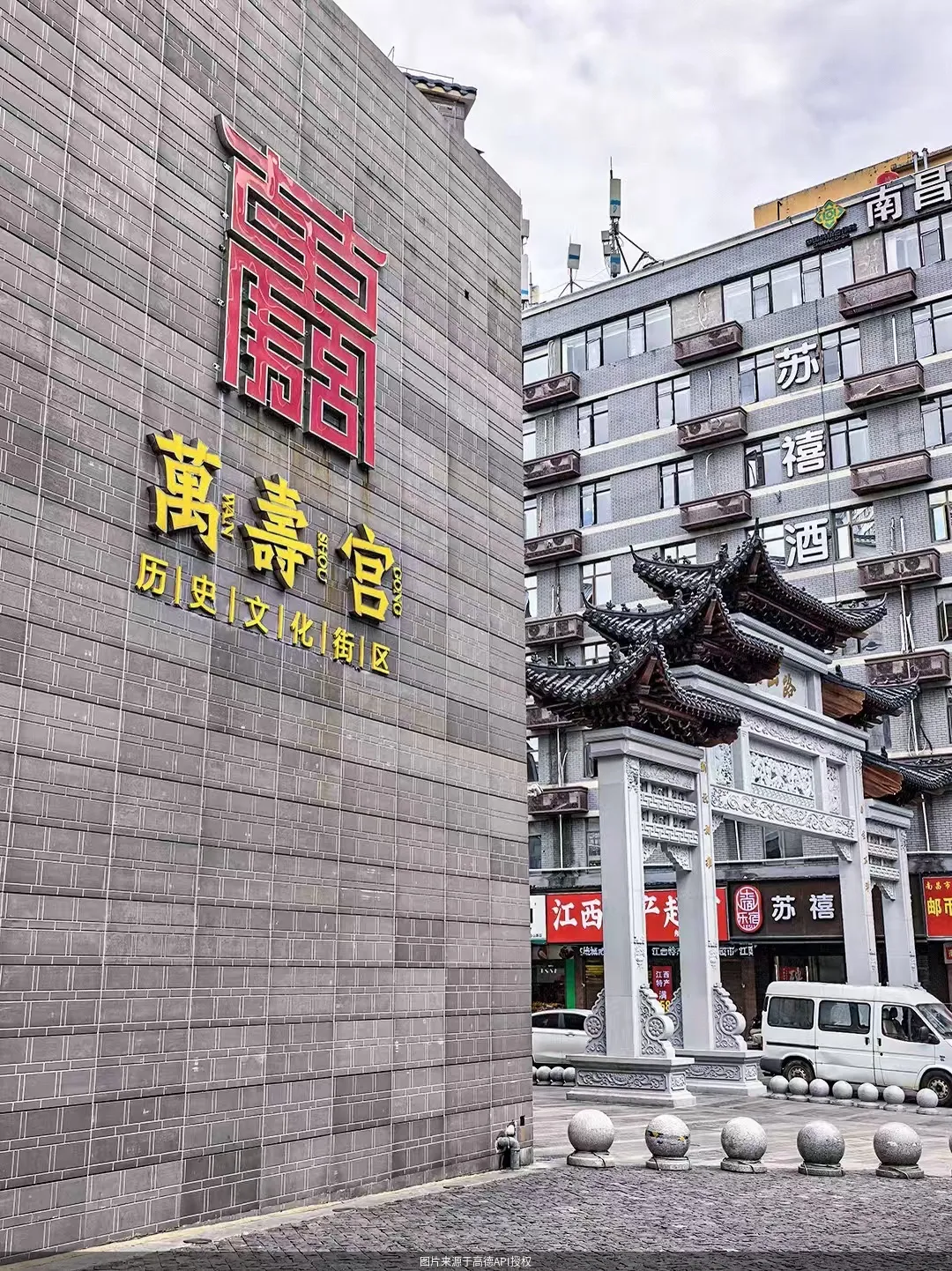
Entering and strolling the district is free at all hours, and the lanes stay lively from late morning until well after midnight, with individual restaurants, teahouses and shops keeping their own hours. The temple courtyards are also free to enter in normal circumstances. Bring local mobile payment or small cash for food counters, most are inexpensive and casual. Weekend evenings from 18:00 onward are the busiest and most atmospheric, while weekday afternoons are calmer for browsing shops. Peak queuing happens at the famous noodle and soup counters; go early or be patient. The area is flat, stroller-friendly, and English is limited, so pointing and payment apps do most of the work.
The district lies in Xicheng old town, a few hundred meters east of the Gan River embankment and within easy walking distance of the Pavilion of Prince Teng, roughly 10 to 15 minutes on foot. Nanchang Metro Line 1 serves the area with a stop a few minutes' walk away, and taxis from the railway stations take 10 to 20 minutes depending on traffic. The lanes are pedestrianized, so wear comfortable shoes and expect crowds on weekend evenings. A natural itinerary is Tengwang Ge in late afternoon, then walk to the district for dinner and the lantern-lit evening scene; the Youmin Temple and Bayi Square area are a short taxi ride onward.
The district is an evening destination by nature: arrive around sunset, ideally after a late-afternoon visit to the Pavilion of Prince Teng, and stay through the lantern-lit peak from 19:00 to 22:00. Spring and autumn evenings are the most comfortable for outdoor snacking; summer nights stay hot but animated, and winter crowds thin though the steaming food counters feel even more inviting in the cold. The district is busiest on Friday and Saturday nights and during Chinese holidays, when the lanes become shoulder-to-shoulder, visit earlier in the evening if you dislike crushes. For teahouse performances, check schedules locally, shows cluster in the evenings and on weekends.
No, the streets and temple courtyards are free to enter. You only pay for whatever food, drinks and shops you choose.
Start with Nanchang's iconic mixed rice noodles and rice-flour spicy soup, then work through fried rice cakes, sugar cakes, stinky tofu and the fiery local mains at the old-name counters.
About 10 to 15 minutes on foot, which is why the classic plan is watching sunset from the tower and walking to the district for dinner.
The lanes fill from 18:00 and peak between 19:00 and 22:00, especially on weekends and holidays. Weekday afternoons are much calmer.
 Full day · 8–10 hours
The city runs on four-yuan soup and three-yuan noodles, and it is proud of it
View details → Full day · 8–10 hours
A Tang poem, a gunshot that started a war, and the old commercial quarter
View details → Full day · 8–10 hours
Out of the city in 40 minutes, into a forest that stays cool in August
View details → 7 days · 6 nights · private
Wuxia-dream valleys, harvest rooftops and the porcelain capital where
View details → 2 days · 1 night · private
A compact first-visit loop of Nanchang: the rebuilt Tengwang Pavilion
View details →Booked a private guide for one day in Nanchang and it was worth it just for Tengwang Pavilion. My guide read out chunks of Wang Bo's essay at the spots they describe, which I would have totally missed on my own. Also squeezed in the August 1 Uprising Memorial — the 1927 timeline there is laid out clearly enough that I actually followed it.
Took the kids to the August 1 Uprising Memorial and they were more into it than I expected — the old rifles and the dioramas kept them quiet for a solid hour. Wanshou Palace afterwards was a good reward, we let them pick snacks from the stalls. Only gripe: the pavilion stairs were packed on a Saturday, so go early if you have little ones.
Private car & driver, day trips and multi-day routes from Nanchang. · Free consultation · reply within 12h