
In the Ming, Wudang was an officially built sacred mountain: three hundred thousand soldiers and civilians raised it over thirteen years, eight palaces, two monasteries, thirty-six hermitages and seventy-two cliff temples unfolding along the pilgrim route. Three heritage days restore that order, starting at the Xuanyue arch at the mountain's foot and climbing the old trail step by step to the summit.
The theme is architecture negotiating terrain: Taizipo folds its axis up a steep slope, Nanyan hangs palaces off a sheer cliff, and the Golden Summit gathers every axis at the top of all peaks. No rushing; read each palace as a sentence, and only the sequence makes the whole essay.
Itinerary at a glance
| D1 09:00 | Xuanyue Gate: The First Gate of the Pilgrim Road |
| D1 10:30 | Taizipo: Architectural Wit on a Steep Slope |
| D1 11:30 | Nine-Bend Yellow River Wall: A Wall That Tells Stories |
| D1 14:30 | Zixiao Palace: The Mountain's Most Complete Architecture Lesson |
| D1 16:30 | Xiaoyao Valley: The Heritage Day's Breathing Hole |
| D2 08:30 | Nanyan Palace: Taoist Nerve on a Sheer Cliff |
| D2 11:00 | Wudangshan Hiking Trails: The Pilgrim Trail's Middle Stretch |
| D2 14:00 | Langmei Shrine: A Small Waystation on the Old Trail |
| D2 15:30 | Taihe Palace: The Final Assembly Below the Golden Summit |
| D2 16:30 | The Golden Summit: The Pilgrim Road's Terminus |
The route, stop by stop
Xuanyue Gate: The First Gate of the Pilgrim Road
Heritage days open at Xuanyue Gate. This Ming stone arch bears the four characters Zhishi Xuanyue, an imperially commissioned entrance to the mountain; passing through it once meant formally setting foot on Wudang.
The carvings reward close reading: cranes, drifting clouds and figure stories crowd the architrave, six centuries of weather polishing the stone. Once a pilgrim assembly ground, now quiet, the right hour for rubbing stones and readings.
The gate lies at the mountain foot, apart from the main palaces, reached by charter or bus. Forty minutes, a solemn overture to three pilgrim days.
Taizipo: Architectural Wit on a Steep Slope
The pilgrim route's first great monastery is Taizipo, built on a steep slope, and the Ming answer was folding: one li four gates splits the axis into stages, the nine-bend wall steers flow and sightlines with curves, and only the top-down view reveals the whole.
The Wuyun Tower's one-pillar-twelve-beams is the mountain's most famous timber riddle, a single column carrying twelve crossbeams, half mechanics and half symbolism. The Prince Hall honors the young Zhenwu, the studying-cultivating legend grounded here.
Slope steps come thick, so pace slowly. The courtyard osmanthus runs ancient, autumn scent flooding the slope, a second harvest beyond architecture.
Nine-Bend Yellow River Wall: A Wall That Tells Stories
The Nine-Bend Yellow River Wall is Taizipo's guiding wall, folding through nine turns with the slope, its rose-colored face meandering through woods, the most photographed wall on the mountain.
Function and beauty are one: the curves screen the view of the summit buildings, so you meet the wall before the monastery, a step-by-step suspense typical of Ming architectural narrative. Glazed tiles and ridge beasts reward looking up.
The wall's end faces the Dragon-Tiger Hall, ten minutes of walking ideal for empty-frame and silhouette shots, softest light before nine in the morning.
Zixiao Palace: The Mountain's Most Complete Architecture Lesson
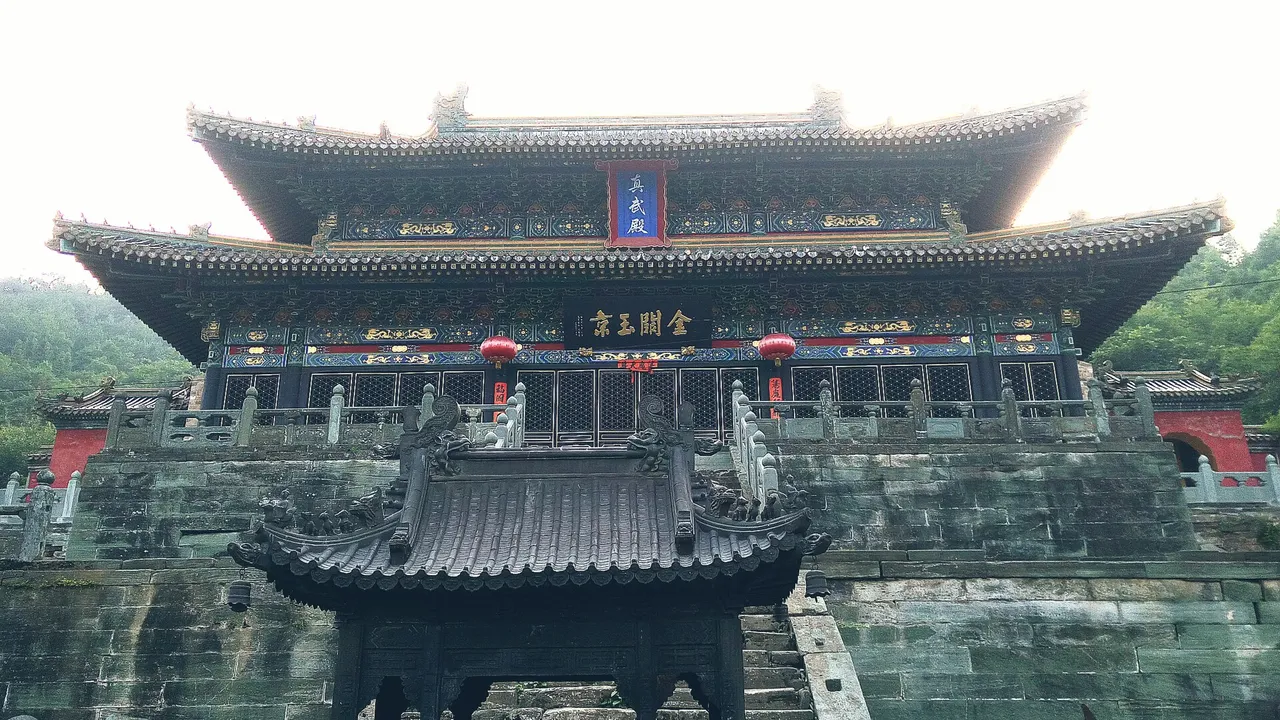
The afternoon belongs to Zixiao. Backed by Developing-Flag Peak and fronted by reflecting water, its axis raises Dragon-Tiger Hall, Zixiao Hall and the Parent Hall tier by tier, a textbook-grade field site of Ming palace architecture.
Read it in three layers: distant, how axis locks into terrain; middle, roof beasts and painted motifs; close, stone terraces and railing detail. The masters' chanting and ritual music are the space's living footnote.
The ground runs gentle, an hour to ninety minutes. Zixiao anchors the three heritage days, and Nanyan and the summit later quote from it constantly.
Xiaoyao Valley: The Heritage Day's Breathing Hole
Close day one at Xiaoyao Valley, switching from palace architecture to ravine nature, resting eyes full of brick and timber. Stream, metasequoia and figures at martial rehearsal compose a loose frame.
Catch a martial show if the slot fits, half an hour; otherwise walk the stream and listen to water. This stop is rhythm design: after dense architecture, a stretch with no assignment.
Ride shuttles out and overnight in Wudang town or on-mountain lodging, entering the line's core passages on day two.
Nanyan Palace: Taoist Nerve on a Sheer Cliff
Day two opens at Nanyan, Wudang architecture's most perilous chapter. Palaces nest into the cliff, stone halls mimicking timber entirely in stone, the dragon-head incense beam jutting over the void, Ming religious nerve frozen into building.
Read three things: how halls lock into rock, the beam's cantilever, and the vista before the Liangyi Hall. Before the crowds fill, the cliff's quiet approaches the Daoist state of clear emptiness.
Nanyan is also a key node on the summit trail; after the palaces, set out from here into the climbing stretch. Steps and cliff edges slick often, hands on rails throughout.
Wudangshan Hiking Trails: The Pilgrim Trail's Middle Stretch
The old trail from Nanyan to the summit is the pilgrim route's final leg and the mountain's densest heritage stretch: the First, Second and Third Heavenly Gates tightening in turn, each gate a rite of entry.
Centuries of pilgrim feet polished the steps; look up to the gates, back down the traveled road. The design intent is explicit: let the body arrive at awe before the mind.
About two hours on foot to Taihe Palace at a slow pace; the climbing pitches steepen, so knee braces and poles are advised, and switching to the cable car in rain is no defeat.
Langmei Shrine: A Small Waystation on the Old Trail
Langmei Shrine sits beside the old trail between Nanyan and the summit, honoring the langmei fruit once offered the Ming court as immortal produce, a tiny shrine compressing the whole storyline of Wudang and imperial power.
The shrine is small, ten minutes, its value positional: looking back from the forecourt, the day's temples hide in forest, the pilgrim route's spatial feel clearest right here.
Rest, hydrate, read a stele or two. Beyond this point the steps steepen visibly, so budget the final leg's strength.
Taihe Palace: The Final Assembly Below the Golden Summit
The old trail gathers at Taihe Palace, the summit complex's grounded half, where the Fortune-Turning Hall's narrow passage is the last rite before the top.
See two things inside: how the halls gather the axis with the slope, and how six centuries of pilgrims polished the floors. Palace and summit follow the standard script of buildup and climax.
Final assembly at Taihe: layer up, hydrate, check gear, then climb. On windy afternoons, the shell goes on before the summit.
The Golden Summit: The Pilgrim Road's Terminus
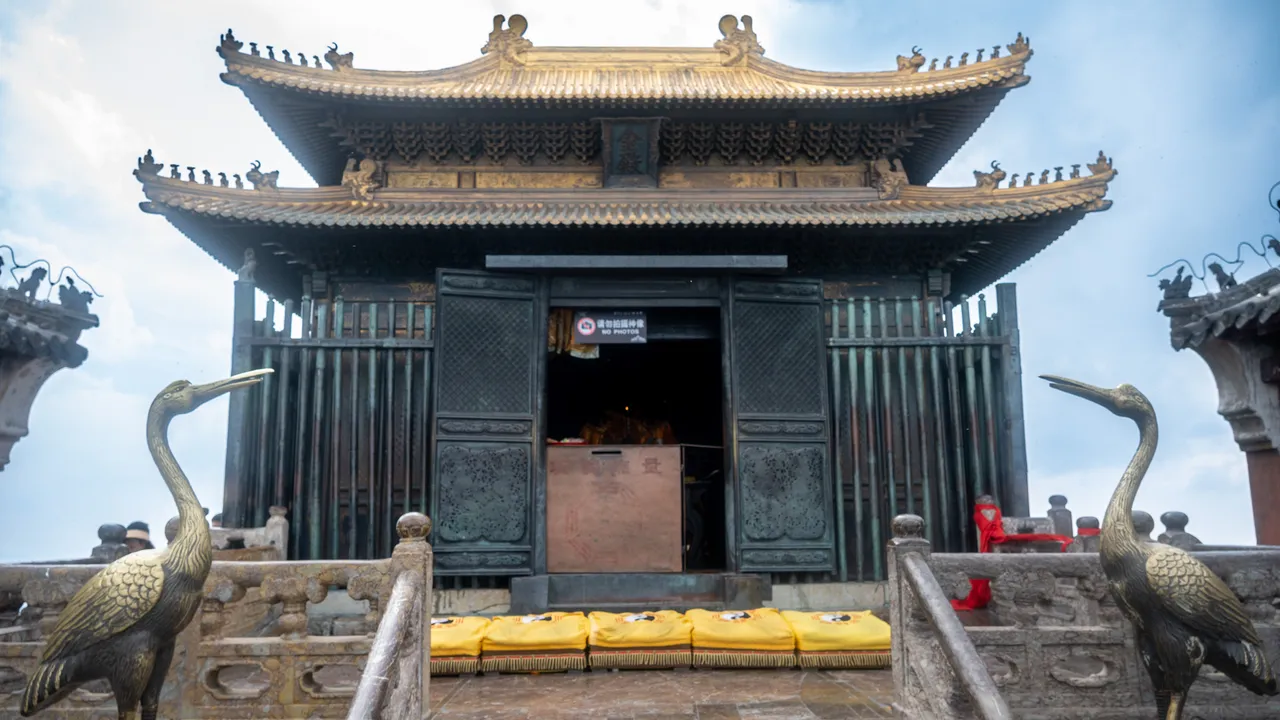
The heritage days close at the Golden Summit. The bronze-and-gold Golden Hall crowns Tianzhu Peak inside the Purple Gold City walls, and every axis followed along three days completes its final alignment underfoot.
Circle the hall and re-read two days of road: Taizipo's folding, Nanyan's cantilever, the trail's gathering, all answers written on the terrain map before you. Clear days show the entire Wudang range.
At sunset the gilding shifts with the light; descend by the Qiongtai cable car and close the three days quietly.
| Getting around |
|
| Budget | Mountain entry about RMB 240, Golden Summit RMB 27, Zixiao RMB 15; with two nights and meals, three days run roughly RMB 900-1,500 pp. |
| Best time | Year-round, osmanthus spring and autumn color adding atmosphere; the pilgrim order starts at Xuanyue Gate, and morning light flatters architectural detail. |
FAQs
Why insist on starting at Xuanyue Gate?
Because the pilgrim order is itself the content: Ming worshippers entered at Xuanyue Gate and climbed stage by stage, and every site's placement and axis was designed around that route. Skip the gate and you see scattered palaces; follow the order and you see one complete work.
Which stretch is hardest across three days, and how to ease it?
The hardest is day two's Nanyan-to-summit trail, two hours of continuous steps. Three easers: sleep early and warm up well before starting; pace with a two-minute break at intervals; or switch mid-route to the cable car and summit from the Qiongtai side at modest loss, never grinding through.
Can this line run in rain?
Yes, with changes: when steps slick, take the cable car for the trail section while Nanyan and Zixiao continue as normal (rain gear in hand), slotting Xuanyue and Taizipo into dry gaps. Mist in rain adds atmosphere, and the Purple Gold walls show their deepest color wet. Keep off cliff edges and high ground in thunderstorms.
What should architecture lovers prioritize?
Four specialisms: Taizipo's one-pillar-twelve-beams and wall-guided circulation; Zixiao's axial hierarchy and stone terrace work; Nanyan's stone-as-timber construction locked into living rock; and the summit's cast-bronze hall plus the Purple Gold defensive wall system. Throughout, watch how each building borrows the terrain, the root difference from plains-style temples.