
Seven days is the ultimate version, built on one idea: treat Dunhuang as a base, not a finish line. The first two days take in Mogao and Mingsha, day three runs the western line for the Yardang sunset, day four reaches Yulin Caves in Guazhou, day five goes north to Jiayuguan's fortress, and days six and seven branch two ways: push west toward Hami or Turpan, or stay for deep slow Dunhuang, filling in the bookstore, the art academy, hot springs and a second cave session.
Practical notes for the eastern Xinjiang extension: direct trains run from Dunhuang to Hami in roughly four to six hours, while high-speed service requires transferring at Liuyuan South station. Turpan works the same way, about three hours from Liuyuan South to Turpan North on the Lanzhou-Xinjiang line. Which branch to take depends on your return city: heading back through the northwest, Hami and Turpan fall naturally en route; flying home to the interior, circling back to Dunhuang is the safer close.
Itinerary at a glance
| DAY1 09:00 | Mogao and the Downtown Culture Belt: Day One of Seven |
| DAY2 09:00 | Mingsha All Day, and the Art of Re-Entry |
| DAY3 09:00 | The Western Line and Yardang Sunset: The Hardest Day of Seven |
| DAY4 09:00 | Yulin Caves in Guazhou: The Hidden Climax for Cave Lovers |
| DAY5 09:00 | Jiayuguan Fortress and the Days Six-Seven Fork |
The route, stop by stop
Mogao and the Downtown Culture Belt: Day One of Seven
Day one of seven is still Mogao, plus the bookstore and the river downtown. The extra time changes one thing fundamentally: you can re-visit the conservation center. After the real caves in the morning, walk the replica caves again in the afternoon in chronological order, then cross-check albums at the bookstore that night. Seeing everything twice is the shortest path to a real framework of cave history.
Skip a show tonight and save Again Dunhuang for the slow block on day six, spreading the emotional peaks more sensibly. Seven days is not about seeing more but about turning what you saw into a system.
Mingsha All Day, and the Art of Re-Entry
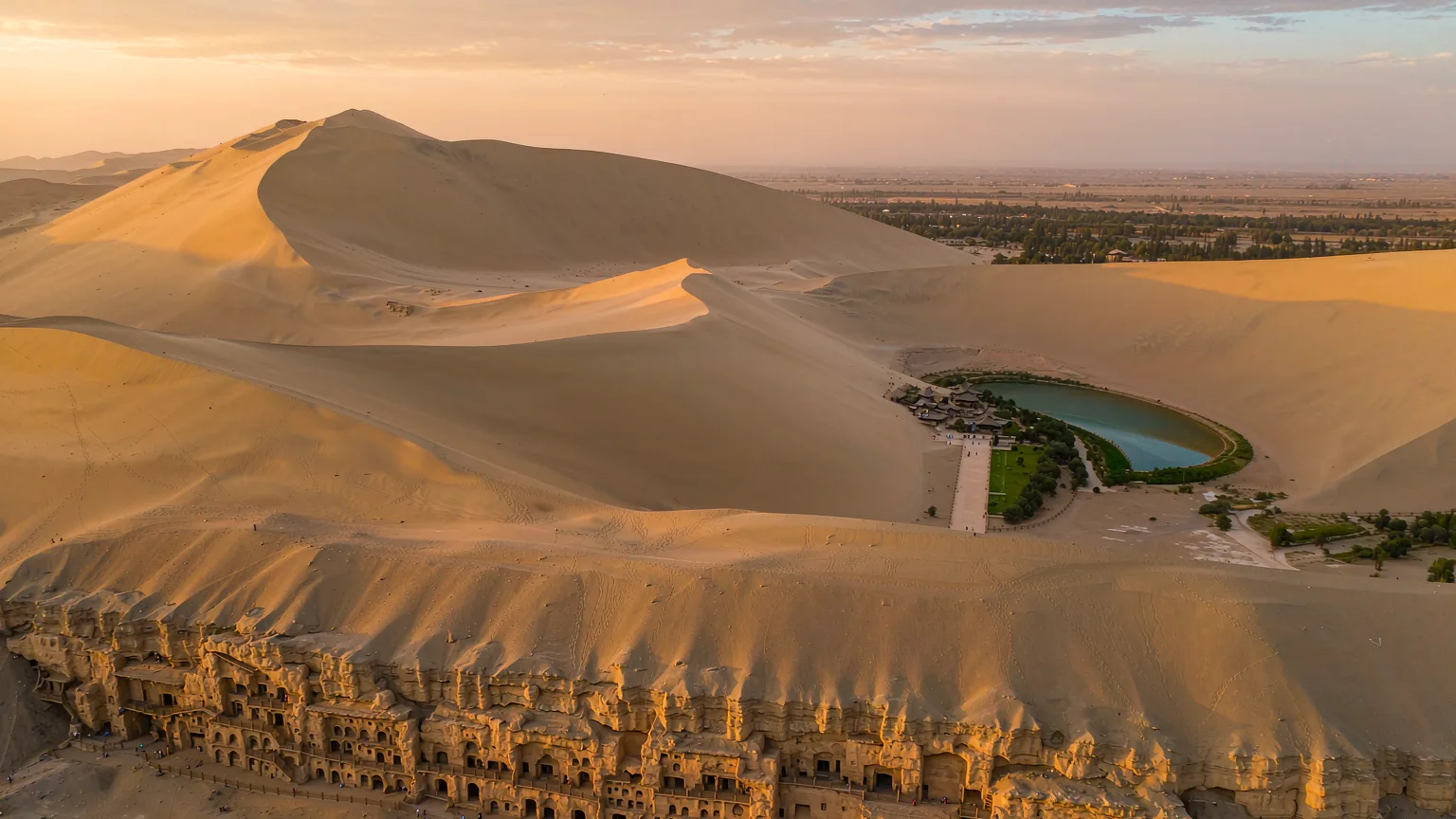
Day two exploits the re-entry policy fully: camels and sandboarding before midday, a hotel nap, then back in for sunset and stars. In high season the sunset spots get crowded; the real value of re-entry is waiting out the crowds in comfort, watching Crescent Spring light up, and shooting a night set before descending.
Close lightly with Music of Dunhuang tonight. Splitting the two shows across the week rather than stacking them is the key difference between a long trip and a three-day dash: everything serves sustainability.
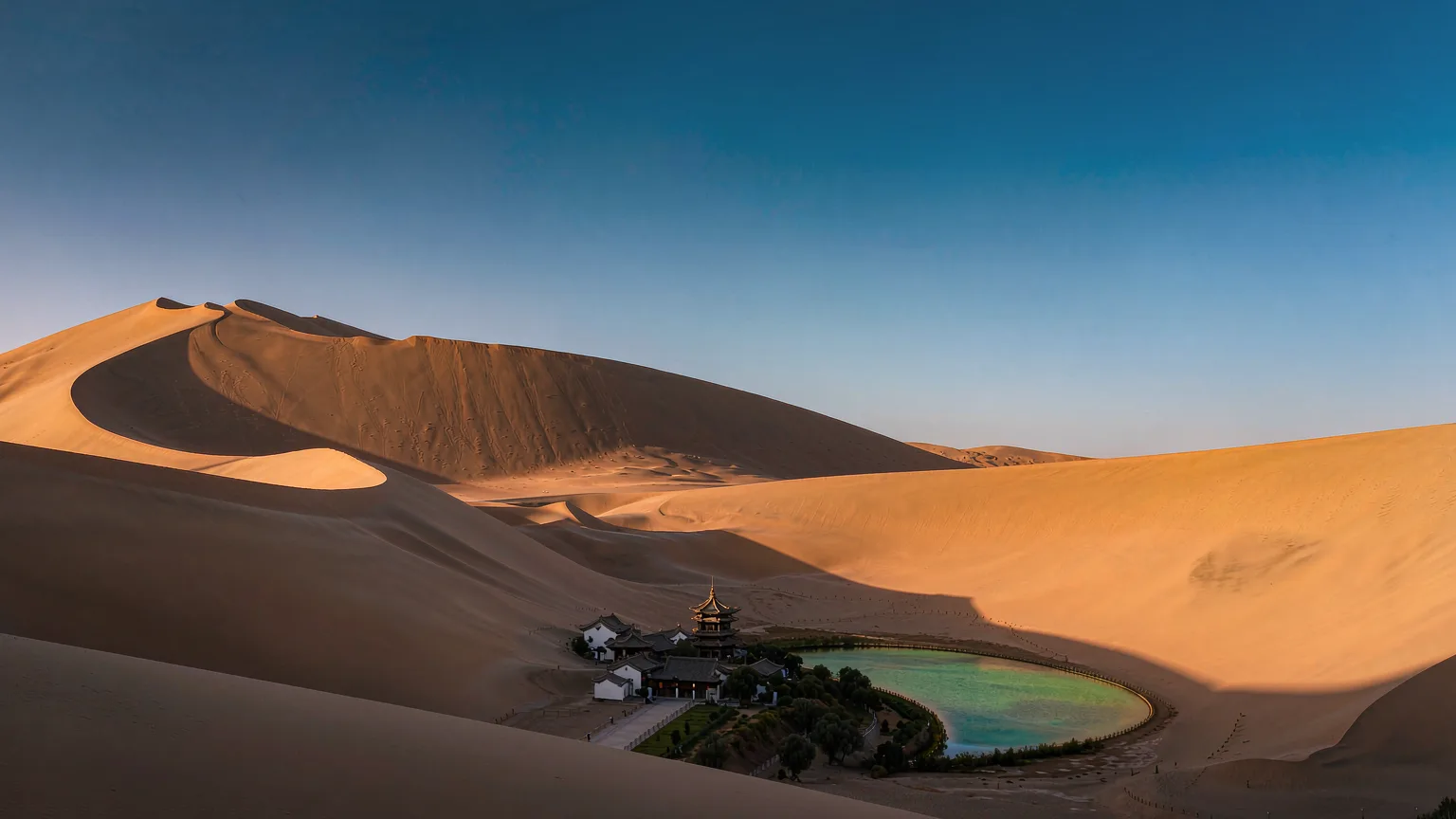
The Western Line and Yardang Sunset: The Hardest Day of Seven
The western line's mechanics are already covered: three stops, sunset at Yardang, a night return. The seven-day version's unique advantage is four full days of recovery afterward, no same-night trains or flights, so use the post-sunset time fully: half an hour more of stars before boarding the car.
Pack the sun-protection trio, water and dense snacks. Gobi UV after midday is unreasonable, the post-sunset temperature drop is unreasonable; only your gear should be reasonable.
Yulin Caves in Guazhou: The Hidden Climax for Cave Lovers
Day four is the Guazhou loop: Yulin Caves' Western Xia murals plus the Tang-era walls of Suoyang City, laid out in the five-day plan. On seven days, apply for one or two special caves at Yulin, fees per current notices and limited slots on site, arriving right at opening. Viewing without glass barriers and with controllable lighting makes the standard Mogao visit feel like a preview.
On the way back through Guazhou county town, try the local honeydew melon and a bowl of Guazhou-style noodles; this small county's sweetness never misses. Early night in Dunhuang before heading north to Jiayuguan.
Jiayuguan Fortress and the Days Six-Seven Fork
Day five runs north to Jiayuguan, where the fortress, the Overhanging Great Wall and the First Beacon Tower make a complete day. The Ming-era complex is in a class of its own for completeness, and the tower viewpoint folds the Qilian snowline and the gobi into one frame. High-speed rail both ways fits in a day; an overnight is far more relaxed, and both work.
Tonight is the fork. Go west: move toward Hami or Turpan from here or from Dunhuang. Stay: return to Dunhuang on day six for the slow finale. One criterion decides: where your homeward transport starts. Follow the main artery and cut everything not on the way.
| Getting around |
|
| Budget | About 2,500 to 3,500 RMB per person: roughly 1,600 for five days around Dunhuang, about 400 for the Jiayuguan round trip with tickets, and 500 to 1,500 of flexible transport and lodging for the Hami or Turpan segment. |
| Best time | May to October. Extending to Turpan in September collects grape season and Dunhuang autumn in one trip. |
FAQs
Is staying in Dunhuang on day seven better than pushing to Turpan?
Depends on the whole route. If Xinjiang continues after this trip, Turpan is just the gateway and belongs later. If you fly home right after, squeezing in Turpan turns into a forced march; staying in Dunhuang closes the trip properly. The rule is simple: Turpan earns its slot only if it lies on your way home.
Is Hami worth a dedicated detour?
Hami's royal palace, its own yardang landforms and the famous melons reward half a day to a day, but unless you happen to be heading east anyway, a dedicated detour is mediocre value. Treat it as a bonus on the way, not a must-see, and the decision makes itself.
What principles govern pacing across seven days?
Alternate hard and soft: insert a low-intensity day between brutal days like the western line and Jiayuguan; asleep by eleven nightly; any day over twenty thousand steps is followed by a downtown-only day. Seven-day trips collapse not from one brutal day but from three full-load days in a row.
Must I book all seven nights of lodging in advance?
A week ahead is plenty for Dunhuang lodging, prices drift little. But lock shows, Mogao tickets and charters early. If Jiayuguan hosts an overnight, book that too; small-city inventory in high season is tighter than Dunhuang's.