
Seven days in Guiyang rush nothing, running against the usual playbook: three days to get fluent in the city, two in the mountains and waters, one at the springs, and an unhurried exit. The pace works because Guiyang itself suits slowness, cool summers, gentle prices, dense lanes, with another bowl of noodles always one corner away.
The master plan: two days of old town plus museums, day three into Huaxi with a Qingyan night, day four Tianhetan and Hongfeng, day five Colorful Guizhou City with an opera evening, day six the springs, day seven departure. Downtown serves as base camp the whole way, with one bag move to Qingyan. Most venues close Mondays, so line the plan up against the calendar first.
Itinerary at a glance
| Day 1 · 09:00 | Jiaxiu Tower: The Origin of Seven Days |
| Day 1 · 11:00 | Wenchang Pavilion: The First Morning on the Old Wall |
| Day 1 · 14:00 | Qianling Mountain Park: The Slow Afternoon Climb |
| Day 1 · 19:00 | Qingyun Road Pedestrian Street: The First Market of Seven |
| Day 2 · 09:00 | Guizhou Provincial Museum: Building Coordinates in a Morning |
| Day 2 · 13:30 | Guizhou Provincial Ethnic Museum: The Afternoon's Other Telling |
| Day 2 · 16:00 | Lanyubai Batik Studio: When Knowledge Lands in Your Hands |
| Day 3 · 09:30 | Huaxi Ten-Li River Flats: A Full Morning for One River Valley |
| Day 3 · 13:30 | Huaxi Yelang Valley: A Stone Ravine Worth a Second Look |
| Day 3 · 16:00 | Qingyan Ancient Town: A Night inside the Stone City |
| Day 4 · 09:30 | Tianhetan: The Deepest Cave at Your Freshest Hour |
| Day 4 · 14:30 | Hongfeng Lake: The Week's Largest Mirror |
| Day 5 · 14:00 | Colorful Guizhou City: Completing the Heritage Panorama |
| Day 5 · 19:30 | Guizhou Qian Opera Theatre: The Cultural Finale |
| Day 6 · 15:00 | Guiyu Hot Spring: Zeroing Six Days of Fatigue |
The route, stop by stop
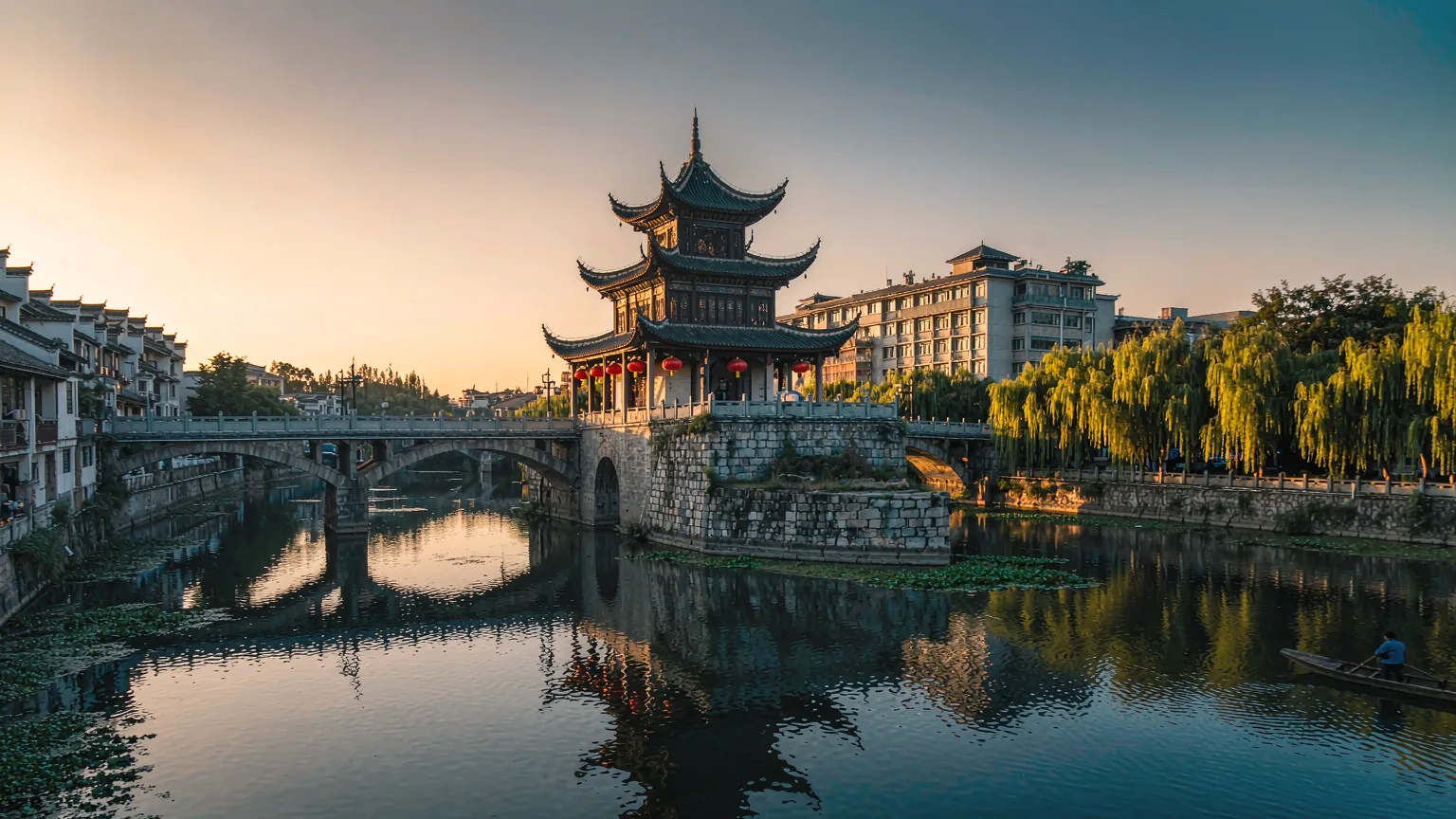
Jiaxiu Tower: The Origin of Seven Days
Day one books nothing mandatory; starting at Jiaxiu Tower simply fixes a coordinate for the week. The morning Nanming belongs to exercising locals, tower, bridge and garden all free, and by the time you take your first pot of tea in Cuiwei Garden, the city's rhythm has transferred to you.
The riverside paths around the tower deserve several passes: across seven days it becomes your reference for jogs, strolls and photos, so learn it today. Lunch on changwang noodles in the nearby old streets, then point the afternoon at the old walls.
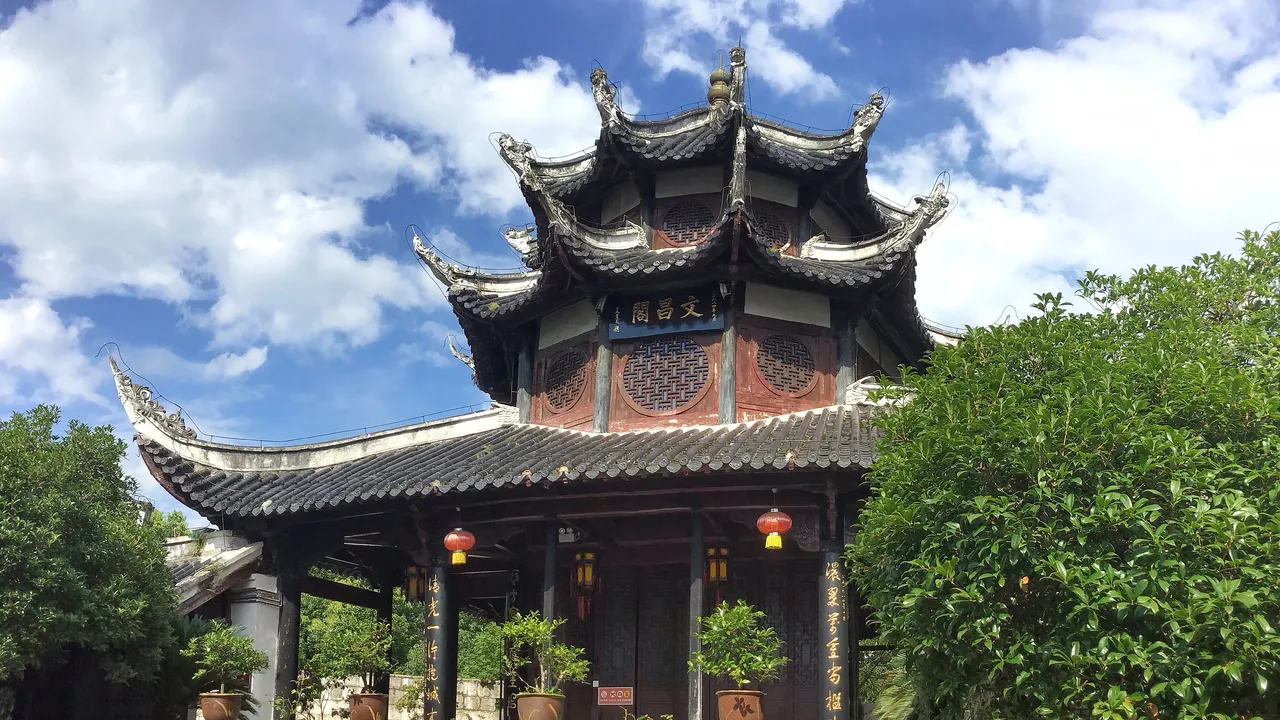
Wenchang Pavilion: The First Morning on the Old Wall
Walk north from Jiaxiu and the nine-cornered pyramid roof of Wenchang Pavilion emerges behind the trees. This Wanli-era tower is structurally unique in the country, and the old east gate wall beneath takes a short walk, brick shades ringing like growth rings of centuries of repairs.
Deep travel means finishing the exhibits before moving on: the pavilion's account of the city's founding and wall history runs short, a solid twenty minutes that grounds everything you see in the next six days. Lunch around Minsheng Road, since the afternoon's Qianling climb wants good legs.
Qianling Mountain Park: The Slow Afternoon Climb
The afternoon Qianling climb need not hurry: RMB 5 entry, stone steps taken slowly, a rest at the mid-hill Hongfu Temple, and the summit pavilion surveying the basin. Macaques run as the road's regular show, and day one is when you learn their temperament, leave them alone and they return the favor.
Descend by a different line past the zoo and Qilin Cave, catching the pandas en route to the exit. Dinner near the park gate, then hand the evening to your first night market at Qingyun Road.
Qingyun Road Pedestrian Street: The First Market of Seven
Qingyun Road will recur across the week: the proper market closest to downtown and the universal answer to unplanned evenings. Tonight is reconnaissance, learning where the wraps, griddle, brain flower and ice slush live, so later visits become precision strikes.
Split your market eating fifty-fifty, half to trusted classics like wraps and slush, half to unseen stalls. The deep-travel pleasure only surfaces on the second and third visits, when you start having regular stalls, the true sign of having eaten a city fluent.
Guizhou Provincial Museum: Building Coordinates in a Morning
Give day two's full morning to the provincial museum, no speed run, floor by floor through chronology. Fossil wall, Yelang bronzes, chieftain gold, Ming-Qing relics and ethnic dress run past three hours read properly, time deep travel can afford at extraordinary return.
In each unit do three things: photograph motifs, note terms you did not catch, and flag themes to dig deeper tomorrow. The more homework the museum does for you, the more depth the ethnic museum, heritage hall and Qingyan will pay back.
Guizhou Provincial Ethnic Museum: The Afternoon's Other Telling
The afternoon ethnic museum complements the morning: where the provincial house tells chronology, this one tells people. Regalia, silver, batik and embroidery pack the galleries densely, and every motif term noted this morning meets its object here, preview-then-review the most rewarding way to see exhibits.
Reading three to five labels in full beats skimming thirty pieces. In the silver hall, watch the craft zones, forging, wire-drawing and chasing hung side by side, differences plain to the eye.
Lanyubai Batik Studio: When Knowledge Lands in Your Hands
After two museums, work with your hands by evening. Lanyubai's batik class runs about two hours, wax knife, beeswax, indigo vat, oxidation, and the full flow turns your sense of motif from visual to muscle memory. The Butterfly Mother and bronze-drum patterns you noted all morning now flow from your own blade.
Sequencing the workshop after the museums is deliberate: understand first, then do, knowing what every line means as you draw it. The dried piece travels home as the week's first Guizhou that truly belongs to you.
Huaxi Ten-Li River Flats: A Full Morning for One River Valley
Day three enters Huaxi, and the right way to ride the wetlands is destination-free: drift along the Ten-Li flats as egrets, lotus and redwoods take turns starring, detour into Huaxi Park, and catch the plane-tree avenue in its best backlit morning.
Deep travel can spend the whole morning here, since Huaxi's temperament is slowness itself. Beef noodles in the old streets at noon, Yelang Valley after, then into Qingyan for the night. Pack the evening before and carry only a daypack today.
Huaxi Yelang Valley: A Stone Ravine Worth a Second Look
In a seven-day plan the valley sits right where afternoon side light richest expresses the stone faces. Song Peilun's two-decade figure field shocks on first sight and rewards detail on second, and deep travel's edge is time for that second look, even a half-hour detour on the way back.
The stream and wet grounds give the stones reflections, and photographers can spend a whole afternoon. From the valley run to Qingyan in half an hour, banking the wall sunset before dark.
Qingyan Ancient Town: A Night inside the Stone City
Enter Qingyan at dusk, meeting the retreating day tours head-on. Wall sunset, lane twilight, trotter dinner, and the night town returns to locals. The overnight's value is that undisturbed seven a.m. lane walk, mist on flagstones outperforming any filter.
Sleep early, walk at half past seven, breakfast at the inn by eight, check out at nine to finish the sights, and leave at ten for Tianhetan. The town's day splits in two, with both ends at their best.
Tianhetan: The Deepest Cave at Your Freshest Hour
Day four runs from Qingyan straight to Tianhetan, half an hour by road. Boat cave, dry cave, falls and gorge boardwalks in one morning pass gives the week's best ratio of energy to experience. Remember to look up as the boat enters, and to listen to the water.
The deep-travel bonus is the gorge boardwalk, which most day visitors skip: it follows the falls downstream through empty, wild scenery. Lunch near the area, then give the last great lake to Hongfeng.
Hongfeng Lake: The Week's Largest Mirror
Enter Hongfeng at four to catch the golden light. Island-threading cruises, shoreline walks and village fish dinner make this the week's most relaxed half day; the deep way is ignoring sail times, walking the shore first and picking your frames before boarding.
After the sunset gilds the lake, return downtown in about an hour, then hollow out day five's morning, waking naturally, with Colorful Guizhou City reserved for the afternoon.
Colorful Guizhou City: Completing the Heritage Panorama
Empty day five's morning completely and enter Colorful Guizhou City after lunch. The heritage museum reads at peak efficiency now: the provincial chronology, the ethnic museum's objects and your own hand-drawn batik converge into one knowledge web, Miao stitch, silver, Nuo masks and papermaking each finding its slot.
The block's stage buildings begin lighting after four, dinner sour-soup fish on site. Ethnic song-and-dance shows often play at night per the daily program, then back to the hotel, since tomorrow holds another finale performance.
Guizhou Qian Opera Theatre: The Cultural Finale
Booking one Qianju night across the week marks the trip's upgrade from sightseeing to dwelling. Qianju sings in Guizhou dialect, evolved from yangqin storytelling, with subtitles carrying the plot while the local tonality of the singing is the ticket's true value.
After the curtain, late supper nearby, digesting the show the local way. With no performance that night, slide this stop to day six, soaking by day and opera by night, a natural two halves.
Guiyu Hot Spring: Zeroing Six Days of Fatigue
Day six is a dedicated recovery day: free morning for sleeping in, lane-wandering or souvenir shopping, then into Guiyu at three, soaking until dinner. The garden pools look best in afternoon light, steam trading places with tree shadow, rotating pools at fifteen minutes with water between.
Placing the springs second-to-last is deliberate: the post-soak ease carries into departure day, making luggage and airport lines painless. At night add a Qianju show or one more market run as the week's curtain call.
| Getting around |
|
| Budget | Tickets total RMB 300-450 pp; seven days run RMB 2200-3500 pp with lodging, meals and transit. |
| Best time | Jun-Sep plays the cool-summer card hardest, though the full run works in any season; keep the plan clear of Monday closures. |
FAQs
Is seven days too long, and which days flex out?
Seven is the comfortable deep solve, compressible to five by cutting the springs day and the Colorful Guizhou day, keeping the rest. Extending also works, an extra night in Huaxi or a spare day for downtown lanes. Cut by protecting sleep and tempo, never by counting sights.
Which stops across the week require advance booking?
The provincial and ethnic museums need real-name booking and close Mondays; the Lanyubai class and Qianju show book ahead; Tianhetan boats need seasonal slots; Qingyan rooms book early in season. Everything else flexes same-day, which is exactly why a seven-day plan weathers surprises.
Is this route easy solo?
Very. The city is safe, markets and sights pose no solo friction, and charters convert to ride-shares at fair cost, while theater and class seats sell singly. Only the mountain and rafting stretches merit companions; the rest frees a solo traveler to eat by their own clock and shoot by their own light.
How do I keep the eating fresh across seven days?
Allocate by zone: old-town days for changwang noodles, tofu balls and bean hotpot; markets alternating Qingyun and Erqi; Huaxi day for beef noodles and Cross Street snacks; Qingyan for trotters and rice-cake porridge; Hongfeng for lake fish; Colorful Guizhou for sour soup. One proper meal per genre keeps repetition low.