
Haikou's culture reads two ways: through museums that tell how Hainan came to be, and inside crafts and stages still alive. This route runs both in one day, giving the morning and midday to two museums, the afternoon to weaving a strip of Li brocade with your own hands, and the night to Qiong opera sung in Hainanese.
Both museums are free but ticketed, and booking a day ahead is comfortably safe. The brocade session and the opera run on fixed times, so leave the afternoon and evening loose and bridge the middle with an old-town meal; nothing about the day feels rushed.
Itinerary at a glance
| 09:00 | Hainan Provincial Museum: Shipwrecks and the Li Outline |
| 11:30 | Haikou Museum: How the City Began, in a Small Hall |
| 14:30 | Tanyun Li Brocade Craft Studio: Weaving a Strip Yourself |
| 19:00 | Hainan Qiong Opera Heritage Courtyard: A Night Opera to Close |
The route, stop by stop
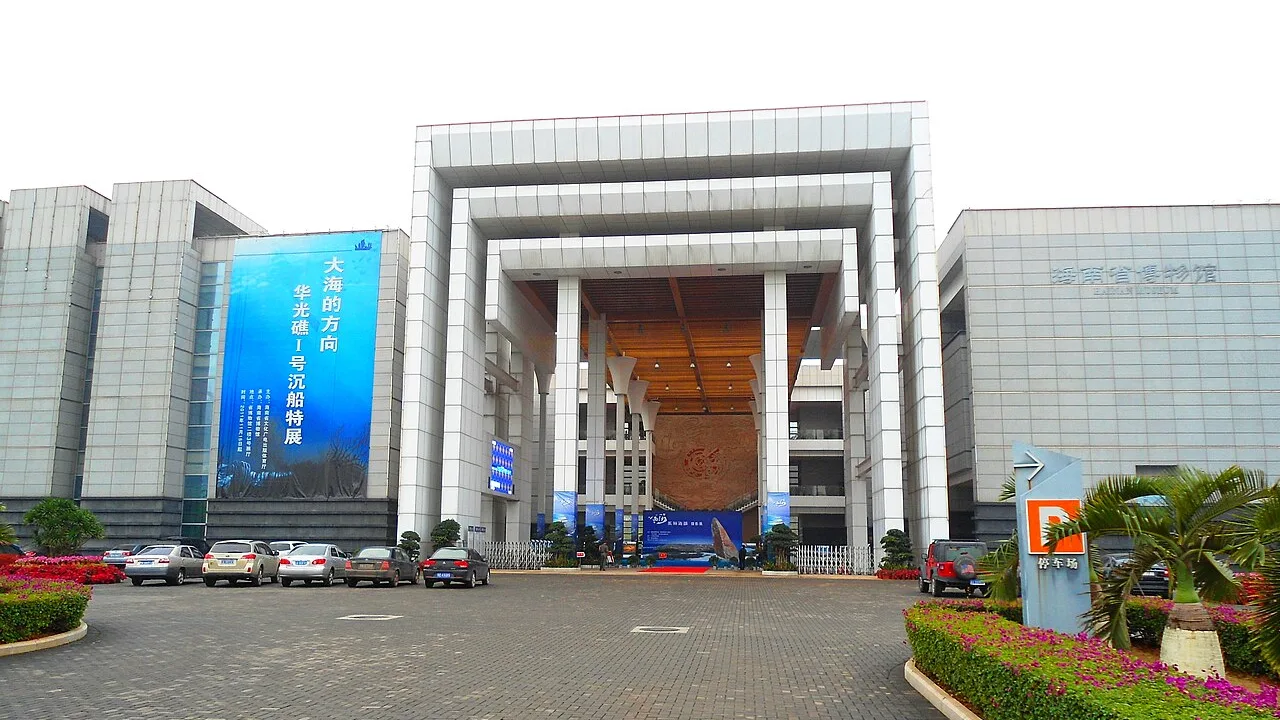
Hainan Provincial Museum: Shipwrecks and the Li Outline
The Provincial Museum is where Hainan starts making sense. The signature hold is the Nanhai shipwreck material: ceramics and hull timbers raised from the Song-era Huaguang Reef One, laying out Hainan's stretch of the Maritime Silk Road with total clarity. The main historical exhibition runs from prehistoric shell mounds to overseas-Chinese remittance letters, two hours for the whole story.
The second pillar is the Li collection: ceremonial dragon blankets, dugout canoes, and Li brocade costumes with pattern charts laid out in series. If you are weaving in the afternoon, study the motifs here first, and the frog and human figures on the loom stop being abstract lines.
Haikou Museum: How the City Began, in a Small Hall
The City Museum stands beside the Wugong Temple complex, small enough to serve as the Provincial Museum's encore. Its story is narrow and good: Haikou's climb from the Haikoupu fishing hamlet to a treaty port, covering the Song-era Baishajin anchorage, Qing stone steles from ten temples, and period photographs of the arcade trading port. The stele collection is the quiet surprise.
One hour suffices. Step out and glance at the Wugong Temple grounds, no ticket needed for the gate area, where the memorial pavilion and old trees already give you old Haikou's foundation. Lunch nearby, since Haifu Road runs thick with local eateries.
Tanyun Li Brocade Craft Studio: Weaving a Strip Yourself
Li brocade is a craft carried by Li women for three thousand years, worked on a back-strap loom strapped to the waist, the weaver's own body the frame. The studio's session walks you through it with a Li teacher: reading motifs, dressing the warp, working the treadle, and in a bit over two hours you finish a small handwoven band to take home. Only with hands on the loom do you grasp that every dense pattern in the museum was picked out thread by thread.
No experience is needed, and the teacher paces to your hands. It plays less like a craft class and more like three quiet hours; once the loom starts clacking, the afternoon heat stays outside the door.
Hainan Qiong Opera Heritage Courtyard: A Night Opera to Close
Qiong opera is Hainan's own grand opera, sung in Hainanese, its melodies carrying both coconut wind and a faint Nanyang echo. The courtyard stages it small: a few dozen seats three steps from the stage, the performers' makeup, water sleeves and chorus voices all within reach, far closer and wilder than any grand theater.
Missing the lyrics costs nothing: subtitle screens run Mandarin, and excerpt pieces run twenty minutes each with friendly pacing. After the show, trade a few words with the fans in the courtyard; the elders will happily unpack the story behind the scene, the best souvenir this day offers.
| Getting around |
|
| Budget | Both museums are free with booking; the brocade session and opera ticket add roughly RMB 80-150 pp. |
| Best time | Year-round with climate-controlled halls; the opera courtyard runs its fullest shows Friday to Sunday, and Monday closures call for rearranging. |
FAQs
Do both museums require booking, or can I walk in?
The Provincial Museum requires online real-name booking, tightest on weekends and holidays, so lead two or three days; the City Museum is relaxed and walk-in works on weekdays. Both close Mondays, so steer the route around Monday or convert that day into a pure craft-and-opera session.
Can I follow Qiong opera without Hainanese?
Yes. The courtyard runs Mandarin subtitle screens, and excerpt pieces carry simple plots, so the movement and percussion carry you in. Read a ten-minute synopsis of that night's piece beforehand and the experience jumps a level. Chatting with fans afterward beats any audio guide.
Can children join the brocade session?
Yes, the studio is family-friendly, with simpler motifs and shorter warps for children. Eight and up is the comfortable range, since younger arms struggle against the back-strap tension. Two hours runs long for small kids, who can finish a mini sample and bow out early.
With only half a day, what stays on the culture route?
Keep the Provincial Museum plus the opera courtyard: one gives the historical outline, the other a living heritage scene, a clean balance of still and moving, with no leg over twenty minutes. Save the brocade and City Museum for next time, the former needing a whole afternoon, the latter small enough to catch en route.