
The city's human depth hides behind its rime fame: a Qing-era stronghold of shipbuilding and tribute on the Northeastern frontier, where Wula's tribute administration procured river pearls and giant kaluga sturgeon for the court, the Confucian Temple ranks among the Northeast's finest, and Longtan's hill walls predate the Qing by nearly a thousand years.
Three days run the timeline backward: Qing and modern downtown first (temple, museum, temple hill, church), then the Manchu homeland northward (Wula, Hantun), and finally the Goguryeo-era hill fort, older than the Qing itself. History lovers can slow at every stop; general visitors find the three-day rhythm complete.
Itinerary at a glance
| 08:30 | The Jilin Confucian Temple: Heritage Day One, Lesson One |
| 10:30 | Jilin City Museum: The Archive of Modern Jilin |
| 14:00 | Beishan Park Temples: The Sediment of Folk Faith |
| 16:30 | The Riverbank Church: Another Facade of the Modern Era |
| 09:00 | Wula Manchu Town: The Old Ground of the Tribute Administration |
| 13:30 | Hantun Village: The Manchu Village at the Rime Island Crossing |
| 09:00 | Longtan Hill Park: A Hill Fort Older than the Qing |
| 14:00 | Henan Street: The Modern Commercial Quarter in Situ |
| 17:00 | Century Square: Where Three Heritage Days Close |
The route, stop by stop
The Jilin Confucian Temple: Heritage Day One, Lesson One
Among the Northeast's most complete Confucian compounds, the temple keeps its full Qing ritual apparatus: the axis from Lingxing Gate through the Pan Pool and Dacheng Gate to Dacheng Hall, at roof grades rare in Northeastern timber buildings. As the heritage line's opening, it shows how state cult landed in a frontier city.
Read by stele and display: renovation inscriptions record the temple's fortunes, and cases of ceremony vessels reconstruct the ritual at object level. Quiet and uncrowded, an unhurried hour fits perfectly.
Jilin City Museum: The Archive of Modern Jilin
The museum carries the heritage line's twin threads: the Jilin No.1 meteorite and modern science, and the river basin's urban archive from prehistory to modern times. Shipbuilding, the navy camps and the tribute administration get exhibition lines that fix the city's place in Qing-era Northeast.
A two-hour line: the meteorite hall first, saving the world's largest stony mass for your sharpest hour, then the city-history galleries. Qing-Northeast enthusiasts will find the local gazetteers and maps a hidden bonus.
Beishan Park Temples: The Sediment of Folk Faith
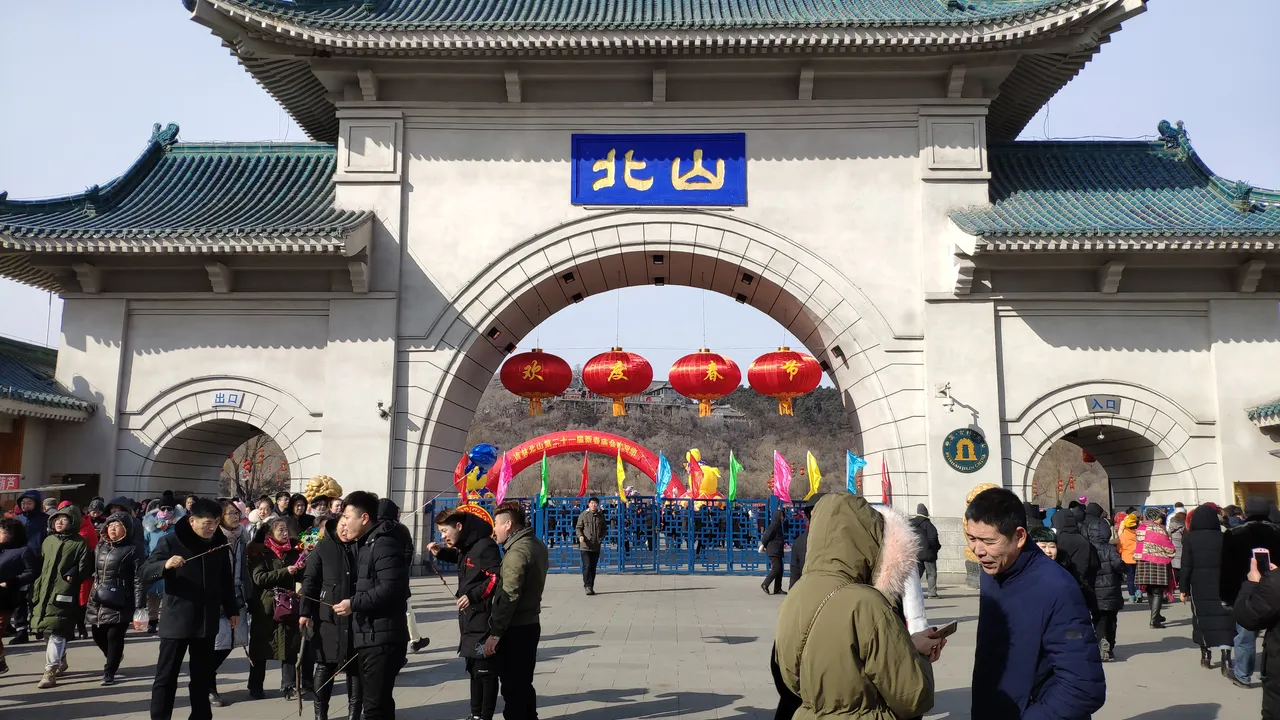
Beishan's Guandi and Yaowang temples, Yuhuang Pavilion and Kanli Palace fuse Confucian, Buddhist, Taoist and guild faith, where merchants, physicians and boat families each kept their gods on one shared slope. The steles are the primary sources, renovation inscriptions writing the city's social organization onto stone.
Forty minutes up, an hour around. The stele route: the Yaowang stele pavilion first, then Yuhuang's courtyards, ending at the summit view, faith and geography read together.
The Riverbank Church: Another Facade of the Modern Era
The Gothic church on the Songhua bank is about a century old, its twin-spired facade the riverbank's sharpest silhouette, physical witness to modern Catholic entry into the Northeast. Facing the Confucian Temple's axial order across the same water, the two mark opposite ends of the city's map of faith.
Read them as a pair: one the hall of official cult, one the church of popular mission, two architectural languages on one river. At dusk the facade backlights into its sharpest profile.
Wula Manchu Town: The Old Ground of the Tribute Administration
Day two's core is Wula. The Qing tribute administration sat here, procuring river pearls, kaluga sturgeon, pine nuts and honey for the court, shipped from the Songhua and the Changbai range all the way to the Forbidden City. The old quarters keep Qing street fabric, and the surviving Sa and Kui mansions stand as physical evidence.
The folk museum and old houses take an hour or two, all on foot in town. For Qing history and Manchu culture the depth outruns expectations: this is no faux-antique scenic zone but a genuinely continuous Manchu settlement.
Hantun Village: The Manchu Village at the Rime Island Crossing
Near Wula, Hantun is the main crossing village for Rime Island, every household running a farmhouse inn that sells out through rime season. Its heritage interest is village form: courtyard layouts, kang-heated houses, gates pasted with Manchu-script couplets.
Winter dawns roar with visitors; other seasons are quiet enough to hear the river. Talk with residents, whose genealogy stories beat any display board, and eat a farmhouse lunch, sticky bean dumplings and stews the standard set.
Longtan Hill Park: A Hill Fort Older than the Qing
Day three returns to Longtan Hill on the town's east side, its walls dating to the Goguryeo period, the summit's water prison and dry pen ancient storage works, the wall lines still traceable along the ridges. It is the oldest large human engineering survival in the city's territory.
An hour up, with site panels explaining the fort's era and functions. From the wall lines above the Songhua, two millennia of siting logic explain themselves: command the channel, hold the plain.
Henan Street: The Modern Commercial Quarter in Situ
Since its Qing-era opening, Henan Street has been the city's commercial axis, veterans and old facades recording the turnover of modern trade. The heritage way to walk it is by facades and shop signs: Republican-style frontages, gilded veteran lettering, old residential gateways in the lanes.
Veteran pastry and cooked-food counters double as lunch, eating history literally. The lanes off the street's end hold the densest old-town fabric, half an hour to walk a century.
Century Square: Where Three Heritage Days Close
Dusk at Century Square faces the Songhua's great bend, the temple, temple hill, church, old town and hill fort of three days all strung along this river. Open the map in your head: every point of the heritage line sits where the river chose.
One sunset and the three-day historical geography class concludes; transit and dinner both surround the square, ten minutes toward Jilin Station.
| Getting around |
|
| Budget | About RMB 350-550 pp: tickets run low, with two days of chartering toward Wula and Rime Island the main cost. |
| Best time | Year-round; the heritage line mixes indoor and outdoor, and temple snowscapes with rime give winter its own flavor, so dress deep. |
FAQs
Without Qing-history background, does this line still pay off?
Yes, with two bits of prep: read up on the tribute administration and the Willow Palisade before departure to grasp what makes Wula and this river city special; the temple and museum panels are plainly written, so on-site cramming works. The barrier is interest, not knowledge; curiosity is the best equipment.
Can Wula and Hantun fit one day?
Yes, the two sit close, bridged by a Manchu hotpot lunch in village or town. Note that rime season packs Hantun with strained lodging, making a day return the relaxed choice; off-season the village is quiet and even an island crossing fits without hurry.
Which stop most deserves extra time?
Wula. Its density is underrated by its distance: the tribute administration's history, Manchu housing patterns and living community transmission reward the better part of a day. Cap the temple and museum at two hours each, give Longtan and the temple hill half a day, and pour all saved time into Wula.
How does this pair with the nature line?
Overlap sits only at Rime Island and Longtan. The best pairing is three heritage plus two nature days: skip Longtan on the heritage line (save it for nature), skip Wula on the nature line (already seen), and five days harvest both lines' best with neither repetition nor gap.