
A hundred-plus kilometers out of Kunming, the land changes costume. Dongchuan's Red Land is an iron-rich soil palette oxidized in a warm humid climate, crops and red earth plotting the ground into color fields; Nuoghei village is stone's world, its Sani Yi walls of fitted slate six centuries old. Both ends of the route are earth and rock.
The Red Land days hinge on lodging and light: sleep at Huashitou village center to catch Damakan's sunrise and Luoxia Gully's afternoon, while day three slows through the stone village and lake toward an evening return. Mountain roads throughout make chartering a car the right call.
Itinerary at a glance
| 14:00 | Luoxia Gully: First Sight of the Red Land |
| 16:00 | The Thousand-Year Tree: A Solo Performance |
| 17:30 | Jinxiyuan Fields: A Panorama Class in Color Blocks |
| 07:00 | Damakan: The Wait Before Sunrise |
| 09:00 | Qicai Slopes: Morning Saturation |
| 10:30 | Yuepu Hollow: Between Village and Color Field |
| 10:00 | Nuoghei Stone Village: Day Three in a World of Stone |
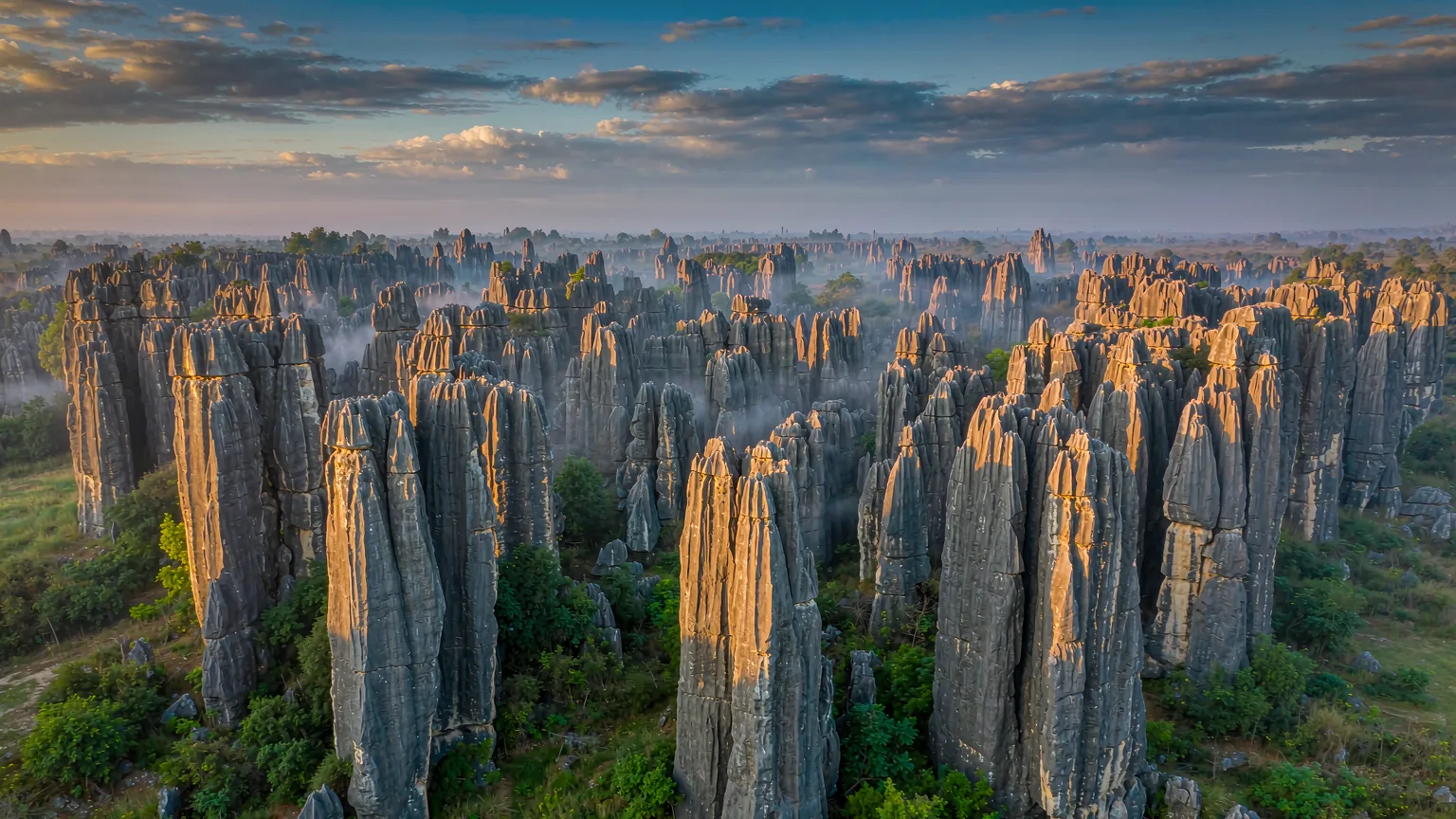
| 14:00 | Naigu Stone Forest: Black Stone and Flower Seas |
| 16:00 | Changhu Lake: One Quiet Stretch of Water |
The route, stop by stop
Luoxia Gully: First Sight of the Red Land
Leave Kunming at midday and reach the Red Land core around two, first stop Luoxia Gully. Red ravines cradle a small oasis of fields with village and trees at the color-field's center, and afternoon side light presses out the land's texture layer by layer.
The viewing deck sits roadside, minutes on foot. This is where scale first registers: take the panorama, then follow the bund colors inward, potato, buckwheat and rapeseed each holding a register against the red.
The Thousand-Year Tree: A Solo Performance
Walk or drive briefly from the gully to the thousand-year tree, standing alone on a gentle slope, its own shade beneath and open red earth and crops all around. Late-day backlight stands the silhouette on the color fields, one of the Red Land's classic frames.
The tree has no fence, so keep a respectful distance and stay off the root zone. A few steps on, the saddle of the pass earns the effort, as dusk turns the valley's light from red to gold.
Jinxiyuan Fields: A Panorama Class in Color Blocks
Day one closes at dusk on the Jinxiyuan fields, gentle farmland diced by bunds into irregular blocks of red, green, yellow and brown, contrast at its fiercest under slanting sunset. Read the whole field as one painting from the deck, the fastest way to understand why the Red Land is famous.
Do not rush off after sunset: in the last ten minutes of daylight the blocks turn to low-saturation velvet, a second temperament entirely. Then back to Huashitou for dinner and an early night before sunrise.
Damakan: The Wait Before Sunrise
Day two leaves in the dark for Damakan, a viewpoint facing the valley's sunrise, morning mist, stacked ridges and villages all silhouette before the light arrives. Local photographers claim positions an hour before dawn, so be there at least forty minutes early.
The true golden window runs half an hour after sunrise, light climbing from the valley floor and lighting the color blocks one by one. Breakfast follows, then the day's circuit begins.
Qicai Slopes: Morning Saturation
Morning light belongs to the Qicai slopes, color blocks packed even denser than Jinxiyuan, with front-on morning sun pulling the red soil to peak saturation. A track drops into the fields, and walking between the blocks differs wholly from viewing them from the deck.
Nine to eleven is the slopes' golden pair of hours; past that the light goes vertical and the blocks flatten. Do not rush this stop, since the Red Land's whole appeal is waiting for light.
Yuepu Hollow: Between Village and Color Field
The circuit ends at Yuepu Hollow, named for field terraces that rise and fall like a musical score. Here human and land compose together: villages set inside the color blocks, cooking smoke and drying crops all part of the frame. Local elders are long used to lenses, though a greeting before a portrait remains courteous.
Leave by midday, lunch at Huashitou and return to Kunming. With spare time, loop home via the canyon viewpoints on a tributary of the Jinsha, mountain-road scenery as an unexpected encore.
Nuoghei Stone Village: Day Three in a World of Stone
Day three shifts to Nuoghei in Shilin county's Guishan hills, a Sani Yi village that walled, paved and roofed itself in local slate six hundred years ago, the stone fabric intact as lanes turn between slate walls and sunlight reflects gray-blue off the rock.
The village runs quiet, elders crafting at their doorsteps and Sani embroidery patterns drying on the walls. An unhurried loop takes ninety minutes; village snacks and farmhouse meals serve on the spot, pea jelly and free-range eggs the simple pleasures.
Naigu Stone Forest: Black Stone and Flower Seas
In the afternoon reach Naigu Stone Forest, its pinnacles black where the main forest runs gray-white, naigu meaning black in Yi. Meadows and lakes open between the stones, spring flower seas cutting the black rock into silhouette, a geological encore right off the stone village.
Crowds run far thinner than the main forest, and a boardwalk climbs to a deck over the whole field. Black stone, green grass and water make a three-color composition, a cool-toned close to three days of earth hues.
Changhu Lake: One Quiet Stretch of Water
The last stop of three days is Changhu, a karst lake in Shilin county whose shoreline turns between pinnacles and pines. Beside the main forest's bustle it feels like another season, the lakeside path a one-hour loop.
At dusk the water takes the sky whole; in Sani legend this is where Ashima bathed and combed her hair, the story lending the lake a gentleness. Then back to Kunming, the countryside route closing at the water's edge.
| Getting around |
|
| Budget | A two-day Red Land charter runs RMB 500-800 per car; lodging and meals about RMB 200-300 pp daily, with roughly a hundred yuan of tickets on day three. |
| Best time | May-June and Sep-Dec give the Red Land its deepest colors; the Damakan sunrise works year-round, with winter mornings calling for real warm layers. |
FAQs
When does the Red Land look its best?
May-June pairs fresh green crops with the red soil at its brightest, September-December layers the most color blocks from autumn crops, and January-March runs dry-gold with morning-mist compensation. The color is farming's timetable, so check recent local photos a week out.
Can I reach the Red Land without a charter?
Possible but hard: buses to Dongqu district, then rural connections or carpools into Huashitou, with sparse schedules and scattered viewpoints eating your two days. For photographers or tight schedules, chartering is the best value.
Is Nuoghei worth the trip, compared with Guandu?
Worth it, and the two are different species: Guandu is an old town quarter, Nuoghei a living stone village with architecture and daily life both native. Lovers of building and village culture prefer Nuoghei, quiet, free, uncrowded, with the one cost being charter or self-drive access.
How should lodging be arranged across the three days?
Night one must be Huashitou, sunrise being non-negotiable; night two back in Kunming or in Shilin town depending on day three's start; evening three returns downtown. Red Land lodging is basic, so set expectations on comfort.