
Kunming is no textbook old town; its history stacks: Dian bronzes underground, Ming-Qing temples, pagodas and streets at grade, and the shadows of the Military Academy and Southwest Associated University across the modern layer. Three days run three layers, old city, deep history, hill shrines, one spine per day.
Day one grounds you in the old core and Green Lake quarter; day two reads the Dian and Ming-Qing chapters at the museum and Guandu; day three climbs the Yuxi and Western hills for temples and grottoes, closing at Daguan Pavilion. Moderate pace, ten to fifteen thousand steps daily.
Itinerary at a glance
| 09:00 | Kunming Old Street (Qianwang Street): Day One Opens |
| 11:00 | Yunnan Military Academy: A Century on the Drill Court |
| 14:30 | Green Lake Park and Yunnan University: A Stretch of the Scholarly Line |
| 16:30 | Golden Temple (Jindian): A Taoist Shrine Cast in Bronze |
| 09:00 | Yunnan Provincial Museum: Day Two Opens on History |
| 14:00 | Guandu Ancient Town: Ming-Qing Street Life, Standing |
| 19:00 | Nanping Street and the Archways: The Old City's Lit Zero Point |
| 09:00 | Qiongzhu Temple: Five Hundred Arhats Open Day Three |
| 13:30 | Western Hills Dragon Gate: Closing on the Cliff |
| 17:30 | Daguan Pavilion: Farewell Under the Long Couplet |
The route, stop by stop
Kunming Old Street (Qianwang Street): Day One Opens
The three days open on Qianwang Street, whose Qing-era banking row keeps the city's fullest stand of heritage houses, the old draft-bank story and Ma Family Courtyard's double eaves on one block. Shops wake late, leaving the woodcarving and gable details to quiet mornings.
Pick up a quarter map at the visitor center and sweep the lanes of Wenming Street and Wenmiao Zhijie with it. The street's narrative hides Kunming's commercial role on the old southern trade routes, the city-level footnote to everything the next two museums will say.
Yunnan Military Academy: A Century on the Drill Court
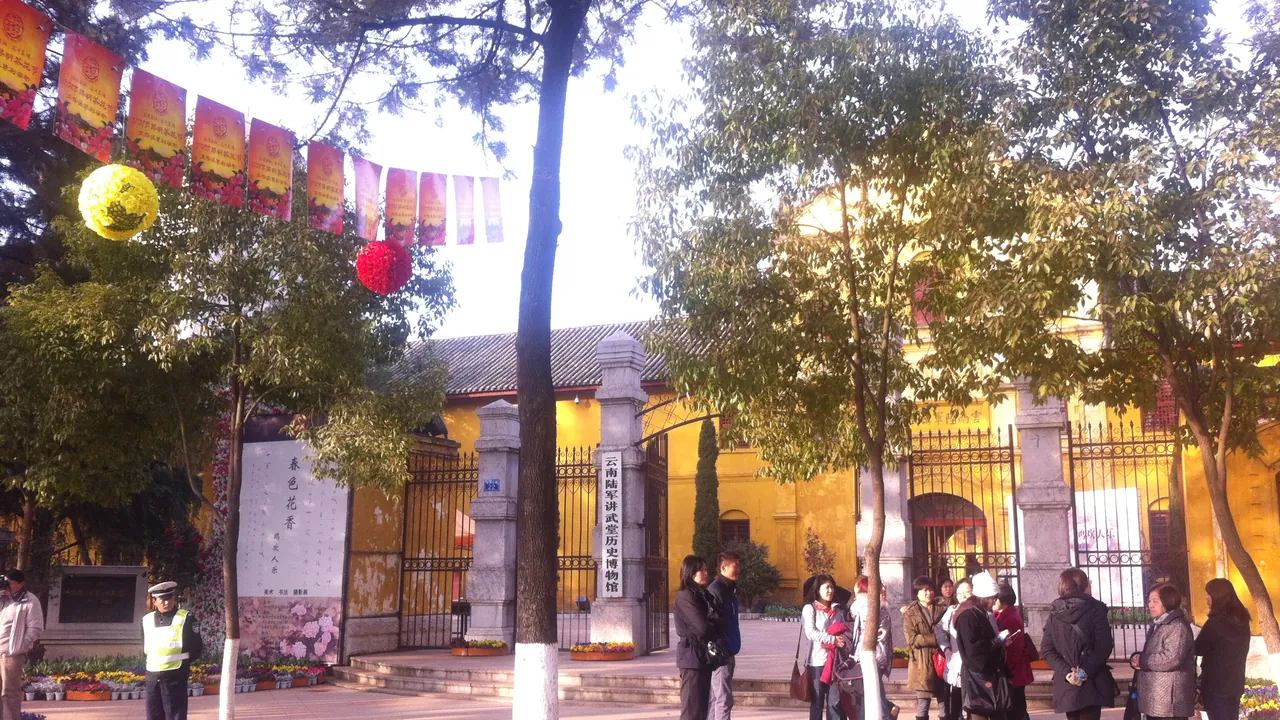
By eleven, move to the academy west of Green Lake, a living specimen of modern Chinese military education in bright yellow, with Zhu De and Ye Jianying among its graduates. Two exhibit floors run from late-Qing drilling through the Protection-of-the-Constitution war to the resistance, ninety minutes in all.
Three things earn the pause: the restored cadet dormitory, the original course timetables, and the colonnade ringing the court. From the center of the yard, the yellow walls explain why a walkaround-corridor building doubled as barracks and fortress.
Green Lake Park and Yunnan University: A Stretch of the Scholarly Line
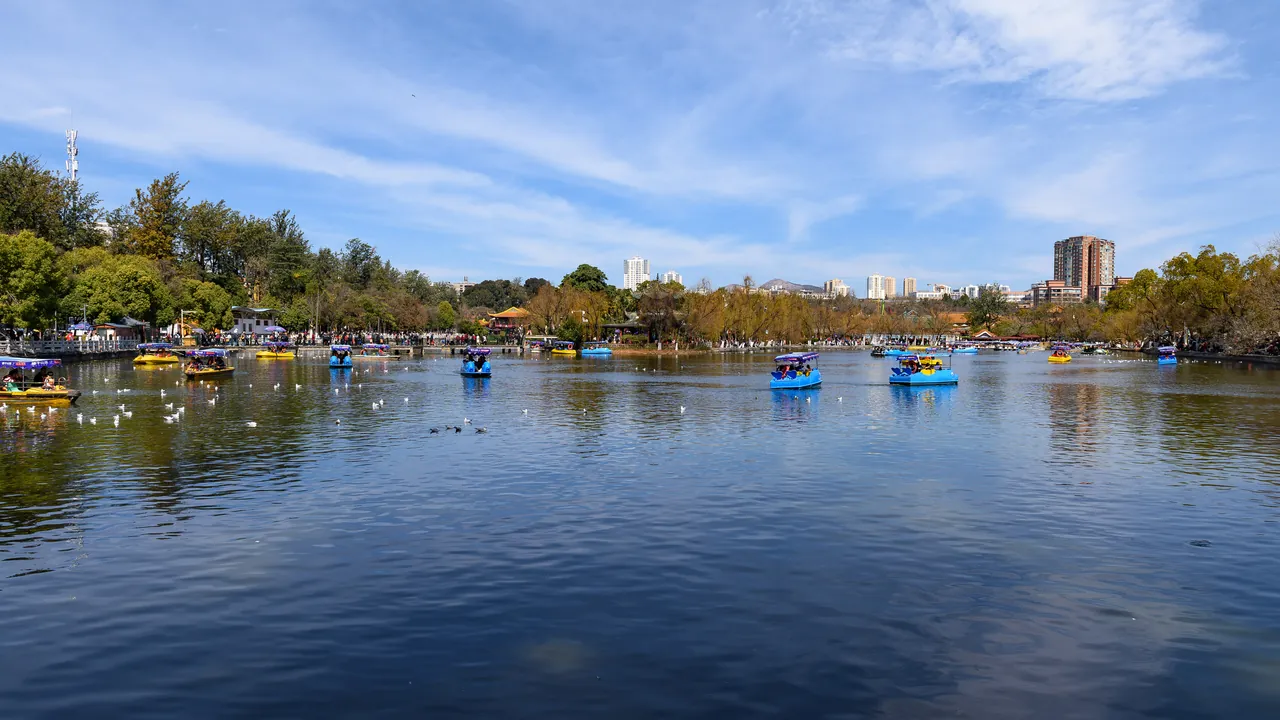
Spend the early afternoon circling Green Lake, a jade set in the city whose own layers run from a Ming-Qing princely pool to today's citizen park. Gull season blankets the water; off-season the lotus and willow dike carry it, with guild-hall and temple sites ringing the shore.
Southeast across the water, the Donglu campus of Yunnan University completes the scholarly line: Huize Hall's brick pile, the old provincial examination hall grounds and the ginkgo avenue close the circle of a lake-centered education quarter, ten minutes' walk between the two.
Golden Temple (Jindian): A Taoist Shrine Cast in Bronze
Day one closes north of downtown at the Golden Temple on Mingfeng Hill. The double-eaved hall is cast entire in bronze, gleaming gold in sunlight, its present body a Qing rebuild and one of China's largest bronze structures; Wu Sangui's reconstruction adds a layer of romance to the Taoist story.
Twenty minutes of stone steps climb to the hall, with the bell tower and relic displays along the way. By late afternoon the crowds recede into the camphor woods, a quiet note to end the first day on.
Yunnan Provincial Museum: Day Two Opens on History
Day two belongs to the provincial museum. Its Dian bronzes stand alone nationally: the ox-and-tiger case, the cowrie containers, the bronze drums, a two-thousand-year-old Dian society cast into archive. The permanent line runs from ancient life to modern upheaval, four hours complete.
Hire the guide: without one, bronze iconography reads as decoration instead of record. Book the first slot, finish the bronze hall before noon, and spend the afternoon lighter on the ethnic and modern galleries.
Guandu Ancient Town: Ming-Qing Street Life, Standing
From the museum, a twenty-minute taxi reaches Guandu. The Miaozhan diamond pagoda ranks among China's oldest of its type, grown into the market streets; the pattern of temples, pavilions and shrines unfolds along the flagstones, and an afternoon covers the main courtyards.
The draw is that it lives: incense burns for locals, schoolkids spill into lanes at dismissal, and the baba ovens peak after two. History here is not in vitrines; it is kept as a way of getting through the day.
Nanping Street and the Archways: The Old City's Lit Zero Point
Night two returns to Nanping. The Golden Horse and Jade Rooster Archways are the city's emblem; their sixty-year light-confluence legend is best taken as romance, while the towers' own Republican rebuilding and the old street grid repay a proper look.
Eat between Nanping and the Nanqiang alleys, small-pot noodles or Dian stir-fries either right. After dinner, mentally rehearse day three: the hill route wants an early night.
Qiongzhu Temple: Five Hundred Arhats Open Day Three
Day three climbs the Yuxi hills in the morning. Qiongzhu Temple's five hundred painted arhats came from the late-Qing folk sculptor Li Guangxiu and his apprentices across seven years, sitting, standing, laughing and brooding in full humanity, breaking every iconographic formula and earning fame as a masterpiece of Eastern sculpture.
The right way to see them is recognition: one arhat reads as a market elder, another as a musing scholar, each modeled on living faces. The main hall and side galleries take two hours, with birdsong replacing crowds.
Western Hills Dragon Gate: Closing on the Cliff
The afternoon moves to the Western Hills. Ascend by path or cableway to the Dragon Gate, Qing masons' Taoist grottoes cut into the cliff, ledges one person wide, and the terrace before Datian Pavilion spilling all of Dianchi below, the grandest single viewpoint geography gives Kunming.
Three days of history condense here into one map: the Dian bronzes, the Ming-Qing shrines and the modern academy all happened along this water's north shore. Descend the ledges to the mid-hill tea room, a cup of Dianhong before the way down.
Daguan Pavilion: Farewell Under the Long Couplet
The last stop of three days is Daguan Pavilion. Sun Ranweng's 180-character couplet sings Dianchi above and a millennium of history below, and everything seen in three days, Dian bronzes, Ming-Qing temples, the modern academy, reads as its annotation. Read the stone line by line, then look at the water once more.
Sunset burns strongest over the inner sea, and the willow dike goes quiet. Back downtown, the lit archways make the farewell, three days of Kunming closed on one couplet and one lake.
| Getting around |
|
| Budget | Three days of tickets (Golden Temple, gate and cableway, Daguan) plus meals and transport run about RMB 500-800 pp. |
| Best time | Year-round; spring and autumn easiest. Museums close Mondays, so slot the provincial museum away from them. |
FAQs
Do three days cover Kunming's history and culture?
The spine holds: old streets, the academy, the museum, Guandu, Qiongzhu and the hills make a complete narrative. Under pressure, protect the museum and academy first; with surplus, add the Southwest Associated University site and Yuantong Temple for a half day.
What if provincial museum slots are gone?
Three fixes: camp the release and cancellation windows, weekday mornings win most; push the museum to day three's morning and retry; or let Guandu and the Golden Temple carry the on-site history, since Kunming's past is not only in vitrines.
Is Qiongzhu Temple far, and worth the trip?
About twenty kilometers out, thirty minutes by taxi. Worth it: the arhats' realism stands in a class of its own nationally, and art lovers will want half a day. Tight schedules can merge it with the Western Hills, Qiongzhu morning and hills afternoon, never reversed for the mountain fog.
Where should I stay for this three-day route?
Sleep in the Green Lake or old-street quarter throughout: day one walks itself, days two and three taxi out smoothly, and Nanping and Wenlin dining sit inside the evening walking radius. No mid-trip hotel swap, saving the real cost of moving bags.