
Kunming's nature reads as one lake, one forest, one deep water: Dianchi for urban openness, the Stone Forest for a geological wonder lifted from an ancient seabed, and Fuxian Lake, among China's deepest freshwater lakes with striking visibility. One water body per day keeps the rhythm clean.
Transport logic: day one hugs Dianchi's shore by bus and taxi; day two wants an early start for the Stone Forest round trip; day three drives an hour and a half to Chengjiang and back by evening. Around ten thousand gentle steps daily.

Itinerary at a glance
| 09:00 | Haigeng Dam: Dianchi Wide Open |
| 11:00 | Western Hills (Xishan): Ridge and Dragon Gate |
| 14:30 | Yunnan Nationalities Village: Twenty-Five Villages in an Afternoon |
| 17:30 | Dounan Flower Market: Asia's Great Flower Night Market |
| 09:00 | The Stone Forest: A Seabed Turned to Stone |
| 14:30 | Naigu Stone Forest: The Black Stones of Spring |
| 09:30 | Fuxian Lake at Luchong: Day Three Runs Deep Blue |
| 13:30 | Mingxing Fish Caves: A Fishing Village and Its Copper Pot |
| 18:00 | Green Lake Park: The Return-to-Town Coda |
The route, stop by stop
Haigeng Dam: Dianchi Wide Open
Day one opens on Dianchi's north shore at Haigeng Dam, a two-kilometer embankment facing the Sleeping Beauty ridge, lake wind, waterline and far ridge in one row. From November to March the black-headed gulls hang overhead, and one toss of feed fills the frame.
Walk the dam through into Haigeng Park for a camphor-shaded change of pace. Give the lake its idling time: twenty minutes on a bench, waiting for wind to push cloud and gull together, before Dianchi's true scale lands.
Western Hills (Xishan): Ridge and Dragon Gate
From the dam, a cableway rises over Dianchi with forest and lake in one frame. The Western Hills form the city's green western wall, Huating and Taihua temples strung along the path as stone steps climb through camphor woods, the best short hike in town.
The Dragon Gate grottoes crown the walk: Qing masons' shrines and ledges cut into the cliff, passages one person wide, and the terrace before Datian Pavilion pouring the whole lake below. Low-stamina plan: cableway up, walk down as far as Huating Temple.
Yunnan Nationalities Village: Twenty-Five Villages in an Afternoon
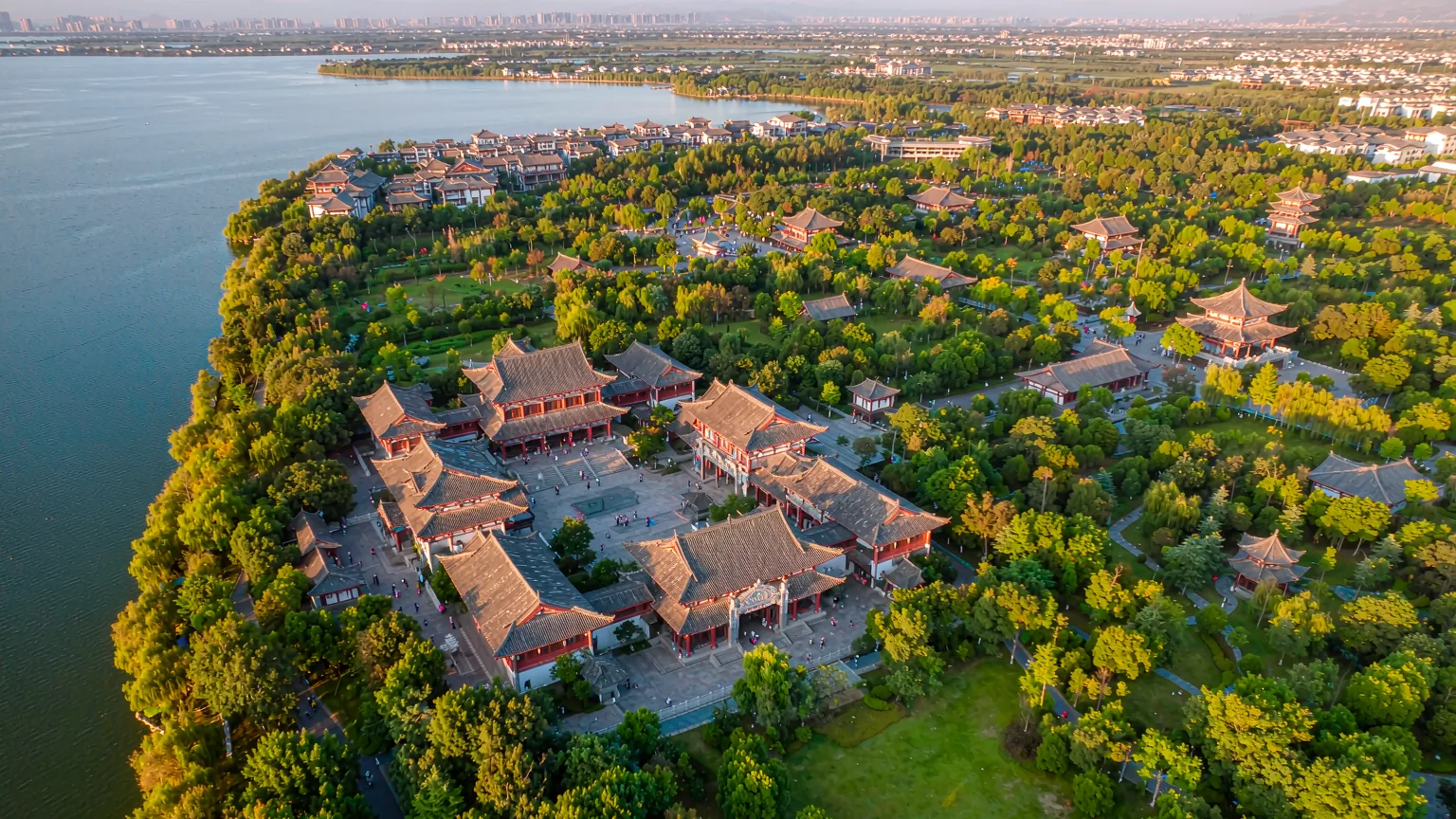
In the afternoon, reach the Yunnan Nationalities Village on the Dianchi shore. This open-air settlement recreates Dai bamboo houses, Bai three-sided courtyards and Yi flat-roofed homes at true scale, linked by paths, with timed song-and-dance shows and festival events scattered among the villages.
It fits a nature day better than it sounds: the village gardens are their own botany lesson, peacock pines in the Dai quarter and prayer flags against a snow-peak backdrop each making a microclimate. Three or four villages cover the essence in about two and a half hours.
Dounan Flower Market: Asia's Great Flower Night Market
By evening, ride metro line 1 to Dounan station, with the market beside it. Asia's largest cut-flower market runs wholesale by day and opens its night market to walk-in buyers after eight, roses sold by the bunch and by the catty, a full armful for twenty yuan.
Watch the spectacle in the auction and wholesale halls, buy in the night-market retail rows. Wrap blooms in newspaper with damp cotton at the stems and they hold two days; where flying fails, Dounan's dried and preserved flowers make a worthy fallback.
The Stone Forest: A Seabed Turned to Stone
Day two starts early for the Stone Forest, carbonate seabed laid down 270 million years ago, then uplifted and dissolved into today's thickets of stone pinnacles. In the Greater Stone Forest the sword-shaped columns crowd like trees, and the view from Wangfeng Pavilion explains the forest metaphor best.
Classic line: from the Stone Screen and Sword-Peak Pond up to Wangfeng Pavilion, then over to the airier Lesser Stone Forest, where the Ashima pinnacle stands at the lawn's end. Mind head and feet in the passages; wet rock turns slick in rain.
Naigu Stone Forest: The Black Stones of Spring
In the afternoon, shift to Naigu Stone Forest, where the pinnacles run black, the word naigu meaning black in Yi. The formations stand airier than the main forest, meadows and lakes opening between them, and in spring the lakeside flower seas set the black stone into silhouette.
Crowds thin by an order of magnitude, rewarding slow walking. A boardwalk climbs to a high deck over the whole field, and the black-stone, meadow and water composition out-minimalizes the main scenic area, holding photographers until closing.
Fuxian Lake at Luchong: Day Three Runs Deep Blue
Day three drives to Fuxian Lake at Chengjiang, China's second-deepest freshwater lake, visibility regularly past five meters, a blue neither the Stone Forest nor Dianchi owns. The Luchong scenic area sits on the west shore, its beach and banyans under Bijiashan the classic lakeside frame.
Morning walks the shore path, water clear enough to count the pebbles at your feet. A hiking track climbs Bijiashan in forty minutes, overlooking the gradient where the lake runs from turquoise to deep blue, Fuxian's most famous sightline.
Mingxing Fish Caves: A Fishing Village and Its Copper Pot
Afternoon reaches Mingxing, where an old fishing village lines the shore below the hill and the fish caves are stone channels villagers once used to run lake water for catching. Today's point is lunch: Fuxian's small endemic whitefish in a copper pot, with copper-pot rice alongside, Chengjiang's standard midday set.
Afterward walk the lakeside boardwalk to digest, wind and shade both in supply. When ordering fish, choose vendors selling farmed or legally caught stock, as some endemic species carry protection rules.
Green Lake Park: The Return-to-Town Coda
Back in town by evening, give the last hour to Green Lake. After a great lake, a stone forest and deep water, returning to this small dense urban lake makes the scale contrast read like a topographic lesson: every great water in Kunming sits within walking reach.
In gull season dusk brings the flocks home; off-season the willow dike and lamps carry the scene. Walk a half loop to Wenlin Street for dinner, closing three water days on one small pot of rice noodles.
| Getting around |
|
| Budget | Three days of tickets (Stone Forest, hill cableway) plus transport and meals run about RMB 600-1000 pp. |
| Best time | Nov-Mar brings the gulls; Apr-Jun gives the clearest water, while the Stone Forest throws afternoon showers in summer, so pack rain gear. |
FAQs
Which day can be cut or swapped in this three-day plan?
Fuxian on day three flexes most, swappable for the museum plus Guandu if you lean cultural; the Dianchi day can halve, moving the flower market to any evening. Do not cut the Stone Forest, the geological lead of the route.
How different is the route in gull season versus off-season?
The difference concentrates on day one: gull season makes the dam and Green Lake the city's liveliest image, off-season trades it for open water and ridge lines with the structure unchanged. April-June brings the clearest water and fullest flower market as fair substitutes.
Can both stone forests fit in one day?
Yes, with an early start: three hours in the greater forest, two at Naigu, plus transfers, fills the day exactly. Greater in the morning, Naigu after lunch, with shuttles between; choosing one, take the greater forest, whose sword-column density is irreplaceable.
Can you swim in Fuxian Lake, and is it safe with kids?
Swimming is allowed in marked zones; the water runs deep fast, so stay inside the buoys. Kids paddle in life vests, with sun and wind both to guard. Out of the water, the boardwalk and beach deliver the full lake experience anyway.