
Seven days read Luoyang whole: the first three run the above-ground and underground history axis, Longmen, Guanlin, White Horse Temple, Erlitou, the museums and the Sui-Tang core; day four gathers the indoor thread at Mangshan's tombs and the canal museum; days five and six head for the Funiu Mountains, the golden summit, a karst cave and a bamboo valley; day seven returns to the old town and closes with a bowl of soup, one street and a show.
The seven-day game is pace: two anchors daily, empty afternoons, light evenings. Distances are short, so the true enemy is fatigue of attention, three days of history suffice, two days of mountains reset the mind, and one last day of street life is what makes it stick.
Itinerary at a glance
| 08:30 | Longmen Grottoes: The First Strike of Seven |
| 18:00 | Luoyi Ancient City: Street Life on Night One |
| 08:30 | White Horse Temple and Qiyun Pagoda: A Quiet Day-Two Opening |
| 13:30 | The Erlitou Museum: The Earliest Capital |
| 09:00 | The Luoyang Museum: Day Three's Master Key |
| 14:30 | Mingtang, Tiantang and Yingtian Gate: The Axis, Afternoon into Night |
| 09:00 | The Ancient Tombs Museum: Day Four Underground |
| 14:00 | The Grand Canal Museum: The Answer of Waterways |
| 08:00 | Up Laojun Mountain: Into the Funiu Range on Day Five |
| 12:00 | The Golden Summit: Noon and Night in the Clouds |
| 14:00 | Jiguan Cave: A Karst Stop on the Descent |
| 16:00 | Chongdugou: Dusk and Night in the Bamboo |
| 09:00 | The Jinji River and the Ride Back: Day Seven's Return |
| 10:00 | Lijing Gate and Cross Street: The Old Town's Last Lesson |
| 20:00 | The Fengwu Shendu Show: Seven Days' Curtain Call |
The route, stop by stop
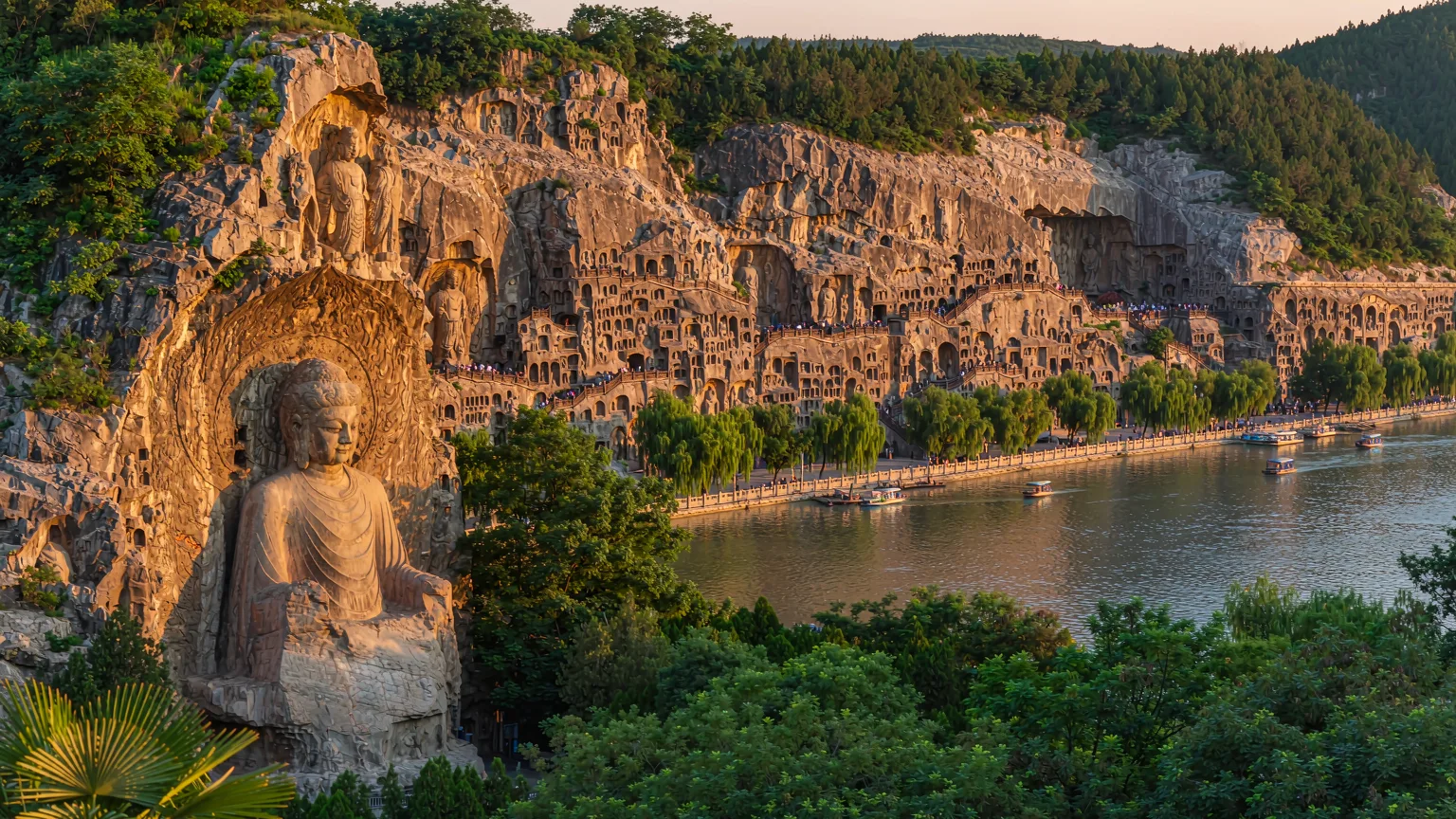
Longmen Grottoes: The First Strike of Seven
Seven days open at Longmen, and give the grottoes a whole day. The morning exhausts the west hill, Fengxian's Vairocana, the Binyang caves, the Ten Thousand Buddha Cave and Guyang, none skipped; morning light makes the cliff more three-dimensional than any other hour, and entering at opening is the only correct start.
The afternoon crosses to the east hill and Kanjing Temple, then climbs Xiangshan Temple and Bai Garden. Unfolding Longmen across a full day differs wholly from the three-day compression; only slowly can you read where Northern Wei carving hands over to Tang.
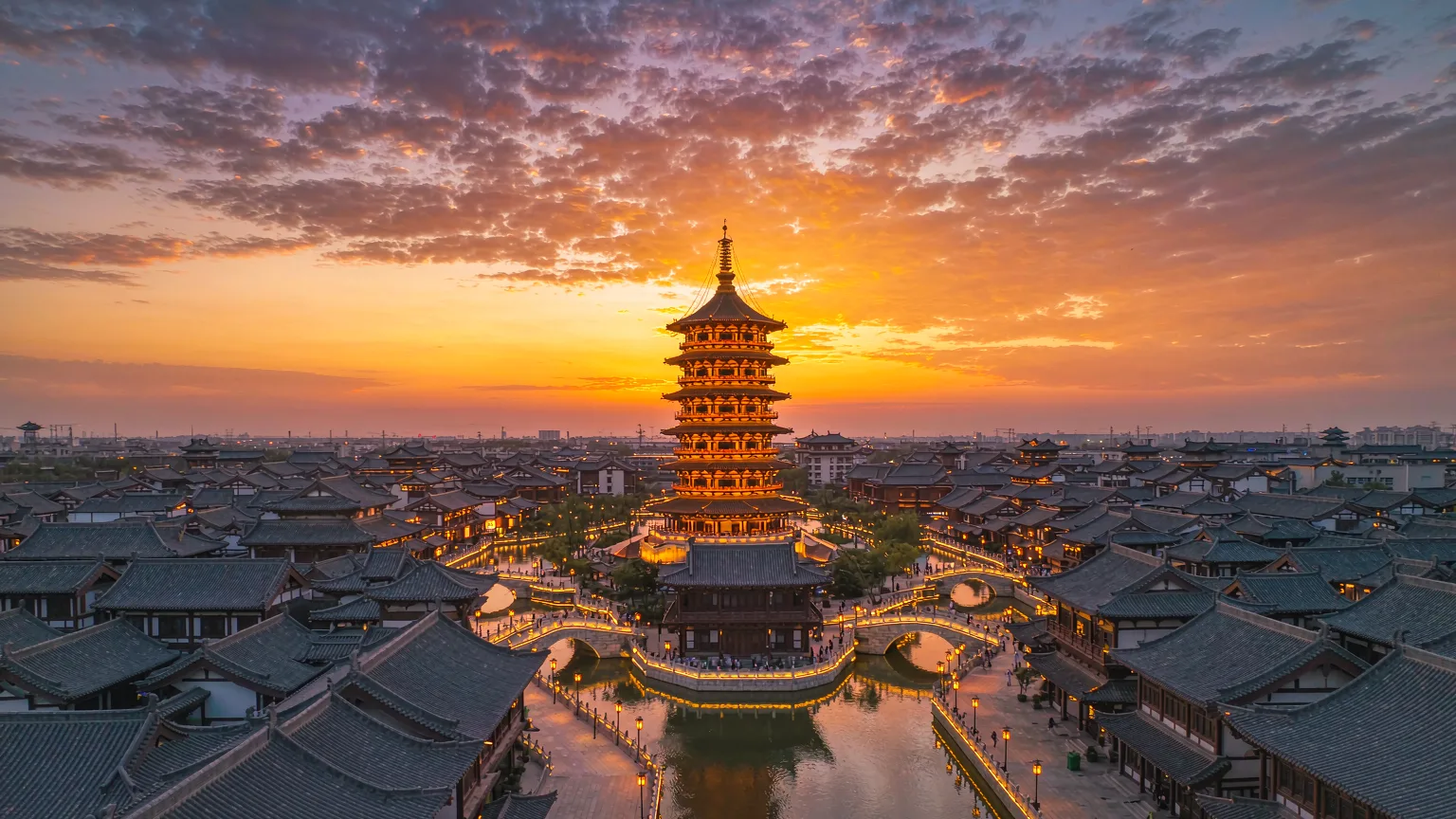
Luoyi Ancient City: Street Life on Night One
Night one stays light: dinner and lanterns inside Luoyi Ancient City, the pagoda, the waterways and silk sleeves the city's nocturnal base color, the food street covering dinner, then a walk home along the old wall to work off twenty thousand steps.
Keep one downtown hotel all week, packing a small bag only for two mountain nights. Early sleep on night one is step one of seven-day pace control.
White Horse Temple and Qiyun Pagoda: A Quiet Day-Two Opening
Day two's morning belongs to White Horse Temple. Bells and cypresses tell the Eastern Han unhurried at dawn; after the central halls comes the international quarter, comparing Indian, Thai and Burmese temple idioms inside one monastery, and the Qiyun Pagoda courtyard closes.
On seven days there is no rush here: sitting half an hour in the pagoda yard with a book is legitimate. Take beef soup nearby at noon and point the afternoon toward Yanshi.
The Erlitou Museum: The Earliest Capital
The afternoon reaches Erlitou in Yanshi, centered on the turquoise dragon, palace foundations and bronze jue vessels; a footpath links museum to protected site, so after the galleries you read the earliest China standing on the land itself.
Seven days afford three full hours including a slow site walk; on the way back, dinner in Yanshi town or straight into Luoyang's old quarter, both within half-hour rides.
The Luoyang Museum: Day Three's Master Key
Day three returns downtown for the master key. The Eastern Han stone beast, the jade cup, the tri-color wall, the Xia and Shang bronzes, everything sighted in two days finds its coordinates in the cases; three hours minimum, audio guide mandatory.
Lunch on fermented-grain noodles nearby, spend the afternoon on the Sui-Tang axis, and take the Yingtian light show at night. Three days in, the city's surface and underground form one net.
Mingtang, Tiantang and Yingtian Gate: The Axis, Afternoon into Night
The afternoon clears the axis's ticketed trio: the Mingtang pits, the Tiantang climb, the Yingtian gate walk, one combo ticket, flat before high, timed so dusk at the gate hands straight into the night projection show, the axis seen by both day and darkness in one day.
Steps stay few but towers and gate stairs tax the knees, so seat yourself between climbs. After the show, walk the lit axis back into the old town; the bricks under lamplight are a different city from daylight.
The Ancient Tombs Museum: Day Four Underground
Day four descends Mangshan. Western Han hollow-brick tombs, Northern Song brick-carved filial-son chambers, the Northern Wei imperial underground palace: one museum explains serve the dead as the living, and stepping into real chambers for murals is rare nationally. Three hours minimum, skipping nothing.
Tombs run cool and steep, so layer up; the claustrophobic can focus on the surface mural halls. Lunch returns downtown, with the afternoon slotted along the same route.
The Grand Canal Museum: The Answer of Waterways
The afternoon goes to the canal museum, whose full-story Bian River cross-section anchors the eye, riverbeds and wrecks stacked legibly across a millennium. Nowhere explains better why waterways made Luoyang a capital, connecting neatly with the axis and granary threads of earlier days.
The building itself is an exhibit, and the roof terrace frames the Luo handsomely; a four-hour indoor day fits here perfectly, resting early to charge the two mountain days.
Up Laojun Mountain: Into the Funiu Range on Day Five
Day five leaves the city, two hours to Luanchuan, two cableways chaining to the Painted Screen's stone forest, boardwalks rolling between pillars, the whole formation floating when fog lifts. The seven-day plan books a summit night, capturing both sunset and sunrise.
Carry one night's luggage only, the rest stored at your downtown hotel; cableway last cars shift seasonally, so confirm next morning's descent times before riding up.
The Golden Summit: Noon and Night in the Clouds
Three gilt-roofed hall clusters crown the peaks, afternoon the likeliest cloud-sea hour with halls adrift like islands; summit guests can idle at the viewing decks as cloud rolls up from the valleys, and sunset firing the gilt tiles is western Henan's priciest scene.
Night stars and dawn sunrise are the trip's highlights. At over two thousand meters, move slowly after dark, check sunrise azimuth and time in advance, and wear one more layer.
Jiguan Cave: A Karst Stop on the Descent
Day six descends and stops at Jiguan Cave, a reward after the climb: a constant eighteen degrees inside, stalagmites, stone falls and an underground stream unrolling along a one-way hour loop, many slick patches, so do not skimp on grippy shoes.
The in-out temperature swing is sharp; pause two minutes in the buffer zone before exiting. Chongdugou follows, half an hour away, a clean line.
Chongdugou: Dusk and Night in the Bamboo
Enter Chongdugou at dusk and check into a waterside farmhouse. The first night plans nothing: a streamside stroll, farmhouse dinner, a bonfire, letting climbing soreness dissolve in water sound; mountain-chive eggs and stewed chicken are the standing menu.
The seven-day plan gives the valley one night plus a next half day, waterfalls on the Jinji River, bamboo on the Dicui, a rhythm that just fits. Mountain nights cool, so keep long sleeves handy.
The Jinji River and the Ride Back: Day Seven's Return
Day seven walks a morning line on the Jinji River, waterfalls and fog the valley at its best, then departs after two hours, reaching downtown before noon.
The afternoon stays flexible: one missed sight, unfinished souvenirs, or simply a hotel nap, banking legs for the evening, since a seven-day journey deserves a formal farewell.
Lijing Gate and Cross Street: The Old Town's Last Lesson
Day seven's afternoon returns to the old town: climb the ramparts at Lijing Gate, walk the east-west avenue to the Drum Tower, and fill in the lanes the first day skated past. Every relic of the week now echoes in the old town's ordinary hours.
Dusk on Cross Street is the journey's stomach finale: bufan soup, skewer hotpot, peony cakes, closing every gap the week left. Sit in a street-mouth veteran and watch the tourists stream past; you are already someone who knows this city.
The Fengwu Shendu Show: Seven Days' Curtain Call
The formal close is an outdoor spectacular. Fengwu Shendu stages the divine capital with water screens and city backdrops, and the relics studied in museums and foundations walked on site all move at once through one hour.
With the show, seven days complete the circle: grottoes, old temple, the Xia capital, the axis, the tombs, the canal, the golden summit, the bamboo sea and the old town, thirteen dynasties' strata walked underfoot. What you carry home tomorrow will be more than photographs.
| Getting around |
|
| Budget | Tickets total about RMB 700-850 pp for the week, with meals and beds near RMB 1600-3000, the two mountain days and summit night the widest variables, charters priced separately. |
| Best time | April or September-October is prime; split the week into four downtown nights and two or three in the mountains, booking everything five days ahead in festival weeks and summit rooms a week out. |
FAQs
Is seven days too long? Does Luoyang fill a week?
It fills, provided you accept the structure of three history days, two mountain days and two flexible ones. Seven days add little information over five; what they add is slack, waking naturally, absorbing a rainy day, revisiting favorites. Packing seven days full serves worse than five.
How do I hedge weather risk on the two mountain days?
Check mountain weather the day before, then rank: Jiguan Cave, indoor and warm, outranks the cableway, which wind closes, which outranks summit nights, where clouds sit below you. The flex move swaps mountain and city days wholesale; a seven-day plan absorbs one full washout.
Where do the seven-day costs concentrate?
Four buckets: seven nights of rooms, the mountain charter, shows and experiences, and the summit night. The biggest levers are lodging tier and whether you sleep on top, with show seats a wide second; ticket costs flex least, and seeing the essentials pays for itself.
What must be completed before leaving on day seven?
Three things: a farewell water banquet or beef soup, one official-channel souvenir, tri-color or peony porcelain, and moving any unbooked museum onto a next-time list rather than forcing it. Completing the journey matters more than completing the checklist; day seven's job is a clean tail, not a sprint.