
Quanzhou's foundations are Song-Yuan: the port of Zayton then ranked with Alexandria in the East, and the city's density of faith remains rare today. The day's four stops slice that greatest eastern port clean through: a Buddhist pagoda, a mosque portal, Mazu's temple, a bridge over the sea, one city holding an entire maritime trading era.
The pacing follows the old town's geography: Kaiyuan Temple on West Street, Tumen Street south of it, Tianhou Temple further south, and Luoyang Bridge ten kilometers north. Inside the walls walk or ride the little shuttle carts, take a bus or taxi out to the bridge, and the day never doubles back.
Itinerary at a glance
| 08:30 | Kaiyuan Temple and the Twin Pagodas: Quanzhou's First Lesson |
| 10:30 | Tumen Street: Mosque and Confucian Temple Sharing One Block |
| 14:00 | Tianhou Temple and the Deji Gate Ruins: The Sea Goddess's Front Door |
| 16:30 | Luoyang Bridge: A Song Project Across the Sea |
The route, stop by stop
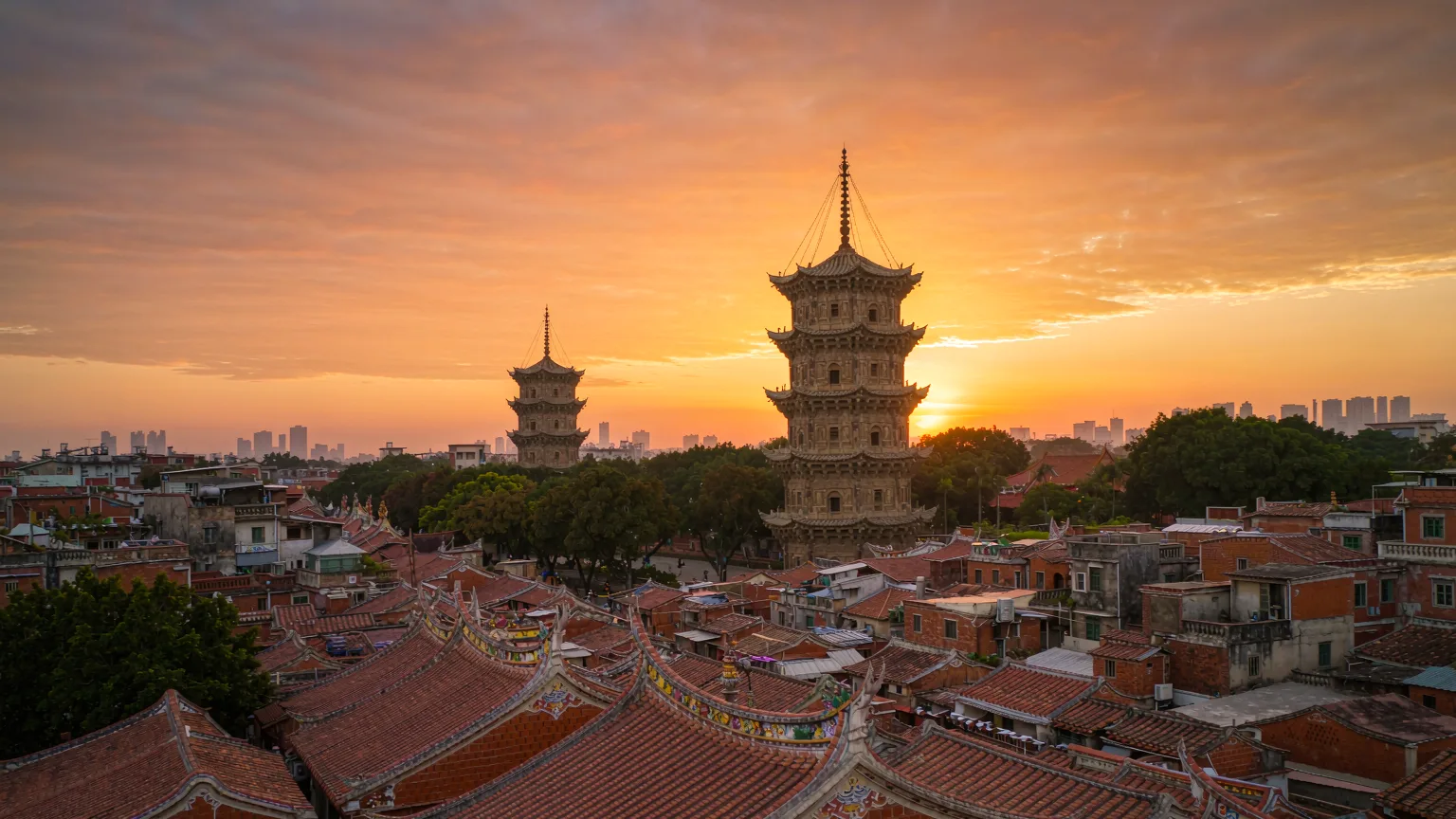
Kaiyuan Temple and the Twin Pagodas: Quanzhou's First Lesson
Kaiyuan Temple is Fujian's largest Buddhist temple, founded in the Tang, with stone pagodas on its east and west flanks: Zhenguo and Renshou, fully stone-built in imitation of timber, standing eight centuries of weather as China's tallest pair. Carvings on the towers include a monkey figure centuries older than Journey to the West.
Behind the main hall, a dozen Hindu columns line the cloister, Brahmanic myth carved inside a Buddhist temple, unique among the world's monasteries. In the Quanzhou Bay ancient-ship hall on the west side lies the hull of a Song sea vessel, one temple holding the whole documentary record of the trade era.
Tumen Street: Mosque and Confucian Temple Sharing One Block
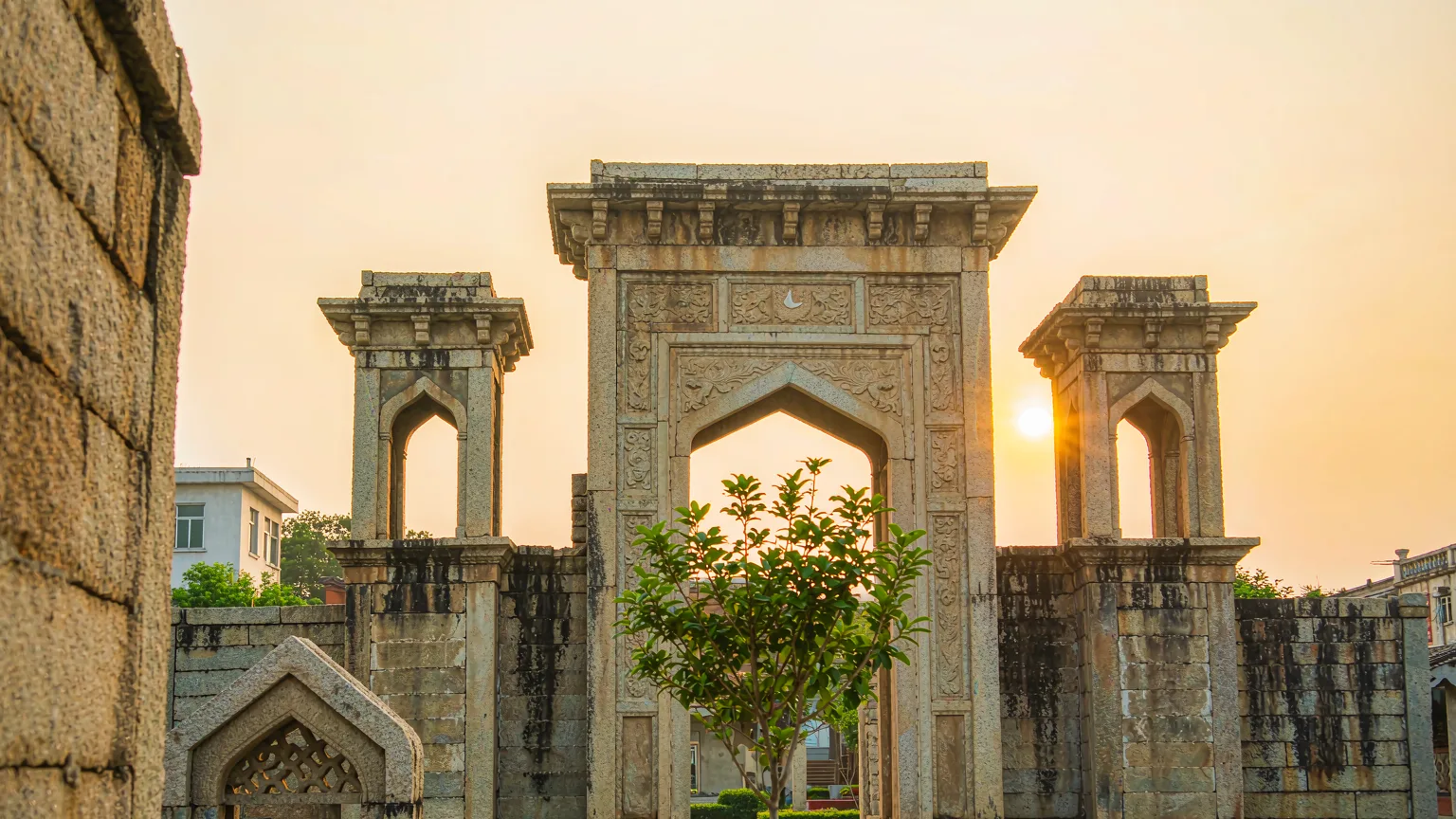
On Tumen Street the Qingjing Mosque and the Confucian Temple stand side by side within a few hundred meters, which is Quanzhou's own explanatory note. The mosque dates to the Northern Song; its surviving stone portal and prayer hall, with Syrian-script carvings and pointed arches, are physical evidence of Arab merchants settled here a thousand years.
The Confucian Temple is the city's literary main hall, its Song carved platform and vast courtyard intact. A Confucian temple and a mosque, neighbors for eight centuries, is a calm only Quanzhou owns.
Tianhou Temple and the Deji Gate Ruins: The Sea Goddess's Front Door
Tianhou Temple ranks among the highest-status Mazu temples surviving, founded in the Southern Song; slow down for the gateway carvings and the coiled-dragon columns of the main hall. In Song-Yuan times, merchant ships prayed here for fair winds before sailing, and Mazu belief spread from this door along the sea lanes across Southeast Asia.
Directly opposite the gate lie the Deji Gate ruins, the buried foundations of Song-Yuan Quanzhou's south gate, gateway, walls and barbican layered in the excavation pit, forming one continuous scene with the temple: out the gate, out to sea. Standing on the boardwalk over the foundations explains more than any model.
Luoyang Bridge: A Song Project Across the Sea
Luoyang Bridge crosses the Luo River's mouth north of town, built in the Northern Song under Cai Xiang, China's earliest surviving sea-crossing stone beam bridge at over eight hundred meters; its foundations fixed with cultivated oysters, a method the ancients called seeding oysters to anchor the base, a world first in bridge engineering.
The full crossing takes about an hour: the stele terrace mid-span, the Moon Bodhisattva pagoda, and Cai Xiang's shrine at the south end. At low tide egrets crowd the flats, and the hour before sunset warms the stone deck into the day's best closing frame.
| Getting around |
|
| Budget | Kaiyuan Temple RMB 10 plus the mosque RMB 3, the rest free; with meals and transport about RMB 80-150 pp. |
| Best time | Year-round, kindest Oct-Dec; early and late light flatter the pagodas and bridge, with noon reserved for streets and interiors. |
FAQs
How to choose between Quanzhou and Quanzhou East stations, and how to get around the old town?
Ride whichever station your train serves; both link the old town by bus, Quanzhou Station slightly closer. Inside the walls, walking plus the little shuttle carts fully suffice: carts cost two to three yuan a ride, hail and go, faster than waiting for buses between sights; only Luoyang Bridge needs bus or taxi, half an hour each way.
Do Kaiyuan Temple and the mosque need booking? Can I buy tickets same day?
Neither needs booking: RMB 10 for the temple and RMB 3 for the mosque, buy on the spot. Ordinary visitor volumes stay mild and even holidays rarely ration entry; what deserves watching is each site's hours and prayer times, since the mosque closes to visitors during prayers, so glance at the door notice first.
With only half a day, Tianhou Temple or Luoyang Bridge?
By appetite: for urban density, the temple plus Deji Gate takes half an hour and chains onward to Tumen Street and West Street; for grandeur, the bridge's sea-crossing sweep and sunset are irreplaceable but cost half a day of transit. First-timers should favor the temple, saving the bridge for a return trip.
What shoes and gear suit the day best?
The day runs on flagstones and old streets, so soft-soled grippy sneakers win; in summer the sun shows no mercy, bring hat, umbrella and sunscreen. Covered knees and sleeves for the temples. Carry water: convenience stores thicken inside the old town but thin out by the bridge.