
Quanzhou entered the World Heritage list as the Song-Yuan world maritime trade center of China, twenty-two component sites across the city. These three days take ten of the best, sequenced as narrative: day one the faith and wharves of the walled city, temple, mosque, Confucian hall, Mazu shrine, city gate; day two the engineering that joined the ocean, the sea-crossing bridge, wind-praying cliff records, the Laozi statue; day three the village and the customs house, oyster-shell homes, the sea-worship temple, the trade office ruins.
Three days on, Quanzhou stops being a city with old buildings and becomes a standing Song-Yuan maritime history: who traded here, which gods they served, how ships sailed, how trade was governed, all checkable against real things.
Itinerary at a glance
| 08:30 | Kaiyuan Temple and the Twin Pagodas: Opening Day One |
| 10:30 | Qingjing Mosque: An Arab Merchant Portal a Millennium Old |
| 14:00 | The Confucian Temple: The Front Face of the City's Letters |
| 16:00 | Tianhou Temple and Deji Gate: The Ritual of Sailing Out |
| 08:30 | Luoyang Bridge: Day Two's Sea-Crossing Works |
| 11:00 | Qingyuan Mountain and Laojun Rock: China's Largest Daoist Stone Statue |
| 15:00 | Jiuri Mountain Wind-Praying Inscriptions: The Official Record of Pre-Sail Rituals |
| 08:30 | Xunpu Village: Day Three Starts in the Fishing Village |
| 11:00 | Zhenwu Temple: The Sea-Worship Ground at the River Mouth |
| 14:30 | The Maritime Trade Office Site: Song-Yuan's Customs Hall |
The route, stop by stop
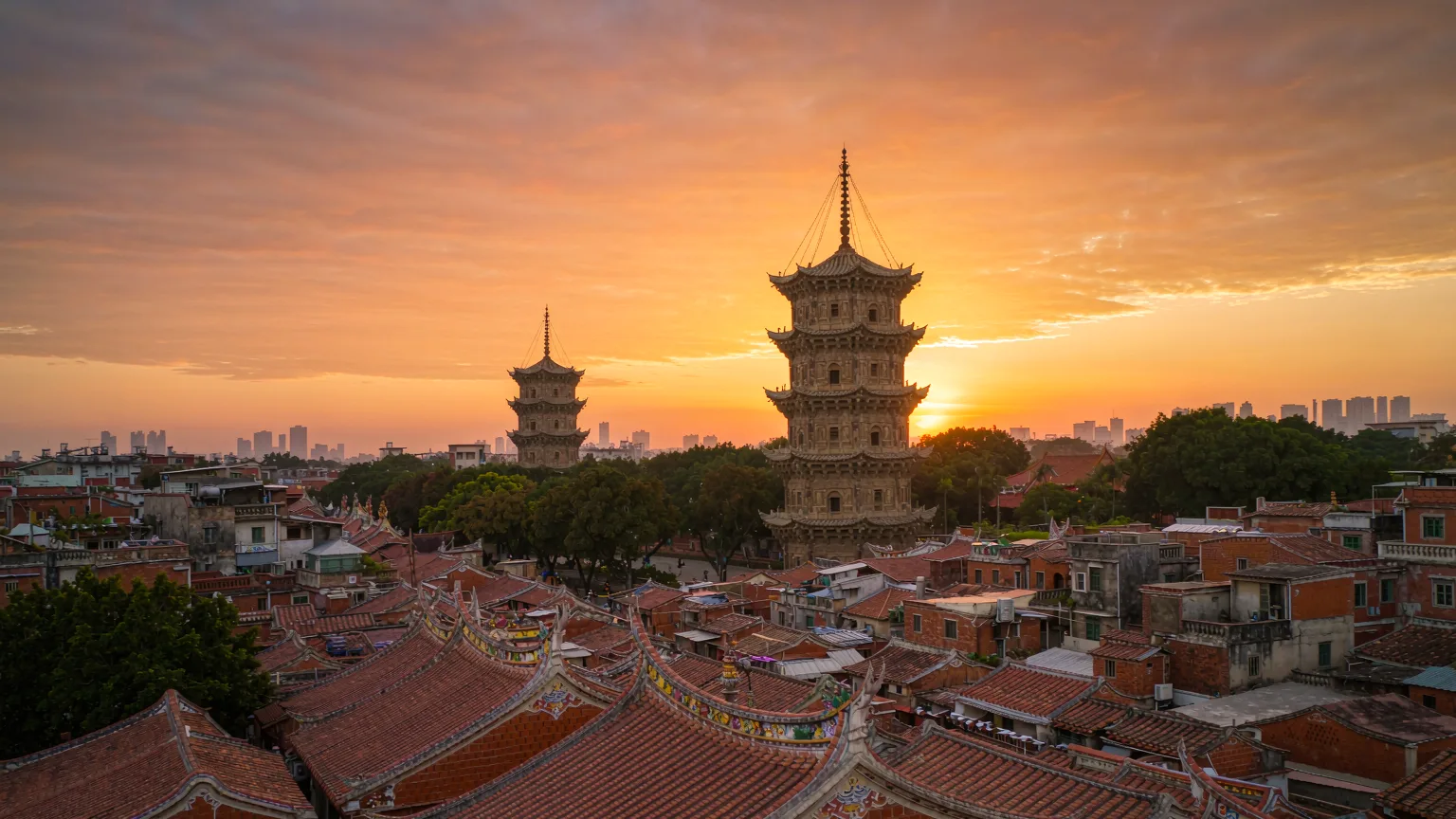
Kaiyuan Temple and the Twin Pagodas: Opening Day One
The circuit opens at Kaiyuan Temple: China's tallest stone pagoda pair, Hindu columns in the cloister as the first physical proof of plural faiths. Enter at dawn when the courts empty and tower shadows rake the yard, building the feel of the city first.
The Song ship hull in the west gallery is day one's first exhibit of things: this vessel once moored in the bay not far from the temple.
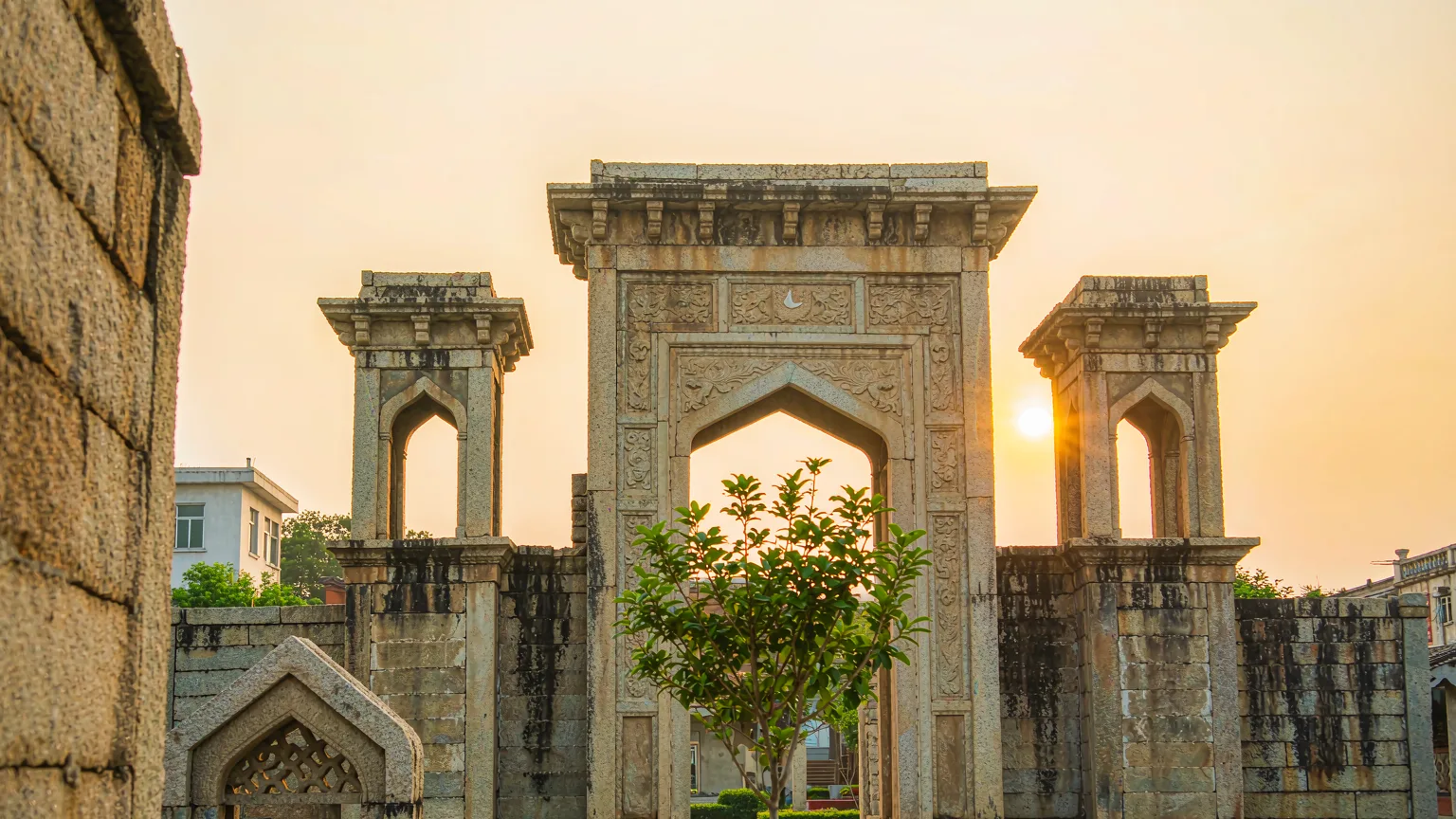
Qingjing Mosque: An Arab Merchant Portal a Millennium Old
Walk from the temple to Tumen Street's Qingjing Mosque: the stone portal raised in the Northern Song still stands, the prayer hall's broken walls and Syrian-script carvings recording a millennium of Arab settlement, among the oldest mosques surviving in China.
Then the Confucian Temple next door, a Confucian hall and a mosque neighbors for eight centuries, the most everyday footnote to Quanzhou's plural faiths. Ninety minutes covers both.
The Confucian Temple: The Front Face of the City's Letters
The afternoon opens formally at the Confucian Temple: the main hall's Song stone platform and vast courtyard fronting Quanzhou's name as a coastal home of letters, its exam-era graduate counts ranking near the top nationally, this temple the start of the evidence chain.
The square hosts nanyin sessions and chess tables at dusk, street life at full flavor, then walk south to Tianhou Temple.
Tianhou Temple and Deji Gate: The Ritual of Sailing Out
Day one's closing act: Mazu's temple facing the city gate ruins, merchants passing the gate straight into the estuary, the full ritual of wind-praying, sea worship and clearance staged in one shared space. From the boardwalk over the Deji excavation, read the layered foundations of the Song-Yuan gateway.
The pairing is the key to Quanzhou as a city that is a port: its axis runs not to imperial power but along the harbor's working line.
Luoyang Bridge: Day Two's Sea-Crossing Works
Day two starts early at Luoyang Bridge, crossing fully before crowds thicken and light goes harsh: eight hundred meters of Song stone beams, oyster-fixed foundations, the mid-span steles and Moon Bodhisattva pagoda in sequence. This bridge was the great artery joining Song-Yuan Quanzhou to its northern hinterland and the sea.
Low tide brings egrets to the flats, old wheel ruts still run the deck, and the Wan'an Bridge stele waits in Cai Xiang's shrine at the southern end.
Qingyuan Mountain and Laojun Rock: China's Largest Daoist Stone Statue
Midday moves to Qingyuan Mountain: Laojun Rock at the foot, a Song-era Laozi seated statue carved from a natural boulder, the largest surviving Daoist stone figure in China, with a city-wide saying about touching the nose for long life.
Strong legs can climb to Nantai Rock for the city and bay panorama, three hours return; lighter itineraries linger around the statue and gate, where the heritage essence sits.
Jiuri Mountain Wind-Praying Inscriptions: The Official Record of Pre-Sail Rituals
Afternoon reaches Jiuri Mountain in Fengzhou, its cliffs carved with the official record of Song wind-praying rites: maritime-trade officials and imperial clansmen climbing twice yearly to worship the sea gods for merchant winds, each rite memorialized in stone. Ten such inscriptions survive, the most narrative of all the heritage components.
Read the cliffs and you are leafing through Song-Yuan sailing paperwork directly. About ninety minutes in all.
Xunpu Village: Day Three Starts in the Fishing Village
Day three opens early at Xunpu, ahead of the flower-crown crowds, to see the working village: walls of oyster shell, aunties crowned in fresh flowers, boats returning with the dawn. The village's Shunji Palace and its Mazu faith echo the temple seen two days ago.
Early Xunpu carries no performance: net-drying, oyster-shucking and mending are just the morning's work. Save the crown experience for a quieter dusk if you want it.
Zhenwu Temple: The Sea-Worship Ground at the River Mouth
The morning's second stop, Zhenwu Temple near Shitou Street, keeps an old stone lintel reading Wudang Mountain, ancient banyans rooted over the boulder out front. Song-Yuan officials worshipped the sea here, part of the same state ritual system as Jiuri Mountain's inscriptions.
Direct on the way from Xunpu, the temple is small and precise, half an hour enough; from the rise before it, picture the river mouth once packed with a thousand sails.
The Maritime Trade Office Site: Song-Yuan's Customs Hall
The finale returns inside the walls at Shuimen Lane: the Maritime Trade Office ran Song-Yuan overseas commerce, collecting duties, issuing permits, hosting foreign merchants. The site is modest, its value positional, embedded exactly in the old city's inland waterway node.
The lane-mouth panels explain the water gate, the office and the harbor as one system; once understood, this unassuming courtyard is the brain of the Song-Yuan trade machine.
| Getting around |
|
| Budget | Tickets total about RMB 100, RMB 10 the temple, RMB 3 the mosque, RMB 70 Qingyuan, the rest free, before meals and transport. |
| Best time | Kindest Oct-Dec; dodge Monday closures, and give Luoyang Bridge a clear evening. |
FAQs
Must I cover all twenty-two heritage sites in three days?
No, these ten carry the whole narrative: urban faith, the temple, mosque, Confucian hall and Mazu shrine; maritime engineering, the bridge and Jiuri Mountain; governance, the trade office and Zhenwu; port life, Xunpu and Deji Gate. The rest lie out in Jinjiang and Shishi, worth adding with spare time but not needed to understand the story.
What are the ticketing and booking situations?
Kaiyuan RMB 10, the mosque RMB 3, Qingyuan RMB 70, Jiuri a small fee, all on site; the Confucian Temple, Tianhou, Deji Gate, the bridge, Zhenwu, the trade office and Xunpu are all free. No advance booking anywhere, and only Qingyuan might ration on holidays, the lightest ticketing load imaginable.
How do I compress this to two days?
Fold the Confucian Temple into the mosque stop, same street, three minutes on foot, and choose between Zhenwu and the trade office on day three, the office if governance intrigues you. The two-day version keeps the temple, mosque plus Confucian hall, Tianhou with Deji, the bridge, Qingyuan, Jiuri and Xunpu, still ninety percent of the story.
Any dress or etiquette rules at the mosque and temples?
The mosque requires covered knees and sleeves, no strappy tops or shorts, with prayer hours closed to visitors; Buddhist and Mazu temples set no hard rules, just neat dress, low voices and no flash indoors; Xunpu is a living community, greet residents before shooting. Those three layers keep the whole trip graceful.