
Seven days unfold in four chapters, town, water, stone, village: day one frames the old city; days two and three read water and geology through the three Huangguoshu sections plus the bridge and fossil park; day four pairs Longgong with a spring recovery; days five and six read people through Tianlong, Yunshan and Jiuzhou; day seven closes lakeside before departure. Short drives let the week breathe.
Lodging rhythm: night one downtown, nights two and three at Huangguoshu town or Zhenning, the last four downtown, bags moved twice. Most venues close Mondays and true Dixi clusters around Spring Festival, so match your dates to the calendar first. The week's point is not volume but depth, knowing each stockade and each fall well enough to tell it to others.
Itinerary at a glance
| Day 1 · 09:00 | Anshun Confucian Temple: Chapter One of Seven |
| Day 1 · 18:00 | Gufu Street Food City: The Week's First Sitting |
| Day 2 · 08:30 | The Great Waterfall: Lesson One on Water |
| Day 2 · 11:00 | Tianxingqiao: A Slow Reading of Stone and Water |
| Day 2 · 14:30 | Doupotang: The Widest Curtain of Water |
| Day 3 · 09:30 | Baling River Bridge: The Other Side of Stone |
| Day 3 · 13:30 | The Guanling Fossil Beds: A Seafloor Classroom from Two Hundred Million Years Ago |
| Day 4 · 09:30 | Longgong: Closing the Water Theme |
| Day 4 · 19:30 | Bailing Hot Spring: Settling the First Four Days |
| Day 5 · 09:00 | Tianlong Tunpu: Day One of Reading People |
| Day 5 · 14:00 | Yunfeng Tunpu, Yunshan Stockade: A Defense Reader on the Ridge |
| Day 6 · 09:00 | Jiuzhou Ancient Town: The Merchant Street in Full |
| Day 6 · 11:30 | Qin Fazhong Nuo Mask Museum: The Workshop of Faces |
| Day 6 · 17:30 | Anshun Haochi Street: Resupply for Seven Days of Hauls |
| Day 7 · 09:30 | Hongshan Lake Park: The Last Hour before Leaving |
The route, stop by stop
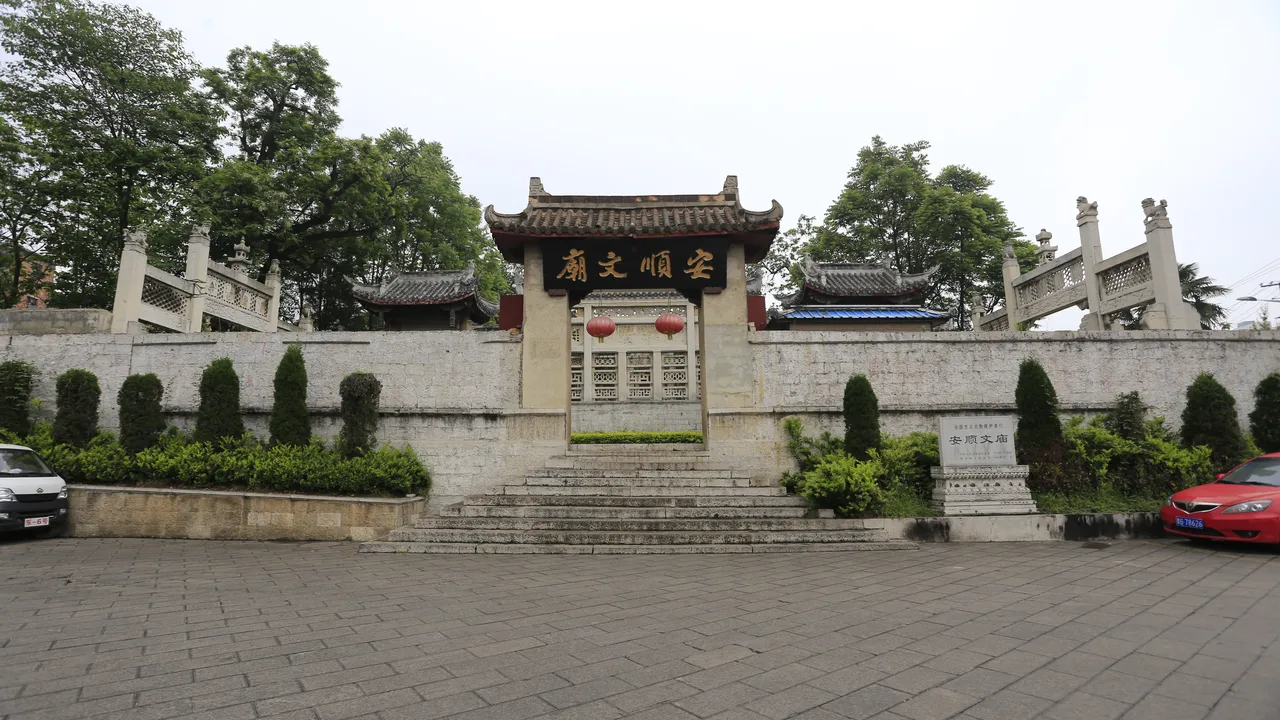
Anshun Confucian Temple: Chapter One of Seven
Deep travel opens at the temple because it explains what Anshun is: a city founded on Ming military establishment with schooling planted after. The pierced columns before the Dacheng Hall, dragons carved openwork from single blocks, give physical proof of the stone-palace title and deliver the stone theme's first lesson for the week ahead.
The advancing layout of pan pond, lattice star gate and gateway is itself an exhibit; walk the axis once and ritual spatial order explains itself. Mornings stay thin, so read the exhibits slowly and load the city's founding story into your head as the reference for six days to come.
Gufu Street Food City: The Week's First Sitting
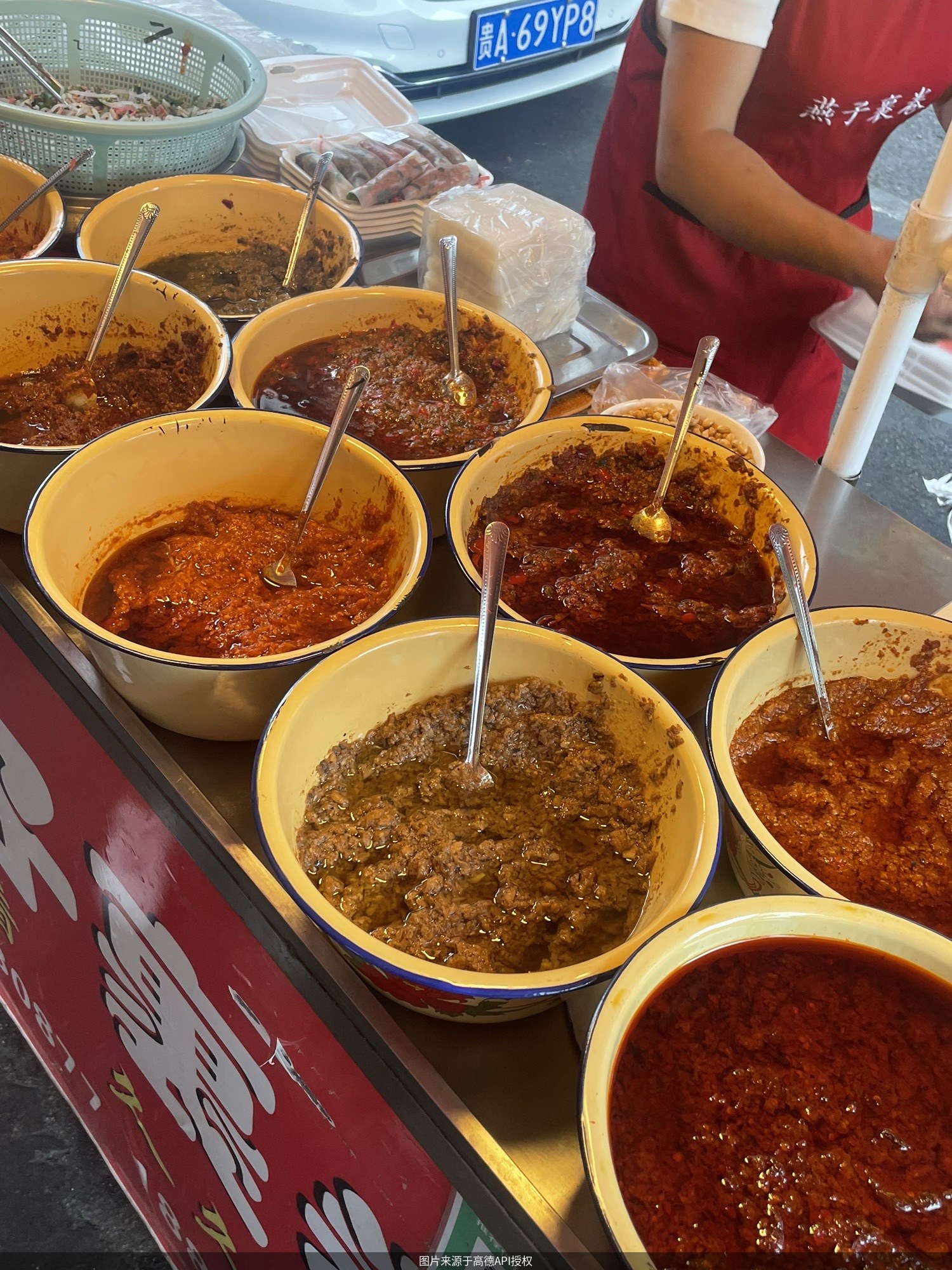
Hand day one's close to Gufu Street. Duoduofen, grilled intestine, cold rice noodles and steamed cakes line the block as stall fires wake after six. Deep travel eats differently from checklists: tonight is reconnaissance, noting stalls and prices, and seven days later you leave with your own food map.
The first-night set: duoduofen as staple in a small sour-hot pot, intestine with chili powder, ice slush to close. Start mild, ramping the Anshun flavor across the week, keeping night one well short of full.
The Great Waterfall: Lesson One on Water
Day two opens with thunder at the great falls. Enter at opening, when high water makes a wall of the seventy-seven-meter drop, spray in your face, a rainbow straddling; the Water Curtain Cave threads the fall's waist with the roar swelling inside the rock. Deep travel spends an extra half hour here, reading one fall from every deck height, each change of light and angle new.
After half past nine the groups flood in and only about one golden hour remains, so spend it fully. Finish falls and cave by noon, eat at the scenic area, and give the afternoon to Tianxingqiao.
Tianxingqiao: A Slow Reading of Stone and Water
Tianxingqiao deserves over two hours: every counting-step stone carved with a date, find your birthday; the Silver Chain combing rapids into beads spiraling into the deep pool; and the deep route completing the whole from the lower exit pockets the quiet stretch around Star Gorge Falls.
The lower half runs thin with people, made for slowing. Ferns in the stone joints, light jumping on the water, details the groups have no time for. Exit for lunch at Huangguoshu town, Doupotang after.
Doupotang: The Widest Curtain of Water
The afternoon's Doupotang complements the morning's pressure: Huangguoshu's widest fall spreads level, no thunder of freefall, one broad sheet sliding across the travertine bar, nostalgia preloaded by the classic Monkey King opening shot.
The deep-travel sight is the bar's geology: millennia of travertine built today's slide, water combed into countless threads across its face. An hour covers the area; lodge back in town by dusk and sleep early, since day three points into Guanling.
Baling River Bridge: The Other Side of Stone
Day three climbs the Baling River Bridge. A suspension span of over a kilometer crosses the gorge more than three hundred meters above water, the in-bridge science museum and sightseeing passages letting you climb the structure. Looking down at karst mountains from mid-air, you suddenly grasp why Guizhou is called a bridge museum, roads being the region's true wonder.
International BASE-jumping challenges often stage here, a bonus if your dates align. Visits need tickets and booking, closing in strong wind. Lunch in Guanling county town, the fossil park pointing the same way.
The Guanling Fossil Beds: A Seafloor Classroom from Two Hundred Million Years Ago
The afternoon fossil park is the week's sharpest contrast: from falls and bridge into the Triassic sea. Ichthyosaurs, Keichousaurus and crinoids lie in excavation posture inside the in-situ hall, one whole rock wall carpeted with fossils, the strata overhead their epitaph.
Deep travel reads it slowly: finish every species label and grasp the full evidence chain behind the sentence, Guizhou was once ocean. No touching and no flash inside. Return downtown for the night, since day four pairs Longgong with springs and wants good legs.
Longgong: Closing the Water Theme
Day four closes the water theme at Longgong. The Dragon Gate Fall seizes the ear first, then two chambers of cave boating rank top of the southwest's kind: stalactites low over the underground river, lamplight trading with cave daylight, rapeseed fields ringing the exit in spring gold.
Deep travel can give Longgong half a day: beyond the boat, walk the flower valleys and terraced paths outside. Return downtown to rest in the afternoon, the evening spring a gentle period on the water theme.
Bailing Hot Spring: Settling the First Four Days
Four days of climbed steps, sprayed mist and walked cliffs settle account by account in the pools. Rotate at fifteen to twenty minutes, sampling the hottest shallowly, rehydrating in the lounge. Placing the springs mid-week rather than at the end keeps the second half's village days at full charge.
Observe the rules: soak on neither empty nor full stomach, never after alcohol, caution with cardiovascular conditions. Sleep early, since day five runs two stockades and wants a good night under it.
Tianlong Tunpu: Day One of Reading People
Day five opens the people theme. Tianlong's lanes are all stone, sentry holes, watchtowers, women in royal-blue robes, turning the post-conquest settlement of six centuries ago into something underfoot. The training hall stages Dixi daily, masked actors with war banners singing the Xue and Yang sagas.
The deep advice is walking the full guided circuit before going free: the stockade's layout, well positions, which clan's hall sits where; hearing the spatial story once, your later solo wandering reads entirely different things. The old post road and its tea earn their own stop.
Yunfeng Tunpu, Yunshan Stockade: A Defense Reader on the Ridge
The afternoon's Yunshan answers Tianlong's street warmth with a ridge: the village hangs on high ground, the entry a stone-step climb, wall and gates a complete defense system. Ming-Qing houses and shop lanes survive intact under national key heritage status, with far fewer visitors than Tianlong.
From the wall, read the siting wisdom at a glance, against the mountain yet not upon it, watching without abandoning the fields. Quiet is the luxury here, the place to verify the spatial logic you heard this morning.
Jiuzhou Ancient Town: The Merchant Street in Full
Day six morning gives Jiuzhou its full window. The old seat of the Ming Anshun prefecture carries street flavor beyond most villages: West Street's shops once salt firms and horse inns, teahouses running long tiles and lidded bowls, the old church site and local-goods shops mixed through a few lanes.
The deep method splits the half day: walk the street first, then claim a teahouse bench for half an hour. Tunpu cloth shoes, hand chili sauce and bamboo weaving source the best souvenirs, sellers usually the makers, a few words of chat worth more than any haggling.
Qin Fazhong Nuo Mask Museum: The Workshop of Faces
Before noon the mask museum sits in a village out the Jiuzhou direction, inheritor Qin Fazhong having opened his own workshop as a museum. The ground-floor bench spreads blanks and chisels, upstairs hundreds of faces ranked by role, red for loyalty, white for treachery, palette as camp.
Yesterday's village opera gets its full annotation here: walk the flow from timber selection through roughing to consecration, and the mask stops being a prop and becomes a work. With luck Master Qin explains in person; small masks can carry his signature on the base.
Anshun Haochi Street: Resupply for Seven Days of Hauls
Return downtown into Haochi Street, a market of dried and packaged goods by day, supper ground by night. Restock souvenirs in one pass: Zhenning bobo candy, dried Cili fruit, vacuum chili chicken, with village-bought loose chili sauces upgraded to better packaging.
The checklist: production date, seal integrity, vacuum availability. Wrap fragile bobo candy in clothes at suitcase center. Eat dinner on site, restocking as you go, since day seven runs light and packing can happen early.
Hongshan Lake Park: The Last Hour before Leaving
Check out on day seven, store bags, and walk one last ring at Hongshan Lake. An hour on the boardwalk, egrets skimming the water, local elders dozing on benches; seven days of Anshun complete their farewell in this hour. You have seen its loudest water and its quietest stone.
Collect bags before noon and run for the airport or rail hub with ample road time. One piece of advice for the week: Anshun deserves a second visit, high-water Huangguoshu and festival-season Dixi being two entirely different towns.
| Getting around |
|
| Budget | Tickets total RMB 450-650 pp; seven days run RMB 2200-3600 pp with lodging, meals and transit. |
| Best time | June-Oct peaks the water while Mar-Apr blooms the Tunpu; the Spring Festival window stages the most true Dixi, first choice for deep travel. |
FAQs
How does the seven-day plan handle rainy days?
Anshun rain mostly falls in showers, and the rule is swapping land for water: rain days leave Longgong, museums, workshops and springs untouched, while Huangguoshu gains mist in drizzle, walking fine until thunder forces a reshuffle. Keep village-outdoor and downtown-indoor days swappable and the week always holds a good hand.
Should all seven days be chartered?
No. Downtown's three days run on foot and taxi; the Huangguoshu direction has the shuttle as backstop; charters truly matter for the Guanling day and the two village days, three to four chartered days total. Chartering by need halves the cost of a full-week car, with downtown taxis nearly free.
How do I pick the best window for seven days?
Match the window to the goal: July-August high water for maximum falls at maximum crowds; Mar-Apr for bloom and kind weather; Spring Festival for true Dixi. Golden Week is the deep traveler's enemy, crowds erasing every edge. If only summer works, start each day an hour early and dodge most of the crush.
What three memories are most worth carrying from seven days?
First, the seconds inside the Water Curtain Cave watching the fall from behind, rare in this country; second, the moment a Dixi mask turns at the opening gong, six centuries living on one wooden face; third, the bowl of tea an elder pours in a village teahouse, explaining why Tunpu culture survived at all. Tickets expire, these three do not.