
Beihai's history runs three layers deep: the treaty-port arcades and consulate years, the Han-era birth of the maritime silk road two millennia back, and the nineteenth century a missionary wrote onto a lone volcanic island. Three days take one layer each, from Zhuhai Road's carved gables to Hepu's vitrines to the church at Shengtang.
The logistics must serve two directions, Hepu and the island: day one in town, day two north to Hepu, day three east across the water. Lock the ferry by real-name booking two or three days ahead and reserve the Hepu museum, and the plan is half won.
Itinerary at a glance
| D1 09:00 | The Beihai Old Street: A Century of Treaty-Port Facades |
| D1 11:30 | Waisha Seafood Island: A Working History of the Harbor |
| D1 15:00 | Beibu Gulf Square and the Old Blocks: The City's Memory Court |
| D2 09:30 | The Hepu Han Museum: Globalization Two Thousand Years Ago |
| D2 14:00 | Silk Road Harbor: History Staged as a Night Play |
| D2 20:30 | The Ride Home: A Bowl of Sweet Soup at Qiaogang |
| D3 09:00 | The Weizhou Catholic Church: A Gothic Echo on a Volcanic Island |
| D3 11:30 | Crocodile Hill: An Open-Air Volcanology Class |
| D3 16:00 | Five-Color Beach from Afar: The Itinerary's Footnote in Time |
The route, stop by stop
The Beihai Old Street: A Century of Treaty-Port Facades
Heritage opens on Zhuhai Road. After the 1876 Chefoo Convention opened Beihai, British, German and French consulates followed, and the Zhuhai Road arcades are that era's product, scroll gables, louvers and gilt shop names, each building with its own file.
Morning light rakes the colonnade, serving both camera and close reading. Detour to the old post office site and church remains at the street's end, grounding the claim of the southwest's earliest treaty port.
Waisha Seafood Island: A Working History of the Harbor
Cross the bridge from the Old Street's north end to Waisha. The harbor here is the other half of Beihai's identity, masts crowding the sheltered basin, noon unloading and net-mending continuing a century of routine. Heritage lives not only in buildings but in this working order.
Lunch at a veteran terrace on the island, watching the pier as you eat. Circle the embankment after, taking in boats, ice plants and ship-repair sheds, and the stop is done.
Beibu Gulf Square and the Old Blocks: The City's Memory Court
Mid-afternoon returns downtown. The Pearl Spirit sculpture at Beibu Gulf Square records the city's pearl-diving origins, and the old blocks around it preserve consulate sites and vintage bank facades, footnotes to modern history within a one-kilometer stroll.
If timing and interest allow, book visits to the historical buildings open to the public; on closed days, reading the street plaques suffices. Rest at the hotel by evening, north to Hepu in the morning.
The Hepu Han Museum: Globalization Two Thousand Years Ago
Day two heads north to Hepu. This museum answers one question, how Han China did business with the world: Persian pottery, Roman glass and Indian-system beads surfaced in batches from the Hepu tombs, proving the port among the earliest and most important departures of the maritime silk road.
Prioritize the imported-goods and gold galleries, with Han pottery houses and well models recovering the daily texture of a port city. Two careful hours, then the tomb site area nearby for a sense of the burials' scale.
Silk Road Harbor: History Staged as a Night Play
Give the afternoon and evening to Silk Road Harbor. By day browse the re-created Han port streets, and after dark the live show begins, merchant ships, markets, lights and actors restaging Hepu's heyday, the visitor both audience and pedestrian in the port.
The park's snack and craft stalls cover dinner. The ride back to Beihai runs about forty minutes after the show, so book your car ahead rather than queueing at the gate.
The Ride Home: A Bowl of Sweet Soup at Qiaogang
Back from Hepu near ten, if energy remains, close with a bowl of sweet soup at Qiaogang. The day showed a port of two millennia ago; now you sit in the lights of a returnee quarter, two peoples gathered by the sea annotating each other in one city.
Choose huai pollen jelly, qingbuliang or coconut sago, drinking it slowly curbside. With a boat tomorrow, verify your ticket, pack, and sleep early.
The Weizhou Catholic Church: A Gothic Echo on a Volcanic Island
Cross to the island early on day three, first call the Shengtang church. Late-Qing French missionaries raised this Gothic church of coral stone and lime mortar, and through a century of typhoons it still stands among banana groves and houses, physical proof of Weizhou caught in modern history.
The thick walls surviving island humidity are a materials lesson in themselves. Old wells and stone houses around the village round out the walk, completing the leap from Han-era Hepu to the modern island.
Crocodile Hill: An Open-Air Volcanology Class
Reach Crocodile Hill before noon. As one of China's youngest volcanic islands, Weizhou packs its geology dense: volcanic bombs, scoria, sea caves and columnar joints along the boardwalk, one full loop amounting to an open-air class.
Through a heritage lens, the black shore also fed old islanders' building stone and tide-watching. Leave by your afternoon sailing, glancing back at the Crocodile Hill profile from the deck as three days of timelines close over the water.
Five-Color Beach from Afar: The Itinerary's Footnote in Time
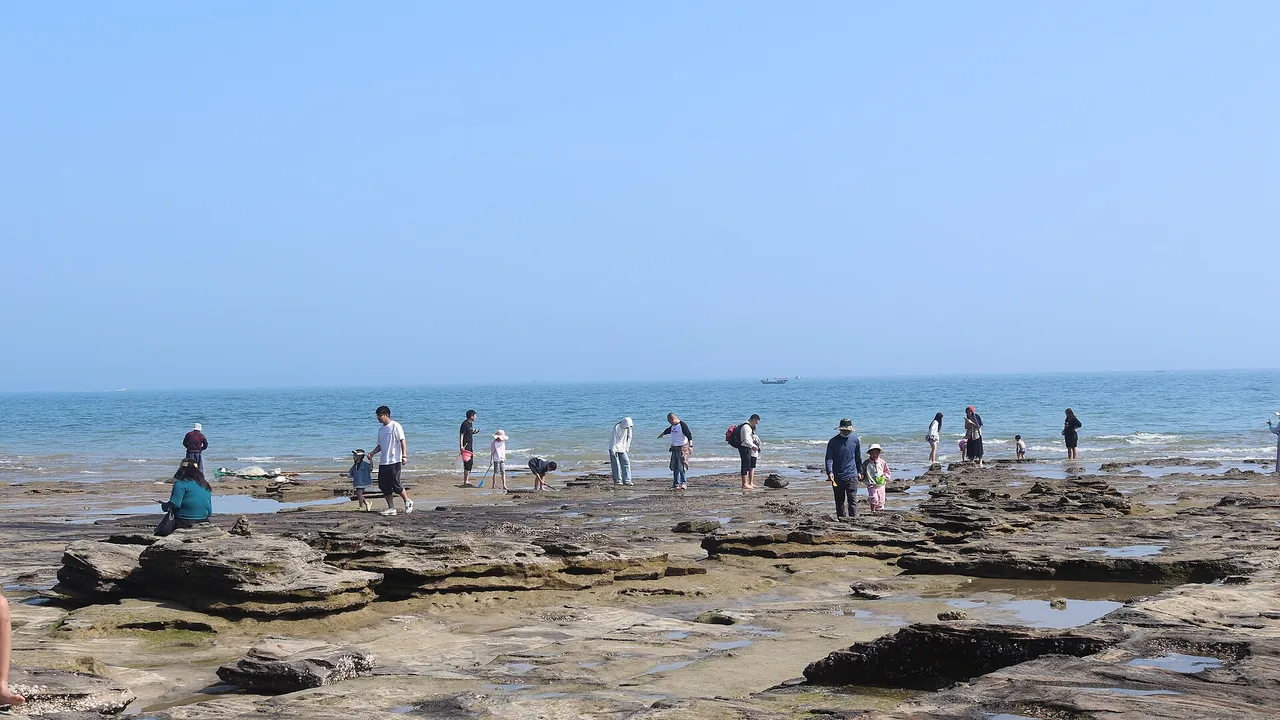
With a later sailing, detour ten minutes to view Five-Color Beach before leaving. These wave-cut platforms record time far older than the Han, volcanic rock ground into pattern by millennia of surf; a gaze from the boardwalk closes the itinerary's sense of scale neatly.
Rushed travelers skip straight to the boat. Evening back in Beihai runs free, the Old Street night market or Qiaogang sweet soup both fitting period marks.
| Getting around |
|
| Budget | RMB 700-1200 pp: return ferries about RMB 240-360, island fee RMB 98, harbor-show tickets separate. |
| Best time | Year-round; route around the museum's Monday closure, and dodge typhoon windows for the island crossing in summer. |
FAQs
How best to order Hepu and Weizhou across three days?
Hepu first, island second, as planned: Hepu ignores weather while the island bows to sailings and wind, so keeping it last maximizes flexibility. If your ferry only lands on day one, flip the order, Hepu working equally well on the return day.
Which heritage buildings and museums need booking?
The Hepu Han museum strictly requires real-name booking and closes Mondays; harbor-show tickets buy online ahead; the Old Street facades view freely all day, interiors per on-site notices. The ferry is the hard real-name booking, top priority.
Does the three-day heritage line suit children?
Partly: museums and night shows rate middling for kids, while the working harbor and volcanic boardwalk suit them better. Give children a task list, find one artifact from Persia, count the church's spires, participation saves the day.
Between the heritage three days and the coast three days, which one?
It follows temperament: history-and-artifact people tolerant of two long drives take the heritage line; sea-and-sunlight people set on the island take the coast line. The Weizhou portions overlap, and with five days, two heritage days splice cleanly onto three coast days.