
Changsha's citywalk has an invisible border: the old-town circle of two kilometers around Wuyi Square. The Ming wall of Tianxin Pavilion, the granite lanes of Duzheng Street and the Jia Yi Former Residence on Taiping Old Street all sit inside it, chaining on foot across one day without a single bus ride.
The route tells its story in layers: first the city's defenses and slopes, then Republican-era mansions and street life in the lanes, an afternoon of snacks and milk tea on the old street, and after dark, the body surrendered to crowds and neon. Changsha's night out-cities its day; walk this line and the phrase stops being jargon.
Itinerary at a glance
| 09:00 | Tianxin Pavilion and the Old Wall: The City's High Starting Point |
| 10:30 | Duzheng Street and Baiguoyuan: Old Changsha in Granite Lanes |
| 14:00 | Taiping Old Street: An Afternoon of Jia Yi and Snacks |
| 17:30 | Huangxing Road and Jiefang West: When Neon Takes Over |
The route, stop by stop
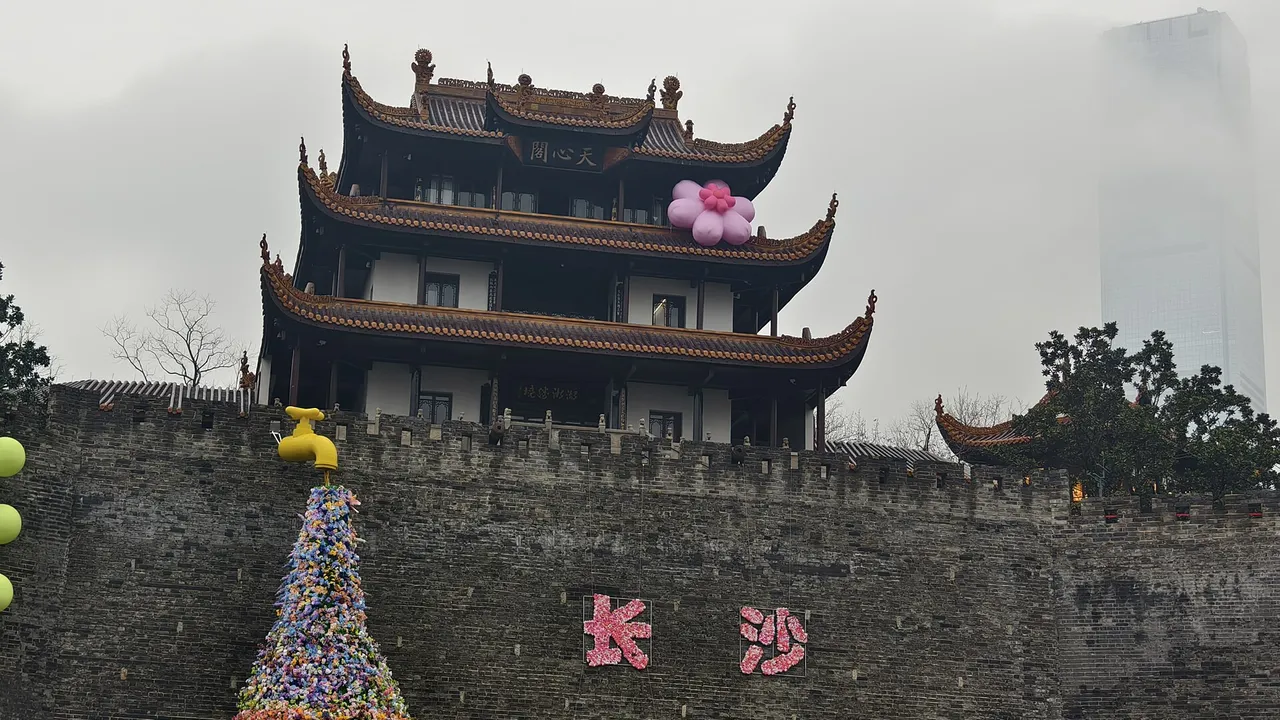
Tianxin Pavilion and the Old Wall: The City's High Starting Point
Start the old-town walk at Tianxin Pavilion, the southeast corner of historic Changsha and keeper of the city's only surviving stretch of Ming wall. The park is free, the pavilion and wall section ticketed, and the three tiers of upturned eaves form the skyline most printed on old Changsha postcards.
From the wall, look north to see the old town's slopes step down toward the Xiang River, south to the high-rises of the new districts. In Qing times this was the city's highest point and the Taiping assault played out below these bricks, now grassed in the joints, pigeons arriving before visitors.
Duzheng Street and Baiguoyuan: Old Changsha in Granite Lanes
Fifteen minutes on foot from the pavilion enters Duzheng Street, a renovated granite lane that wins on quiet: morning teahouses, a street-side barber's pole, cats sunning in old doorways. Deep in the lane hides the relic of Zhanwang Palace, where cooks' guilds once honored their patron, now a single stele and a street full of crayfish kitchens.
The neighboring Baiguoyuan heritage trail rewards slower walking: Republican mansions repainted warm yellow, a well at the lane's mouth still in daily use. This block is the model of the old town's renewal, light on commerce and heavy on life, made for unhurried walkers.
Taiping Old Street: An Afternoon of Jia Yi and Snacks
After lunch, walk twenty minutes or ride the metro one stop to Taiping Old Street. The street's weight shows in daylight: the Jia Yi Former Residence opens free, a quiet courtyard on the footprint of a house from two millennia ago, one wall away from the hawking. Its granite paving is among the last original street surfaces in the city.
The afternoon street belongs to snacks and milk tea: Black Classic's stinky tofu, the sugar buns of Ligongmiao, Hu's slow stews, and the densest Sexy Tea shop coverage in the country. Adopt the guerrilla tactic of one portion each and share everything, or your stomach will file for bankruptcy by the street's end.
Huangxing Road and Jiefang West: When Neon Takes Over
The old street's north mouth feeds straight into Huangxing Road pedestrian street, the silhouette of the Huang Xing statue backed by the twin towers of the IFS. Heritage brands alternate with new-Chinese-label stores, and the city's appetite for spending peaks at dusk, everyone queuing regardless of age.
After dark, turn into Jiefang West Road, shorthand for Changsha nightlife, where bars, livehouses and late-night stalls run from 9 pm to the next morning. Drinking is optional; walking one stretch inside the crowd, feeling a city that treats night as its main business day, is this citywalk's true terminus.
| Getting around |
|
| Budget | Wall-and-pavilion entry about RMB 32, all lanes free; with food and milk tea, RMB 100-200 pp keeps the day comfortable. |
| Best time | Year-round, best in spring and autumn; the lanes want morning light, and Jiefang West truly wakes only after 11 pm. |
FAQs
How far does this citywalk go, and how fit must I be?
About six kilometers and ten thousand steps, spread over a day, which is manageable; the real cost is pushing through the night crowds of Jiefang West. Two seated rescue points exist: a cafe in Baiguoyuan and a teahouse on Taiping Street, and a half hour at each recharges the legs.
Is the Tianxin Pavilion and wall worth the ticket?
Yes. This wall is the physical proof that Changsha's city site has not moved in two millennia, and the angle from the pavilion, watching old slopes fall to the river, exists nowhere at street level. If you want only street atmosphere, the free park section suffices; climb by taste, not duty.
When do the old lanes photograph best within one day?
Nine to eleven in the morning: sun rakes into the granite lanes, vendors are open but tour groups absent, and light and steam share the frame. The old street suits lanterns and crowds at dusk, while the night shot belongs to the IFS towers at the Huangxing Road corner. Avoid noon's top light for portraits.
Is walking Jiefang West alone at night safe?
Yes, the street stays densely packed deep into the night with full lighting and security, and solo travelers are everywhere. Two cautions: decline every tout at bar doors, and keep valuables in front pockets. Staying sober costs nothing, since the crowd itself is the street's headline act.