
Seven days read Chongqing a second way: not stringing sights into a line but taking the city apart into seven facets, one at a time. Days one and two build the downtown coordinates and texture, day three reads the Song carvers to the west, day four enters the karst, day five goes to the Gorges to read the Yangtze, day six takes in contemporary graffiti and the art academy, day seven returns to industrial history, one pot closing the week.
The enemies of a week are fatigue and repetition, so each day carries a single theme and every county day slows down. Follow this rhythm and on day seven you will find you have not finished Chongqing; you have learned how to move through it.
Itinerary at a glance
| D1 09:30 | Jiefangbei: Origin of the Coordinates |
| D1 15:00 | The Yangtze Cableway: A First View from Above the River |
| D1 19:00 | Hongya Cave: The First of Seven Nights |
| D2 09:00 | Ciqikou Ancient Town: Old Lanes and Older Teahouses |
| D2 11:30 | Liziba: The Train the Age of Its Tower |
| D2 14:30 | Eling No.2 Factory: The Patina of an Old Printworks |
| D3 09:30 | Dazu Rock Carvings: A Day Eye to Eye with the Song |
| D4 09:30 | Wulong Three Natural Bridges: Walking at the Earth's Core |
| D4 14:30 | Fairy Mountain: An Afternoon on the Grasslands |
| D5 10:00 | White Emperor City: The Knocker on the Gorges' Door |
| D5 13:00 | Qutang Gorge: Ten Kilometers by Boat |
| D6 09:30 | Huangjueping Graffiti Street: The Base Color of Contemporary Chongqing |
| D6 14:00 | Luo Zhongli Art Museum: The Academy's Other End |
| D7 09:30 | Chongqing Industrial Museum: Gears from a Century and a Half Ago |
| D7 18:30 | Nanshan Pipayuan Hotpot: The Week's Signature |
The route, stop by stop
Jiefangbei: Origin of the Coordinates
Day one does one thing only: locate Chongqing. The monument stands ringed by the densest towers of the southwest, street noise surging from the seams, history and commerce stacked here for seventy years.
Read the terrain on foot in the morning, rest in the afternoon, and take the cable across for a first two-river look at dusk. Depth begins with not overdrawing; day one's job is to set the tempo.
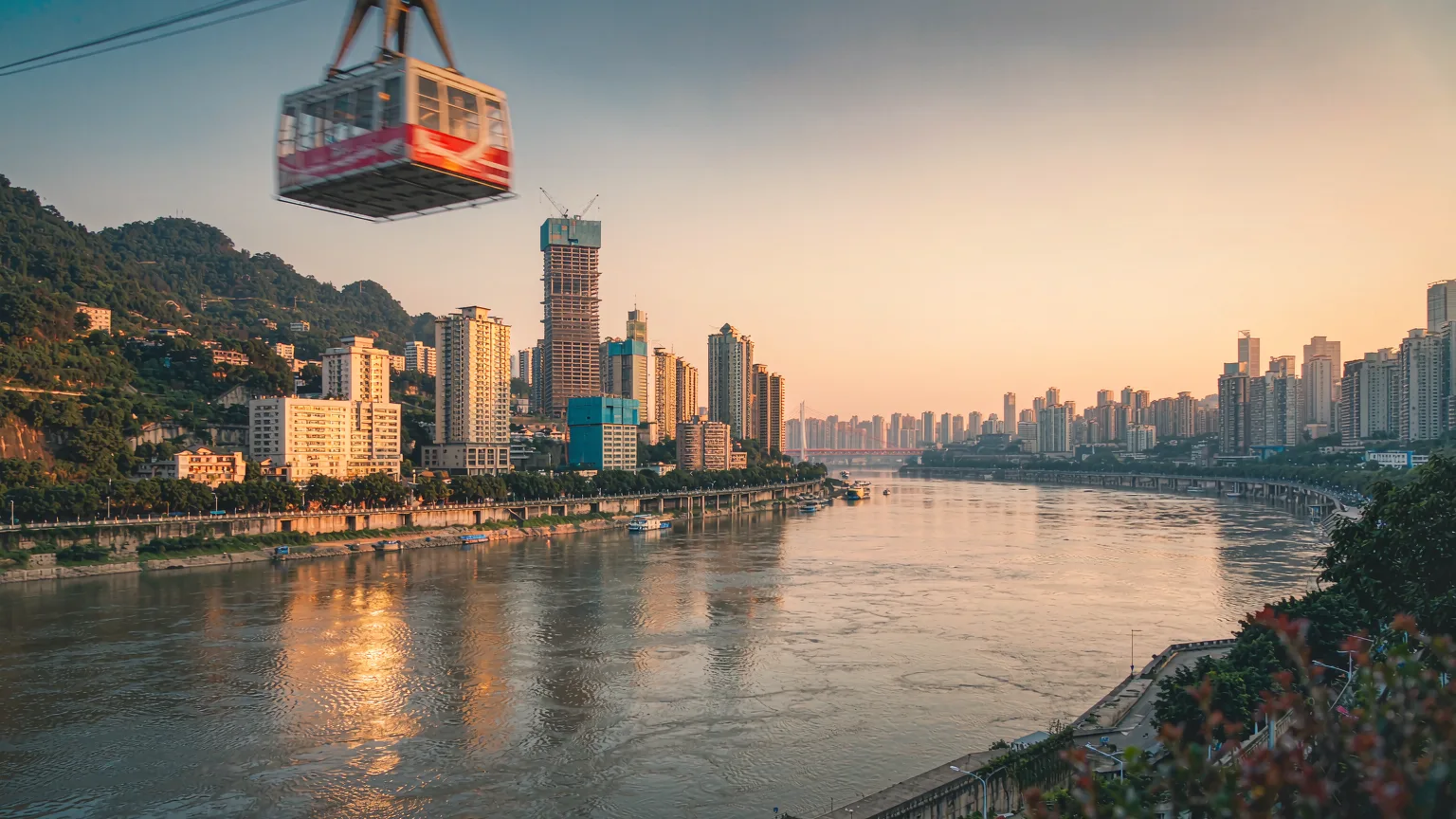
The Yangtze Cableway: A First View from Above the River
The afternoon cable sets a height reference for the week: four minutes pack the peninsula, the south ridges and a Yangtze bend into one frame. However deep the Wulong gorge or however low the Qutang boat later, you will measure against this.
On the south side, walk the riverside path briefly and return; day one adds nothing else, and half an hour in the river wind is the whole program.
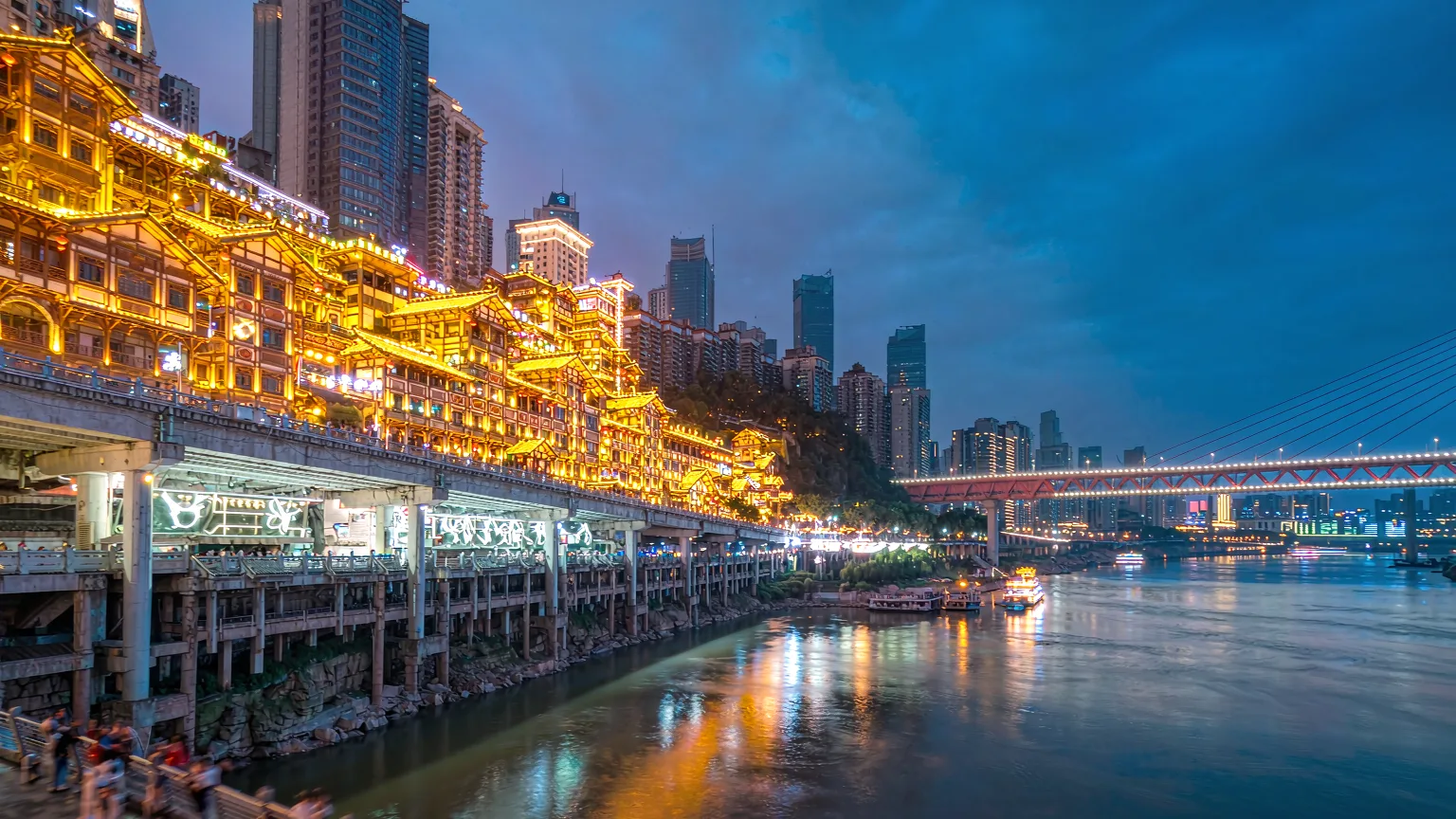
Hongya Cave: The First of Seven Nights
At night the lights climb from the cliff base, eleven tiers of stilted buildings afloat on the Jialing. The panorama from Qiansimen Bridge becomes the week's baseline for night views, every evening after quietly measured against it.
See it and return, no late snacks scheduled. Deep travel wins on tempo, so sleep early and save the quiet morning for tomorrow's old lanes.
Ciqikou Ancient Town: Old Lanes and Older Teahouses
Day two enters the texture layer. Skip Ciqikou's main street for the side lanes, where the teahouse's bamboo zither and opera singing survive as the old wharf's sound heritage, and the bluestone gradient still traces the porters' unload routes.
A full hour in the teahouse outreads crossing three main streets. Before leaving at midday, walk the riverside path once and memorize the Jialing's width with your body.
Liziba: The Train the Age of Its Tower
Midday at Liziba: line 2 exits through a tower's sixth floor, train and building designed together and coexisting for over two decades. Boards at the free deck explain the line's extreme ratio of bridges and tunnels.
One down train and one up train, then turn to the boards and the grade underfoot: this stop matters less for photos than for calibrating your instinct for Chongqing's scale.
Eling No.2 Factory: The Patina of an Old Printworks
The afternoon climbs to Eling. The No.2 Factory once printed banknotes and stamps; its red-brick sheds now terrace three tiers up the slope as containers for bookshops, select stores and coffee, with one of the peninsula's finest rooftops.
Day two's theme is how the city grows on slopes, and the factory is its most direct specimen: every level's height difference is the street's own historical drop.
Dazu Rock Carvings: A Day Eye to Eye with the Song
Day three heads west to meet eight-hundred-year-old craftsmen eye to eye. Baodingshan's Great Buddha Bay scrolls sutras into market life, the Thousand-Hand Guanyin's 830 gilded hands holding the whole field together.
Hire a guide for the full route; three hours later, looking back at the cliff from the exit, what you remember is not any single figure but an entire Song-dynasty way of seeing the world.
Wulong Three Natural Bridges: Walking at the Earth's Core
Day four enters Wulong. At the Three Natural Bridges the sinkholes plunge two to three hundred meters, boardwalks spiraling from cliff to floor, three stone arches taking turns overhead while the pit bottom keeps its own microclimate.
The gorge floor stays cool and damp, the gap with the surface sharpest in summer. Shuttles link the main viewpoints, steps concentrate between bridges, and an unhurried two hours suffices.
Fairy Mountain: An Afternoon on the Grasslands
The afternoon swaps the sinkhole's vertical for the grassland's horizontal. Fairy Mountain's vast meadows blanket the summit, cattle, windmills and cloud shadows composing a different geological mood, the little train threading through.
Walking the grassland needs no destination; arrive wherever you arrive. Sleep in Wulong or return downtown, since tomorrow's Fengjie is the week's farthest leg.
White Emperor City: The Knocker on the Gorges' Door
Day five reaches Fengjie and hands the whole day to the mouth of Qutang Gorge. From White Emperor City's ramparts, Kuimen faces you, the Yangtze pinched into a narrow gate, the ten-yuan note's scene unfolded at full size.
Split your time between the Three Kingdoms entrustment hall and the poets' inscriptions along the walls. This is the week's only pure river day; slow down, watching clouds outranks hurrying.
Qutang Gorge: Ten Kilometers by Boat
Afternoon, the pleasure boat enters Qutang, walls closing overhead, ancient inscriptions skimming past at water level. Riding the gorge is the week's only moment eye-level with the Yangtze, wind slamming between the cliffs.
Off the boat by three for the evening rail back. Watching the river slide past the return window closes day five's loop on its own.
Huangjueping Graffiti Street: The Base Color of Contemporary Chongqing
Day six returns to the present. Huangjueping's walls carry generations of the art academy's graffiti, apartment blocks to teahouses and nothing spared, one of Asia's rarest whole-street painting sites.
Pair the teahouse's lidded bowls and street noodles with the walls, reading the strata of eras above and the strata of daily life below. Morning slanted light reads the surfaces best.
Luo Zhongli Art Museum: The Academy's Other End
The afternoon reaches the Luo Zhongli Art Museum in the university town, its mosaic facade of tile shards laid by hand, the galleries tracing the academy's painterly lineage and the full genealogy behind Luo's Father.
After the museum, walk the Huxi campus half an hour: murals, sculpture and field paths interleaved, the living spring that fed Huangjueping's painted street.
Chongqing Industrial Museum: Gears from a Century and a Half Ago
The last day reads industry. On the old steelworks' site, rolling machines, locomotives and vast halls stand in place, the ordnance-to-steel genealogy clear at a glance, rust the master color of the city's modern history.
From Song carvings to nature's stone arches to the Gorges to these steel frames, the week completes its jigsaw today: this is a city forever rebuilding itself.
Nanshan Pipayuan Hotpot: The Week's Signature
The closing feast sits mid-slope at Pipayuan: a thousand tables cascading down the hill, one burner each, lights stitching a sea through the trees. The rivers, sinkholes, gorges and painted walls of seven days each find their seat beside this pot of red broth.
Count tripe by the seven-up-eight-down, drink the broth at its first pour, and look back once at the lit hillside before descending. Day seven's meaning is not ending but confirming you will return.
| Getting around |
|
| Budget | Covering Dazu, Wulong and Fengjie transport, tickets and lodging throughout, about RMB 4000-6000 pp, excluding long-haul fares. |
| Best time | April-May and September-October run steadiest, dodging summer and Golden Week crowds; winter river haze dims the gorge views. |
FAQs
Does a seven-day trip feel repetitive?
Not if you split by theme: each day here has a single protagonist, night views, old lanes, carvings, karst, rivers, the contemporary, industry, none overlapping. Repetition risk concentrates in old towns and night views, so each appears once, with the rest of the week given to counties and neighborhoods.
What is the steadiest transport plan for the three county days?
Dazu and Wulong sit west and southeast, each an easy rail round trip in one day, saving a hotel night; Fengjie lies farthest, so take a morning train out and an evening back, or simply overnight there. Where possible, slot a city day between county days as a buffer.
Which stops require advance booking?
Three hard bookings: Dazu's capped peak-season slots, the Three Bridges' combined entry and shuttle ticket, and holiday time slots for the Yangtze cableway. Everything else is on-site or free. Finish all three bookings the day your dates are set, far kinder than handling them piecemeal.
If my stamina falls short, which day goes first?
Trim Fairy Mountain first, keeping only the gorge-floor section of the Three Bridges, and donate the saved energy to the Fengjie day; next, swap the Industrial Museum day for hot springs. The week's flexibility lives in its second half, so the first three days can run as written.