
Guilin city gets treated as a transit stop on the way to Yangshuo, which wastes a remarkable place: the city itself rises out of karst peaks, with Solitary Beauty, Diecai and Fubo hills standing straight up downtown while the Li and Peach Blossom rivers knot through the four lakes, stitching the whole city into one park. A single day covers the highlights clockwise, almost entirely without taxis.
The plan saves energy for dusk and night: gentle morning walking at Elephant Trunk and Fubo hills, the Diecai climb in the afternoon for the panorama that explains the whole landscape, dinner in the East-West lanes, then the two-rivers cruise after 7 pm past the twin pagodas and lit bridges. The boat starts around 210 yuan, not cheap, but it is the only way to gather the entire waterway nightscape in one sitting.
Itinerary at a glance
| 08:30 | Elephant Trunk Hill: Reading the City's Emblem |
| 10:00 | Fubo Hill: The Pearl-Returning Cave and Its Legends |
| 12:00 | Lunch and Zhengyang Street: Rice Noodles at Midday |
| 14:30 | Diecai Hill: A Karst Seminar from Above |
| 16:30 | Ronghu, Shanhu and the Twin Pagodas: Warm-Up Before the Cruise |
| 19:30 | The Two Rivers and Four Lakes Night Cruise: Ninety Minutes of Light |
The route, stop by stop
Elephant Trunk Hill: Reading the City's Emblem
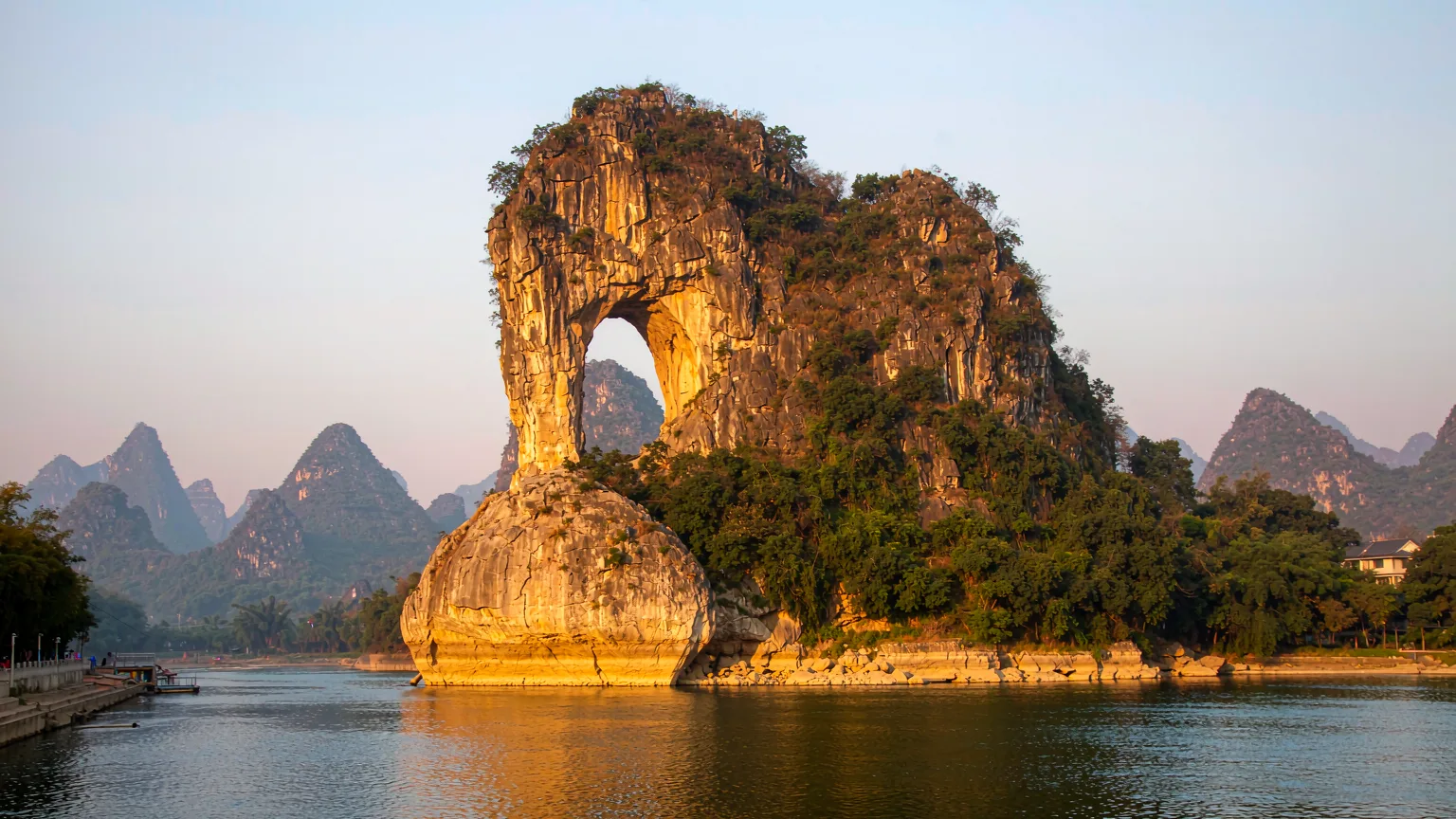
Elephant Trunk Hill is the emblem of Guilin: a lone karst peak dipping into the confluence of the Li and Peach Blossom rivers like an elephant drinking, the natural arch between hill and water forming the trunk. Admission runs about 55 yuan and a careful loop takes an hour, but photo positions matter: the riverside walkway directly across from Water-Moon Cave is the standard shot, backlit by morning sun and often veiled in mist.
Beyond the hill itself, Water-Moon Cave holds dozens of Song-era and later stone inscriptions, proof that this elephant has been admired for eight centuries. The summit path is short and looks over the river confluence, though the view cannot match Diecai Hill in the afternoon, so skip it if time runs short.
Tour groups pile in after 8:30 in high season and the classic spot queues up, so enter at opening. To see the elephant for free, the riverside along Binjiang Road or Zizhou Park frames it from the side, a different but worthy angle.
Fubo Hill: The Pearl-Returning Cave and Its Legends
Fubo Hill stands on the Li River just north of Elephant Trunk, admission about 25 to 30 yuan, named for the Han general Ma Yuan. The interest concentrates in the Pearl-Returning Cave at its foot: the Sword-Testing Stone hangs from the ceiling a hair's width above the ground, credited to the general's blade, while a Qing-era cauldron and bell nearby astound with their scale.
The cave opens straight onto the riverbank, the Li River pressed right against the entrance, a layering of hollow hill and river view unique to downtown Guilin. The summit takes 20 minutes and frames the river's first great bend, with boats sliding beneath.
Crowds here run far thinner than at the elephant, and weekday mornings can feel private. Allow 1 to 1.5 hours for cave plus summit, the most comfortable stretch of the morning.
Lunch and Zhengyang Street: Rice Noodles at Midday
Midday returns downtown, and lunch belongs to Zhengyang Street. Guilin rice noodles are a mandatory ritual: the lucai version is the true form, crispy pork skin, braised beef and pickled long beans all required, eaten dry-mixed first with broth to finish, the local order, at 7 to 15 yuan a bowl. Old street shops beat the chains.
The pedestrian street itself, rebuilt along arcade lines, suits a post-lunch stroll: an old gate wall and ancient banyan sit mid-street, and the south end meets Ronghu Lake, foreshadowing the evening. Browse souvenir prices now but buy nothing; the last day is for calm shopping.
After noodles, hit a dessert cart: mung bean paste or grass jelly at 5 to 10 yuan a bowl cools the palate the way local kids finish their afternoons.
Diecai Hill: A Karst Seminar from Above
Diecai Hill rises in the city's north, admission about 25 to 30 yuan, a cluster of peaks named for rock strata layered like folded silk. The renovated trail reaches the river-viewing pavilion in 30 to 40 minutes, steep but short, fine for ordinary fitness.
The summit is the best view downtown: the Li River slicing the city north to south, karst towers springing from flat ground with buildings threaded between them, one glance explaining how city and landscape interlock here, a whole-system view the elephant cannot give. After 3 pm the light turns favorable and the skyline sharpens.
On the way, the Wind Cave and its cliff carvings reward a pause, inscriptions layered centuries deep. Descending with energy to spare, walk 15 minutes to Mulong Lake's surviving Song city wall, a preview of tonight's waterways.
Ronghu, Shanhu and the Twin Pagodas: Warm-Up Before the Cruise
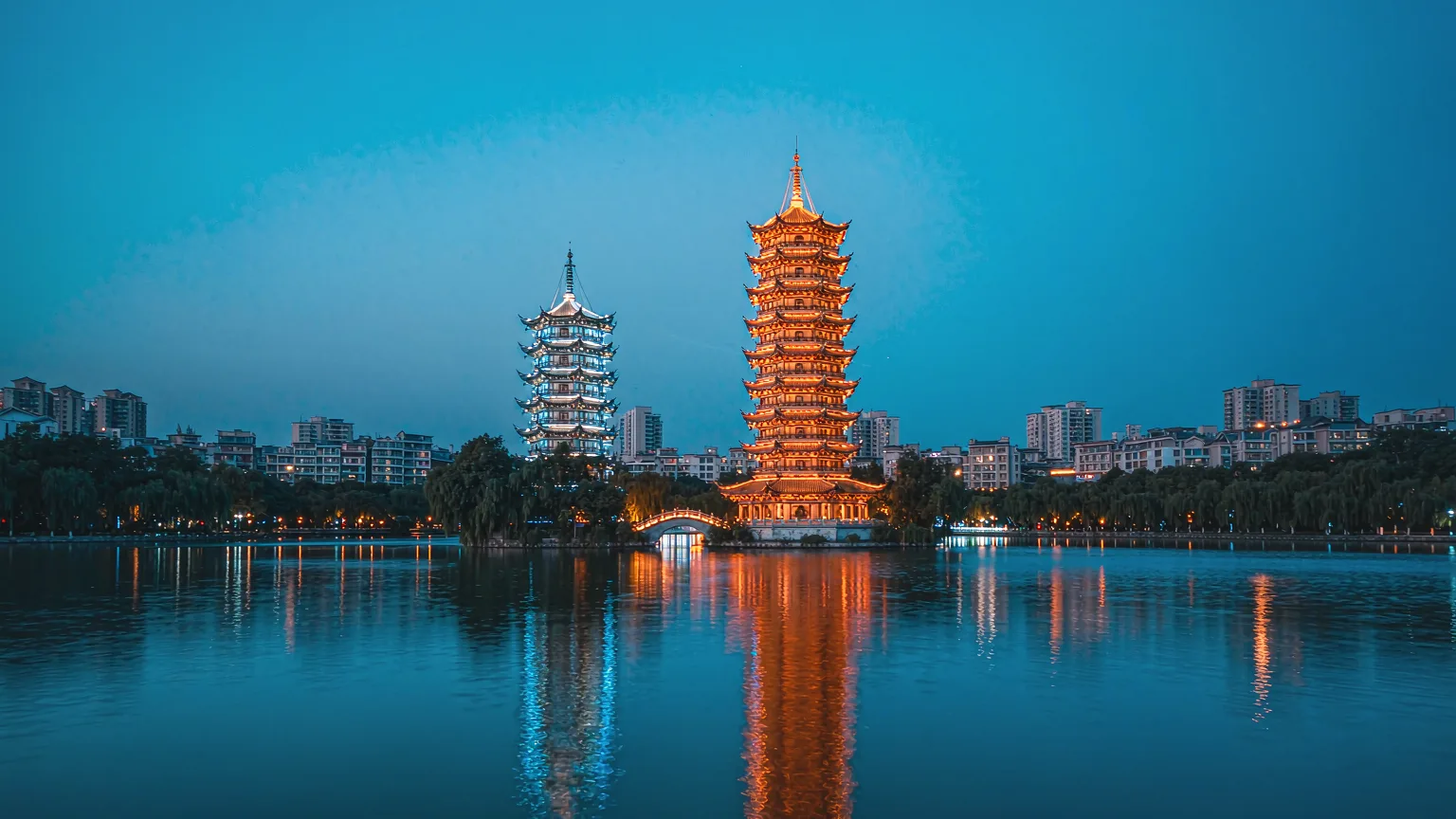
Ronghu and Shanhu lakes open free at dusk as the land-based rehearsal for the cruise: flat lakeside paths past the old gate, the pavilion where the poet Huang Tingjian once moored, and a glass bridge, while locals practice tai chi and chess in the fading light, the city at its loosest. The gold-and-silver Twin Pagodas stand in Shanhu, lighting up after sunset, and their full reflection is the best free frame in town.
Lakeside cafes make the hour before dark worth sitting out. The pagodas admit climbers at night for about 35 to 50 yuan, but interior space is tight and the view loses to the reflection, so most should stay ashore.
Dine in the East-West lanes and board a 7 to 8 pm sailing, when the sky has just darkened and the lights have just awakened, the cruise's finest window.
The Two Rivers and Four Lakes Night Cruise: Ninety Minutes of Light
The Two Rivers and Four Lakes is a modern engineering feat reconnecting the Song-era moat system; boats leave from Jiefang or Wenchang bridge piers for about 90 minutes through Ronghu, Shanhu, Guihu and Mulong lakes and both rivers, from about 210 yuan by vessel class, with glass-roofed sightseers the mainstream.
Three moments carry the trip: the twin pagodas doubling in gold at Shanhu, the Song-wall lighting at Mulong Lake, and the bridge tunnels themselves, several lined with relief carvings and lamps that flash by like time machines. Narration on board neatly explains the water system's history.
Seats and an open deck compete for attention; claim a rail position at boarding for photos. Winter wind bites, so bring a layer, and summer mosquitoes demand repellent.
| Getting around |
|
| Budget | About 300 to 450 yuan per person: Elephant Trunk Hill around 55, Fubo and Diecai hills 25 to 30 each, the night cruise from about 210, plus 80 to 120 for food. |
| Best time | April to October, with May and June swelling the Li River to its greenest; the prettiest sailings run 7 to 8 pm, so save a clear evening for the cruise. |
FAQs
Within the city day, what would I genuinely regret missing?
Three things: Elephant Trunk Hill, the Diecai summit and the night cruise. The elephant is the visual signature, recognizable in seconds; Diecai's summit is the one near-free vantage that explains how karst and city interlock, and skipping it brings regret only once you reach Yangshuo; the cruise bundles the twin pagodas and bridge lighting in one pass. Fubo Hill and the lanes are nice-to-have and the first cuts when time tightens. Rank this way and even a short day loses nothing structural.
Is the 210-yuan night cruise worth it, and are there cheaper alternatives?
Its value is seeing the entire water system's lighting and bridge tunnels in one go, which walking cannot replicate: the lakeshore covers only the two lakes, while the Song-wall nightscape at Mulong Lake and the tunnel passages exist only aboard. The budget alternative is a free night walk from the twin pagodas along Ronghu to the old gate and onward to Mulong Lake, nearly as pretty minus the river and tunnels. A sensible compromise: walk on a tight budget and bank the 210 yuan for the Li River rafts in Yangshuo; with room, do both, since the narration and vantage are genuinely distinct.
Can older parents skip the Diecai climb without losing the day?
Yes, with substitutes. The essence of Diecai is the overlook, so either climb halfway to the Wind Cave and lower platform, cutting the stairs by more than half, or skip the summit entirely and read the peaks at eye level from Mulong Lake and the riverside, redirecting saved energy to claiming deck space on the cruise. The elephant and Fobo Hill involve almost no stairs, and the lakes are flat; with Diecai dropped, the whole day stays near three kilometers of walking, effortless for seniors.
How should the day be reshuffled in rain?
Prioritize indoors and protect the cruise: the elephant works fine in rain, when the river turns moodily misty, and a raincoat beats an umbrella; the caves at Fubo and Diecai shelter you, but drop the summit in heavy rain. Swap the afternoon climb for the East-West lanes and arcade blocks, and confirm the cruise is sailing, since it runs in light-to-moderate rain but stops in thunderstorms and high wind, so check official notices first. In short: keep the boat, drop the climb, and the day still stands.