
Guilin's historical depth hides behind its scenery: the Ming-era Jingjiang Princes' City is the best-preserved princely compound of the dynasty, and Solitary Beauty Peak carries the earliest known carving of the line Guilin's scenery is the finest under heaven, written by the Song official Wang Zhenggong eight centuries before the phrase became a slogan. East of the river, the Guihai Stele Forest gathers the densest cliff inscriptions of the Li River basin, since every literatus passing through Tang and Song Guilin left a mark.
This culture day joins Ming princely history with Tang-Song epigraphy: the morning follows the compound's central axis through the gates and palace ruins, plays an examinee in the old examination hall, then climbs Solitary Beauty Peak for the city view and the Reading Rock; the afternoon moves to the stele forest on Longyin Road for rubbings and originals. Mixed indoors and out, rainproof, and the most solid humanities day Guilin offers.
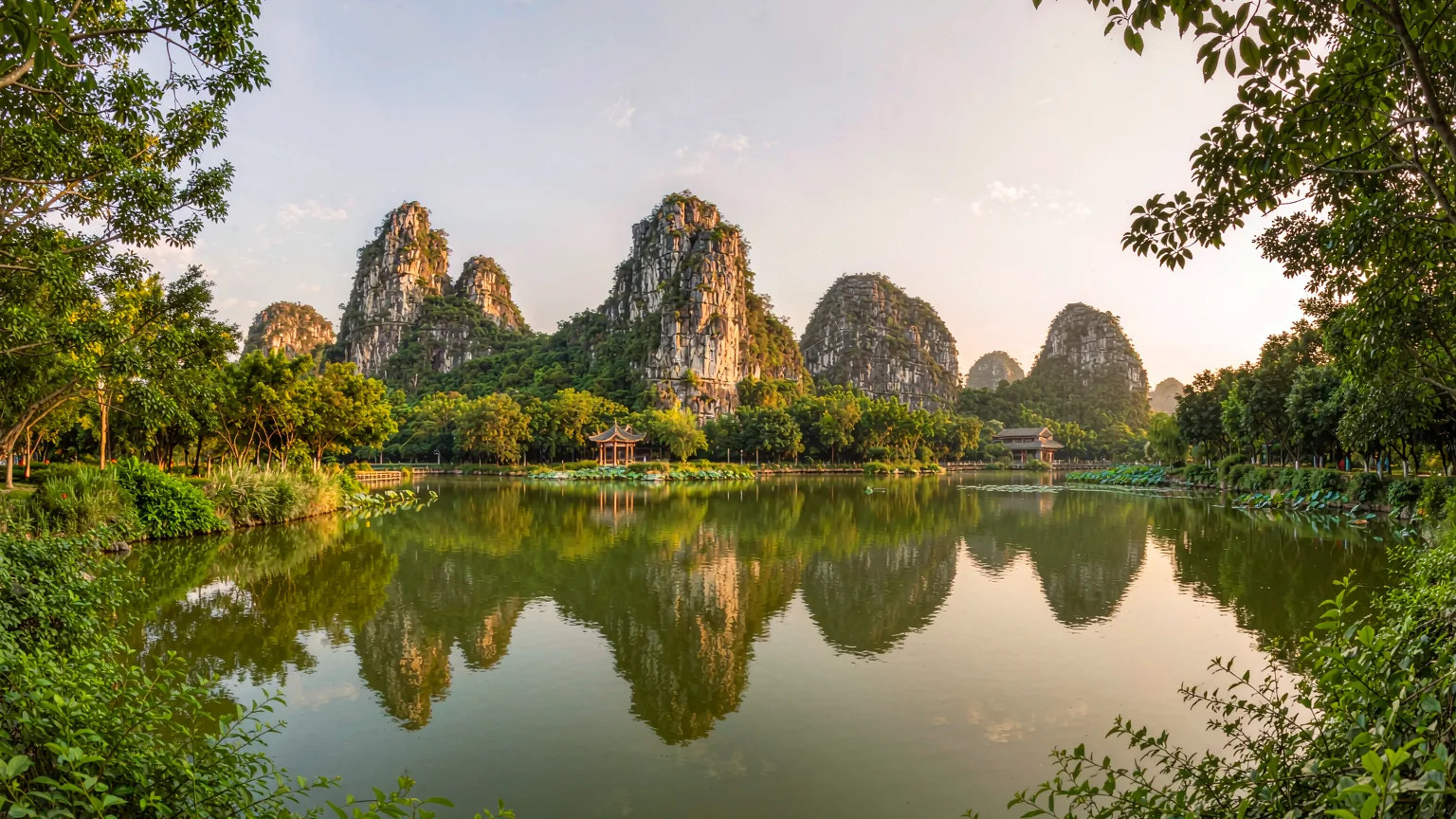
Itinerary at a glance
| 09:00 | Jingjiang Princes' City: A Ming Prince's Central Axis |
| 10:30 | The Examination Hall and Solitary Beauty Peak: Sit the Test, Climb the Rock |
| 12:30 | Lunch Transfer: Old-Town Kitchens en Route to the Steles |
| 14:30 | The Guihai Stele Forest: Tang and Song Visitors' Message Wall |
| 16:30 | Flower Bridge and Seven Star Park: A Scenic Footnote to the Steles |
The route, stop by stop
Jingjiang Princes' City: A Ming Prince's Central Axis
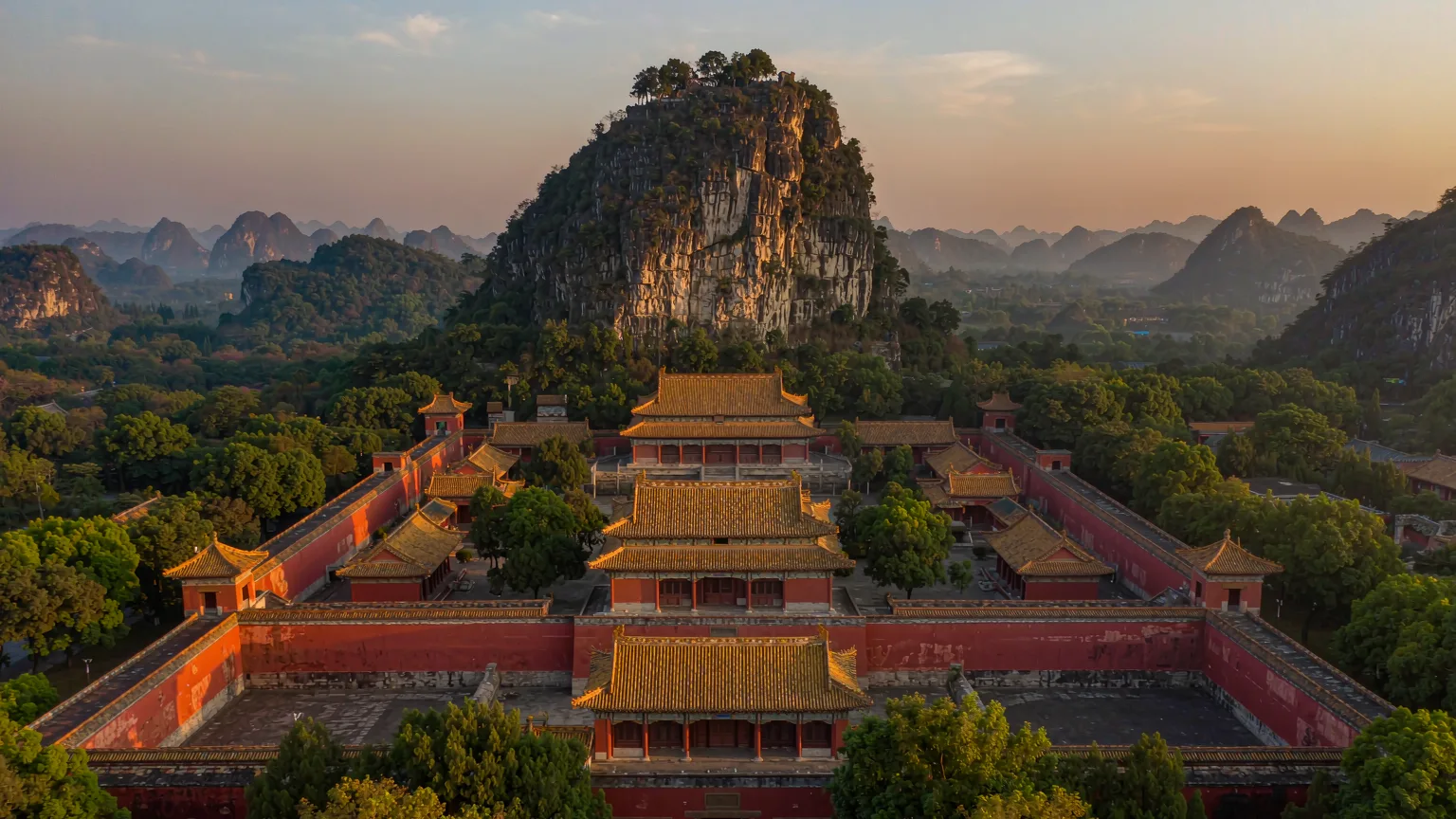
The Princes' City was the fief of Zhu Shouqian, grandnephew of the Ming founder, begun in 1372, four decades before Beijing's Forbidden City, its walls enclosing a city within the city. Enter through Chengyun Gate and follow the axis: the terrace and column bases of Chengyun Hall still read plainly, and picturing a prince's procession there is half the visit. The combined ticket with the peak runs about 100 yuan.
The site's history layers oddly: the Qing converted the palace into the Guangxi examination hall, and the Republic made it the provincial seat, one compound serving three regimes. Most standing buildings are reconstructed, but the walls, ground plan and siting are original, so an audio guide or a borrowed docent matters more than the architecture.
Allow 90 minutes; the compound is compact with a single route. Some exhibit halls close Mondays while the walls and peak stay open, so plan around that.
The Examination Hall and Solitary Beauty Peak: Sit the Test, Climb the Rock
Inside the compound, the restored Qing examination hall lets visitors sit a mock county exam in about twenty minutes: a one-person cell, answering, submitting, then the roll call of results, an immersive experience done with unexpected care and, by family reports, the funniest part of the visit.
Solitary Beauty Peak rises from the compound's center, about 66 meters, the summit stairs taking 15 to 20 minutes, steep but railed throughout. The top gives a 360-degree karst panorama that pairs with Diecai Hill's view, while midway, the Reading Rock marks where the Six-Dynasties poet Yan Yanzhi once studied, its walls carrying Wang Zhenggong's Song-era couplet, the earliest carving of the famous praise of Guilin's scenery.
Exit through the north gate straight into lunch territory. Budget a full three hours for city plus peak; this is the day's centerpiece.
Lunch Transfer: Old-Town Kitchens en Route to the Steles
Lunch in the blocks north of the compound, where local kitchens undercut the scenic-area prices: beyond rice noodles, try vinegar-blood duck or Hunan-Guangxi style stir-fries, 30 to 60 yuan a head. Leave half an hour to digest, since the afternoon means walking and standing.
The stele forest sits about 3 kilometers from the compound, a 10-minute taxi or three bus stops, near Longyin Cave on the south flank of Yueya Hill inside Seven Star Park territory. With slack time, walk a stretch along the Little East River first, where calm water doubles the cliffs, a free appetizer.
Set expectations for the afternoon: the stele forest serves lovers of history and calligraphy, slow-paced and dense with commentary, the wrong stop for a rushing itinerary.
The Guihai Stele Forest: Tang and Song Visitors' Message Wall
The Guihai Stele Forest Museum wraps the cliff inscriptions of Longyin Cave and Rock, admission about 25 to 30 yuan, holding over two hundred carved pieces, the densest concentration of Guilin's stone texts. Inside the cave sit the Song master Mi Fu's portrait and signature pieces and Shi Manqing's famous farewell inscription; calligraphy lovers will not want to leave.
The indoor galleries display rubbings and readings of key carvings, and with commentary the stones open onto the culture of examinations, exile and post roads, since Tang-Song Guilin stood on the route south, and these inscriptions are essentially literati social-media posts. Allow 1.5 to 2 hours.
A few minutes' walk along the Little East River brings you to Flower Bridge, the arched gateway of Seven Star Park, a fine closing view back at the caves. With appetite left, Seven Star Park itself (about 55 yuan) extends the day by 90 minutes into scenery.
Flower Bridge and Seven Star Park: A Scenic Footnote to the Steles
A few minutes along the Little East River from the stele forest, Flower Bridge arches as the gateway of Seven Star Park, a Ming stone span whose half-circle and reflection join into a full moon, the bridge most often seen in old Guilin photographs. The pavilion and inscriptions at its head reward a pause, and the view back at the caves is the culture day's closing frame.
With appetite left, enter the park itself (about 55 yuan), where Seven Star Cave, Camel Hill and the steles belong to one landscape system, adding about 90 minutes; or stay outside on the free riverside path toward Qixia Gate, which works fine too.
A 10-minute taxi back downtown at dusk lands you at the East-West lanes for dinner. The day's rhythm runs from steles to bridge to hills, information density falling as the senses open, which is exactly how such a day should curve.
| Getting around |
|
| Budget | About 180 to 260 yuan per person: the city-and-peak combined ticket around 100, the stele forest 25 to 30, food and transit 60 to 120. |
| Best time | Year-round, best in spring and autumn; tour groups thin out at the princes' city by 9 am, climb before 11 to dodge midday sun, and the stele forest's indoor halls make it rainproof. |
FAQs
Is the Princes' City worth half a day compared to the Forbidden City in Beijing?
Yes, with the right expectations: the value is not building mass, most standing halls are reconstructed, but three genuine things, the Ming wall layout, the natural-and-cultural stacking of Solitary Beauty Peak, and the site's strange afterlives as examination hall and provincial seat, a one-address-three-regimes specimen rarely seen elsewhere. The Forbidden City shows palace architecture at its peak; this place shows how power repeatedly rewrote a city. For anyone drawn to Ming princely institutions or the examination system, it is Guilin's richest humanities stop, while casual visitors will find it half-new, and a guide changes everything.
Does the famous verse really originate on Solitary Beauty Peak?
Yes. On the rock wall by the Reading Rock sits a Song-era seven-character poem by Wang Zhenggong from 1201, containing the line that Guilin's scenery is the finest under heaven, the earliest known occurrence, with the original carving still in place, predating the phrase's later folk attributions by nearly six centuries. The weathered characters need guidance to read, so use the docent or compare the displayed rubbings; knowing what you are looking at gives that half-minute of standing its full weight.
Will the stele forest bore foreign visitors who cannot read calligraphy?
The risk is real but manageable: take the museum guide, since a good one turns inscriptions into stories, an exile's worries, literati friendships, the hardship of post roads, plot lines that need no Chinese; compress the visit to an hour, covering the cave originals and the gallery's key rubbings rather than everything; and pair it with Seven Star Park so half the time goes to scenery. If stone texts simply do not move you, cutting the stop honestly and giving the afternoon to the lanes and noodles is the right call, no culture day needs padding.
Which parts of this culture day actually hook a primary-school kid?
The mock examination is the hook: sitting in the cell, answering and waiting for results is game-like and consistently lands with kids, so brief them on the ancient gaokao beforehand. The peak climb burns energy, and a count-the-peaks game at the top sustains interest; challenge the child to spot characters in the famous verse at the Reading Rock. The stele forest is hardest for kids, so cap it at half an hour, cave only, armed with the analogy that inscriptions are ancient social posts. Split the day into a high-interaction morning and a short afternoon, and their attention budget holds.