
Seven days reads the whole Guilin region: five on a main line balancing classic and depth, one city day, one Li River day, one Yulong-and-gallery day, one Silver Cave with a West Street rest, and two on the Longji terraces; day six pushes north into Ziyuan county, where Bajiao Fort's Danxia peaks and cloud seas speak a geology entirely unlike karst; day seven chooses between Mao'er Mountain, the South China summit at 2,141.5 meters, and a graceful return.
The framework's challenge is transport: public service thins toward Ziyuan and Mao'er, making charter the realistic mode (about 500 to 800 a day), and a single northern line, Guilin to Ziyuan to Mao'er or home, beats doubling back through Yangshuo. Lodging splits one Guilin night, three Yangshuo nights, one Longji night, one Ziyuan night, one flex night, with luggage forever at one-night weight, the entire secret of a seven-day trip staying light.
Itinerary at a glance
| DAY1-2 | City and Li River: The Standard Open and the Summit Day |
| DAY3-4 | Yulong, the Gallery and the Recovery Day |
| DAY5 | Longji, Night One: Dazhai Sunset and a Mountain Evening |
| DAY6 | Longji Dawn, Then North to Ziyuan: From Terraces to Danxia |
| DAY7 | Bajiao Fort and the Road Home: Danxia's Dawn Show |
The route, stop by stop
City and Li River: The Standard Open and the Summit Day
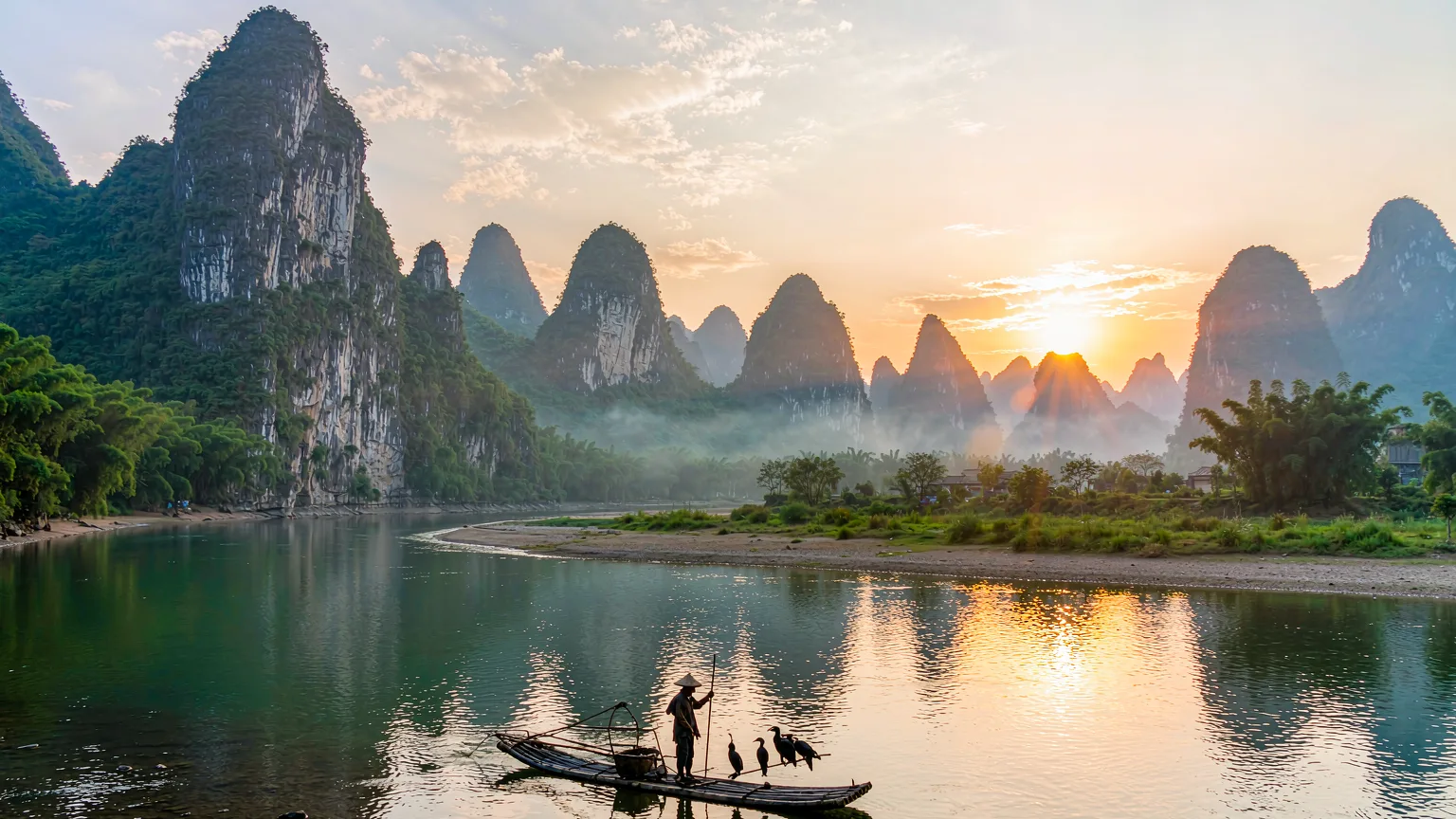
Day one runs the city classics: the elephant (about 55), Zhengyang noodles, the Diecai climb (25 to 30), the lanes, and the night cruise after 7 pm (from about 210). Day two is the Li River: an early raft at Yangdi (about 216 per raft), downstream past the 20-yuan view and Nine Horses Hill to Xingping, with Laozhai at sunset, then on to Yangshuo by evening.
Both days are detailed in the five-day plan; the seven-day version makes Laozhai optional, since days six and seven may hold Bajiao Fort and possibly Mao'er, and leg budget belongs to the mountains ahead, so ride the raft and skip the climb.
Lodging runs Guilin night one, Yangshuo from night two. The jet-lag and energy rules hold: do not max the first two days, seven days is a long run.
Yulong, the Gallery and the Recovery Day
Day three rafts the full Yulong (about 240 per raft) and rides the Ten-Mile Gallery, with sunset at the Cuiping lookout; day four visits Silver Cave (about 90) in the morning and rests around West Street in the afternoon, with the Impression Liu Sanjie show (200 to 240) as an optional night.
The recovery day matters more in seven days than five, since night five sleeps on the mountain, so the last lowland afternoon must clear laundry, charging, shopping and sleep debt in one pass. Longji's day-night temperature swings are real; check jackets and hiking shoes tonight.
Indifferent to caves? Swap day four wholesale for a lazy kayak on a Li tributary or a cooking class, spreading energy evenly across days six and seven.
Longji, Night One: Dazhai Sunset and a Mountain Evening
Day five leaves Yangshuo in the morning for Dazhai (about 3 hours by charter or shared car), entering the area by midday (admission about 80). Cableway or foot up to Lookout One, let the afternoon light rake the valley, close with sunset on the platform, and sleep in a Dazhai guesthouse (150 to 400).
Evening hides the mountain's side shows: bamboo-tube chicken and wild greens for dinner, then a village stroll under real stars, the light pollution so low that the Milky Way shows on clear nights. Signal holds on the main street, so confirm day six's plan before bed.
Dazhai beats Ping'an as the overnight base because dawn cloud-sea odds are higher and the cableway logistics flow better; visit Ping'an on the descent if your route includes it.

Longji Dawn, Then North to Ziyuan: From Terraces to Danxia
Out before 6 am for the cloud sea and sunrise (best on clear mornings after rain), breakfast, then descend. With slack time, add Ping'an's Seven Stars and Moon or Huangluo's hair show, lunch at the mountain's foot, and drive north to Ziyuan county (2.5 to 3 hours), arriving by evening.
The night goes to resting in Ziyuan town ahead of a pre-dawn start at Bajiao Fort. Lodging is plain but clean at 120 to 300, and with energy left, an evening walk along the Zi River catches Danxia in the last light.
The day is a transfer day by nature: terraces in the morning, mountain roads in the afternoon, modest effort but tight timing, and the driver's reliability decides it all, so lock in the 5:30 to 6 am departure the night before.
Bajiao Fort and the Road Home: Danxia's Dawn Show
Day seven leaves Ziyuan at 5:30 am for Bajiao Fort (about an hour; ticket plus shuttle around 100), reaching the lookout by 6:30 to 7. The fort is a masterpiece of Danxia landforms, spiral peaks poking through cloud seas, with the famous cliff-side incense burner promontory the signature frame, cloud odds peaking on clear mornings after rain.
The trail takes 40 to 60 minutes, shortened by the shuttle. Clear the core views by 9 am, descend, and ride 2.5 hours back to Guilin by early afternoon, comfortable for evening transport. A next-day flight frees the afternoon for a Zi River drift or the Tianhu grasslands.
The alternative: unmoved by Danxia, spend day seven at Mao'er Mountain (the South China summit, another dawn start and full day) or close gently in Guilin, the university's princes'-city campus, Ronghu cafes and a farewell bowl of noodles. The last square of seven days goes to whichever picture you want most.
| Getting around |
|
| Budget | About 2,200 to 3,600 yuan per person: tickets and boats 700 to 900, charters and intercity transit 600 to 900, food 700 to 1,000, lodging extra. |
| Best time | April to October; Bajiao's cloud sea peaks on clear mornings after rain and Longji turns gold in September-October, so spend your clearest forecasts on Bajiao and the Li River days. |
FAQs
What do the extra two days of seven actually buy, and is it worth it?
The gains cluster in three places: Longji upgraded from a day-sample to two days, capturing cloud-sea sunrise and a mountain-village night; Bajiao Fort's Danxia cloud seas, a geology alien to karst; and slack across the whole trip, every peak day followed by a buffer. The test: strong appetite for photography, geology or mountain-stay atmosphere makes the marginal value of seven days high; core-scenery visitors get a complete trip at five, with the extra pair diminishing. Budget adds about 700 to 1,200 a head, mostly charters and lodging.
If Bajiao Fort and Mao'er Mountain are mutually exclusive, which one?
Take Bajiao Fort, for three reasons: its scenery is the rarer, spiral Danxia peaks in cloud seas being scarce even nationally; its effort floor is low, 40 to 60 minutes of trail plus the shuttle captures the signature views; and its time cost is contained, a dawn start home by noon. Mao'er is a summit-achievement day, needing a full day and better legs, with summit views hostage to weather, poor value for non-climbers. Unless topping a peak is the explicit goal, Bajiao is the better day seven.
What does a week of chartering realistically cost, and how do I trim it?
Only the Longji leg (1 to 1.5 days) and the Ziyuan leg (1.5 to 2 days) truly need chartering, at a market rate of 500 to 800 a day, some 1,200 to 2,200 per vehicle in total, or 300 to 550 per head split four ways. Trimming: booking via ride-share platforms or guesthouse desks undercuts touts at the gate by a fifth; if four seats won't fill, a proper two-day group tour (400 to 600 a head with car, beds and tickets) replaces charter; and designing the north as one non-repeating line cuts deadhead costs you can negotiate. Never trim the driver's lodging and meals; small savings, bad trip.
What is the master rain plan for seven days?
The rule is indoor conversion plus swapping: rain days take Silver Cave, Xingping's arcades and Ziyuan-town rest, the low-exposure content; rafts run in drizzle, halt in downpours; summits like Bajiao and Laozhai wait for a break. Seven days' natural gift is slack, any peak day can trade with its neighbor. The sustained-storm cut: drop the northern line entirely, converting Ziyuan's two days into Guilin museums, a detour toward Nanning, or an early return. Buy travel insurance covering itinerary changes before leaving, since weather disruption costs more in the mountains than on plains.