
Dayan Old Town rewards a full, unhurried day. Built in the late Song and early Yuan era, the town famously has no city wall: legend says the ruling Mu family refused to enclose the character for Mu inside a box, which would spell trapped. So for eight centuries every entrance has stayed open. Sifang Street, Mufu Palace, Lion Hill and Black Dragon Pool line up into one clean arc, from street level up to the best viewpoint, then down to the water.
Start with the one fixed cost: the Old Town Maintenance Fee, about RMB 50, valid for repeated entries and payable at gate checkpoints or through many guesthouses. Mufu Palace runs about RMB 40, the Wanangu Tower on Lion Hill about RMB 35, and Black Dragon Pool is free with your fee receipt. Counting tickets and two simple meals, plan on roughly RMB 180 per person. No cars run inside the town, so it is all on foot, and grippy shoes matter more than any itinerary.

Itinerary at a glance
| 08:30 | Sifang Street: The Beating Heart of the Tea Horse Road |
| 10:00 | Mufu Palace: The Forbidden City of the South |
| 12:30 | Lunch on the Go: Chickpea Jelly and Lijiang Baba |
| 14:00 | Lion Hill and Wanangu Tower: The Rooftop View |
| 16:30 | Black Dragon Pool: The Classic Mountain Reflection |
| 18:30 | Sifang Street at Night: Firelight and the Circle Dance |
The route, stop by stop
Sifang Street: The Beating Heart of the Tea Horse Road
Sifang Street is the true origin point of the old town, with four main lanes fanning out from a single plaza where caravans once unloaded their cargo. The paving is not ordinary stone but local five-flower flagstone, streaked red and white, polished by centuries of footsteps. Between eight and nine in the morning, before the tour crowds arrive, the square belongs to Naxi grandmothers heading to market and coppersmiths unlatching their shutters, the meltwater in the channels cold enough to sting.
Note the West River on the plaza's western edge: in the old days water was released every evening to flush the market dust down the channels, a ritual unique among China's old towns. Most houses around the square now sell trinkets, but look up at the gables and lintels and you can still read the classic Naxi layout of three rooms and a screen wall. For photos, the lane mouths on the east side catch the morning sun, and before ten the slanted light on the flagstones is at its best.
Mufu Palace: The Forbidden City of the South
Mufu Palace was the seat of the Mu family, Naxi chieftains who ruled northwest Yunnan for over four centuries. When the traveler Xu Xiake passed through in the Ming dynasty, he wrote that its halls rivaled a king's palace. What stands today was rebuilt to the original design after the 1996 earthquake, and the axis is unchanged: assembly hall, scripture tower and guardian halls climbing steadily to a Taoist temple at the top, blending Ming-era official architecture with Naxi and Bai craftsmanship.
Admission is about RMB 40 and includes a free guided tour that departs once a group assembles; do the circuit with a guide first, then revisit at your own pace. Two details deserve attention: the Dongba scriptures in the tower, written in one of the world's few living pictographic scripts, and the top hall, where you can climb up and look back over an ocean of grey rooftops. Allow ninety minutes with the tour; arriving at ten neatly avoids the tour-group wave.
Lunch on the Go: Chickpea Jelly and Lijiang Baba
Skip the sit-down restaurant and graze two streets instead. Chickpea jelly is Lijiang's signature snack, made from a highland chickpea variety grown locally, pan-fried crisp on both sides and dipped in chili vinegar; order it fried in winter, chilled in summer. Pair it with a Lijiang baba flatbread, sweet with rose sugar or savory with scallion and cured ham. Fresh off the griddle, the two together cost about RMB 20 and make a proper lunch.
Two rules for choosing a place: walk past the first three shops on the main drag, where prices inflate, and look for locals at the tables. If a place fills with workers on lunch break, you are safe. Budget RMB 20-30 per person and grab a bottle of local green plum juice next door for the afternoon climb.
Lion Hill and Wanangu Tower: The Rooftop View
Lion Hill rises right beside the western edge of the old town, and the Wanangu Tower at its summit is the highest viewpoint, tickets about RMB 35. Fifteen minutes of stone steps from Sifang Street, through a stand of cypress, brings you to a five-tiered tower over thirty meters tall with an open viewing platform at the top, windows on all sides.
This is where the postcard gets made: more than a thousand grey-tiled Naxi rooftops spread down the slope, and on clear days the snow line of Jade Dragon Snow Mountain sits sharp on the horizon. The light turns best after three in the afternoon, with the mountain sunlit and the rooftops free of glare. Ignore the snack stalls and wishing plaques near the top. Descend on the north slope to head straight for Black Dragon Pool and save yourself a backtrack.
Black Dragon Pool: The Classic Mountain Reflection
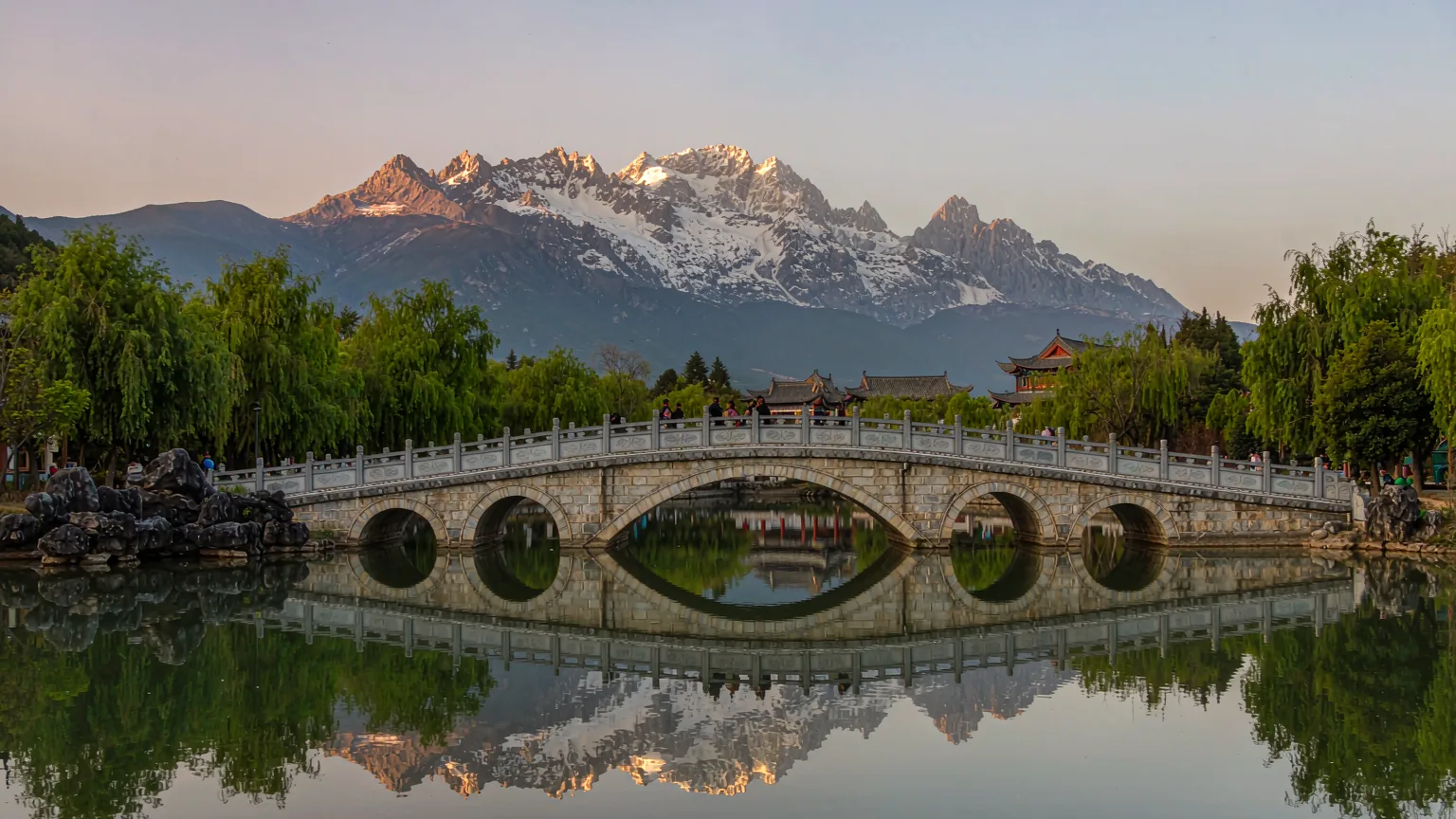
Black Dragon Pool sits at the foot of Elephant Hill at the old town's northern end, free to enter with your Maintenance Fee receipt. It is in fact the source of Lijiang's water: springs well up through the rock, and every channel in town once drew from here. From the stone bridge you get the classic frame, a five-arched bridge, an upturned-eave pavilion and Jade Dragon Snow Mountain all in one shot, the image printed in a thousand picture books.
Whether you catch the reflection is luck: the pool never freezes, but the winter dry season drops the water level until only a thin mirror remains, while the clearest water comes after the rains. The park is sizable; a slow loop of the pool plus the old Dongba research compound on the east side takes over an hour. After half past four the tour groups drain away and locals take their evening strolls, the gentlest hour of the day.
Sifang Street at Night: Firelight and the Circle Dance
Back at Sifang Street you arrive just in time for the night session. After dark a bonfire is lit on the plaza and locals and visitors link hands for the circle dance; the tune runs on a simple two-beat and anyone can join after one lap. Lanterns flicker down the main streets and bar noise drifts over from Xinhua Street, but three steps into any lane north of the Big Stone Bridge, quiet returns.
Plan dinner around Wuyi Street, quieter than Qiyi and dense with small pot restaurants serving pork rib or black goat hotpot; a small pot for two or three runs about RMB 60 per head. Walk back to your guesthouse carefully, watching the open channels in the dark. If Jade Dragon Snow Mountain is tomorrow, be in bed by ten; most cable car tickets are issued for the 7:30 to 9:00 am window.
| Getting around |
|
| Budget | Old Town Maintenance Fee (about RMB 50) plus Mufu (RMB 40), the tower (RMB 35) and two meals: roughly RMB 150-200 pp |
| Best time | Workable year-round, best from Mar-Jun and Sep-Nov; in peak season push Mufu and the tower to the morning to dodge tour groups |
FAQs
Is the RMB 50 Old Town Maintenance Fee mandatory, and what happens if I skip it?
The gates are open, but Mufu Palace, Black Dragon Pool and many guesthouses check the receipt, and most in-town guesthouses simply collect it at check-in. Pay once at the entrance, keep the receipt, and you will use it at least three times in one day.
Mufu Palace was rebuilt after the 1996 quake. Is it still worth the RMB 40 ticket?
Yes. The rebuild follows the original layout closely, the free tour is genuinely good, and the Dongba scripture collection plus the rooftop view are hard to replace. On a tight budget, prioritize the tower, but the full experience is doing both.
Is six stops in one day physically demanding?
Moderate. Expect eight to ten kilometers of walking on stone, with one steep stretch on Lion Hill. Lunch and the pool break up the day, so most travelers manage fine in grippy shoes.
Should I stay inside the Old Town, and how do I handle luggage?
Spend at least one night inside for the empty lanes at dawn and after dark. Cars cannot enter, so arrange for your guesthouse to meet you at the nearest gate, or use the porter carts at the entrances, roughly RMB 20-50 per trip.