
Luoyang's heritage density ranks near the top among Chinese cities: one world heritage site of stone carving, the country's first Buddhist temple, a Xia-dynasty capital site, and the axis of the Tang's divine capital. Three days complete that timeline, from 2000 BC to the Tang, with no repeats.
The rhythm places Longmen south of the city on day one, sends you east to White Horse Temple and Erlitou in Yanshi on day two, and returns downtown for the axis on day three, no backtracking. Each evening holds night views or old-town life; when heritage fatigues, street life resets you.
Itinerary at a glance
| 08:30 | Longmen West Hill: The Morning Summit of Stone |
| 12:30 | East Hill Caves and Xiangshan Temple: The View from Across the River |
| 15:00 | Guanlin: Guan Yu's Head and a Millennium of Incense |
| 18:00 | Luoyi Ancient City: A First Night in Silk |
| 08:30 | White Horse Temple: Day Two's First Incense |
| 13:00 | The Erlitou Museum: The Outline of China's Earliest Dynasty |
| 17:00 | Luoyang Museum: Day Two's Evening Remedial Stop |
| 09:00 | Mingtang, Tiantang and Yingtian Gate: Day Three on the Axis |
| 13:00 | The Royal Chariot Pits: A Last Footnote on Zhou Chariots |
| 15:30 | The Ancient Tombs Museum: Underground Finale |
The route, stop by stop
Longmen West Hill: The Morning Summit of Stone
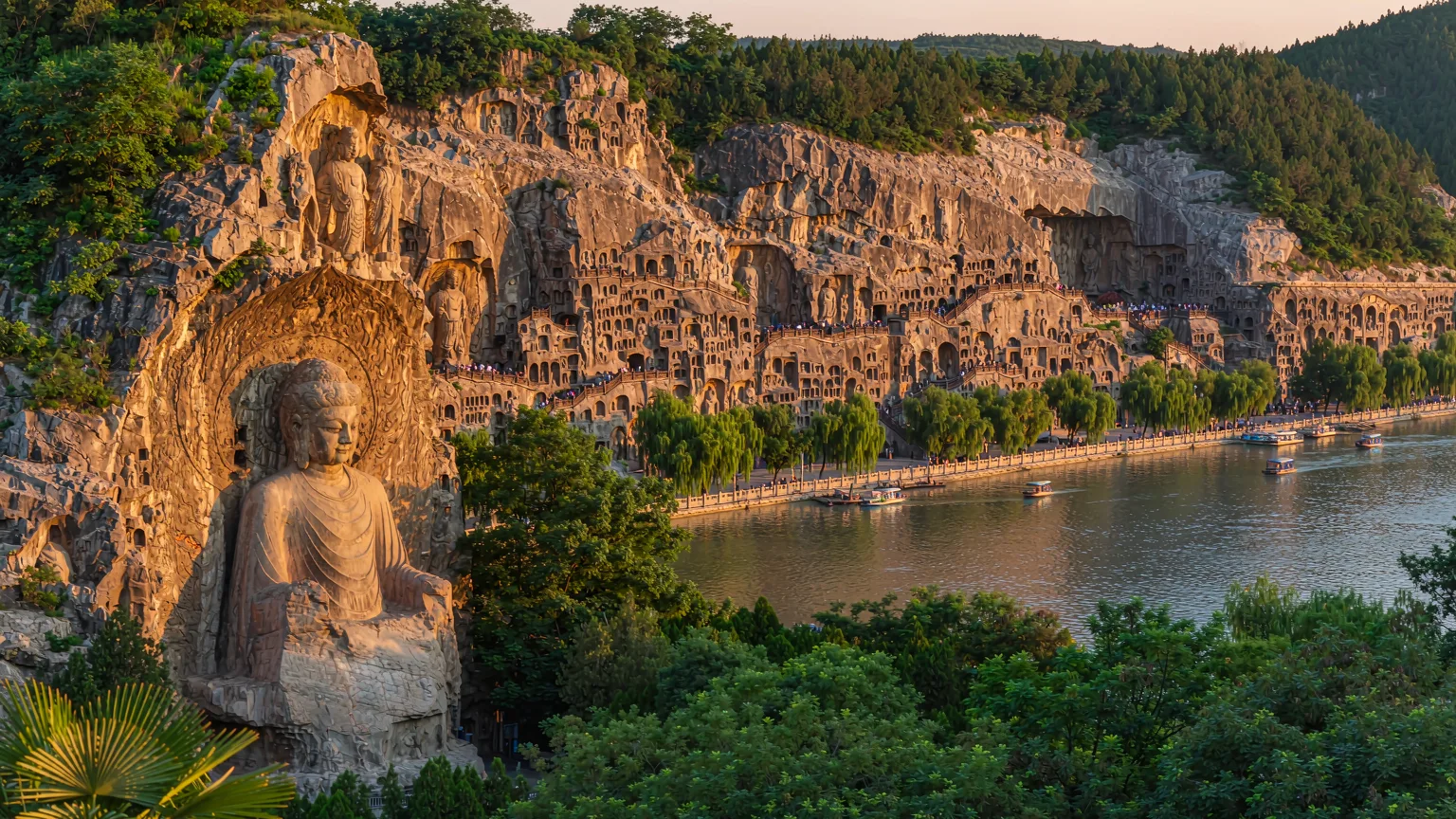
Three days open with the heavyweight. Enter at opening and head up the west hill, finishing Fengxian Temple, the Binyang caves and the Ten Thousand Buddha Cave before tour groups land; morning light gives the Vairocana Buddha its softest face, and the essence of a hundred thousand figures lives on this bank.
The west hill deserves three hours, including easily skipped caves like Guyang and Yaofang, the latter's carved prescriptions a Northern Wei medical archive. When your eyes tire, stop and look across the Yi River, then continue.
East Hill Caves and Xiangshan Temple: The View from Across the River
Cross the bridge to the east hill after noon. Its caves run smaller than the west's, but the angle flips: the riverside path here frames the west cliff in full, the classic Longmen composition, and the luohan figures of Kanjing Temple, with their flowing drapery, deserve a stop of their own.
Southward lie Xiangshan Temple and Bai Garden. The temple once hosted Empress Wu's literary gatherings, and the garden holds the grave of Bai Juyi, the poet who lived here for years and styled himself the Old Man of Xiangshan. Shade is thick and slopes gentle, a merciful cool-down after the morning.
Guanlin: Guan Yu's Head and a Millennium of Incense
Stop at Guanlin on the ride back from Longmen. Tradition holds that Guan Yu's head lies buried here; temples and cypresses date from the Ming, and the forest of ancient trees and steles gives the place its name, lin meaning grove. The front-temple, rear-tomb layout survives intact, with a Qing-era stone lion avenue of real quality.
This is the only Guan Yu burial granted the grove rank, and its incense still burns thick. Students of the Three Kingdoms or folk faith should read the steles and couplets slowly; a fast visitor needs just an hour.
Luoyi Ancient City: A First Night in Silk
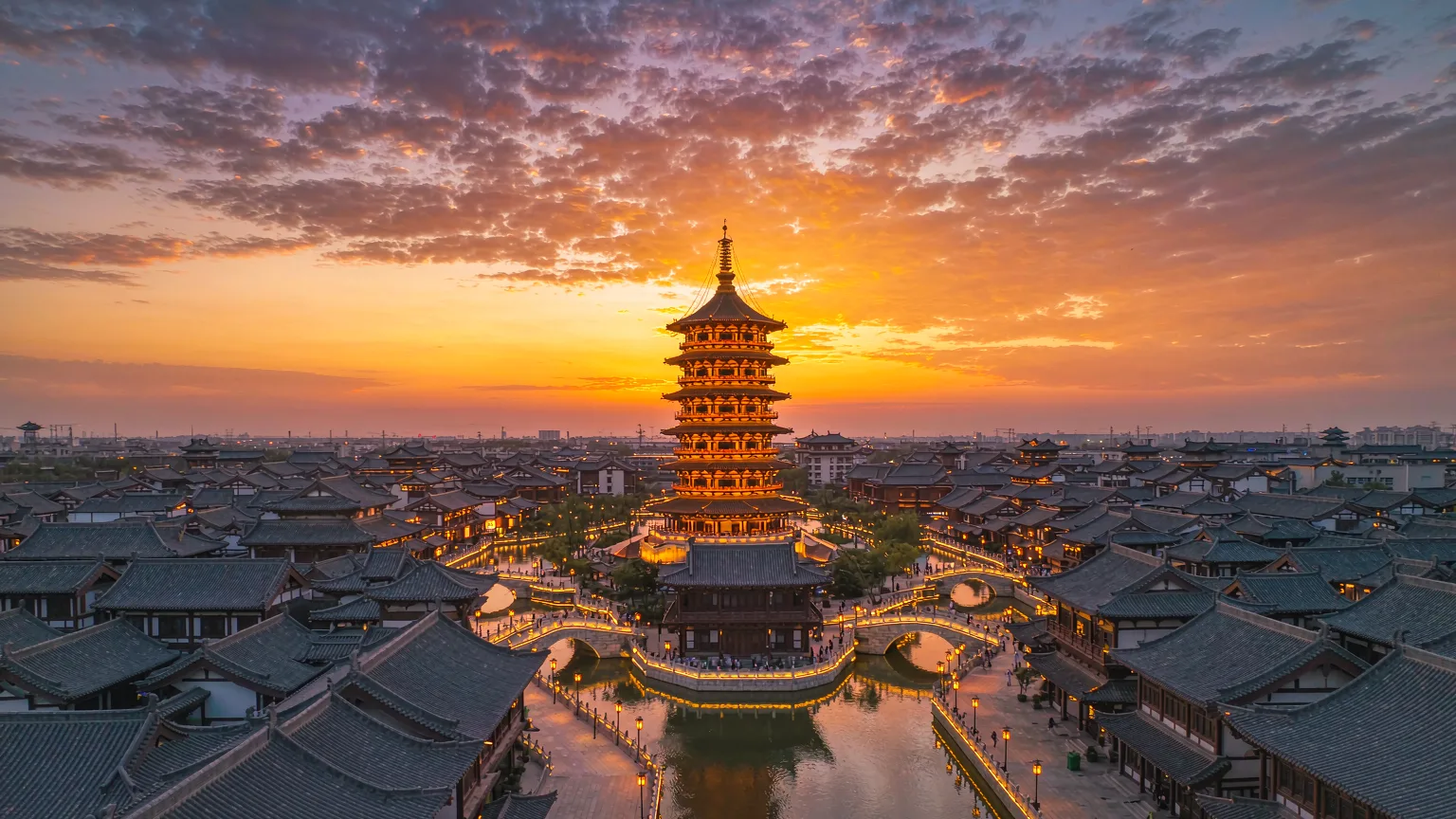
Close day one in Luoyi's night: lantern light on the Wenfeng Pagoda, water in the moat, silk sleeves everywhere, dissolving the day's stone-and-cypress gravity at a stroke. Entry is free with booking, and the craft workshops and food street double as dinner.
With an early start for White Horse Temple tomorrow, do not linger too late: one lap of the pagoda lights, a bowl of bufan soup, then home. Three heritage days burn energy, and sleep is part of the itinerary.
White Horse Temple: Day Two's First Incense
Day two heads east. White Horse Temple, China's first state-built Buddhist monastery, rose in the Eastern Han after the white horse carried the sutras, and its incense has burned two thousand years. At dawn the compound is tour-free, cypresses and bells the best opening.
The international halls on the east side are scenery found nowhere else: Indian, Thai and Burmese temples in a row, Theravada and Mahayana architecture compared inside one monastery. The Qiyun Pagoda east of the main court, a Jin-dynasty dense-eave rebuild, sits in a quiet yard worth a full circle.
The Erlitou Museum: The Outline of China's Earliest Dynasty
From White Horse Temple, about forty minutes southeast to Erlitou in Yanshi. Most scholars tie this site to the middle-late Xia capital of the histories, and the turquoise dragon dominates the galleries: over two thousand turquoise pieces inlaid into a dragon, thirty-seven centuries old.
The museum stands beside the site itself, and after the galleries you can walk the protected fields, putting the idea of the earliest China onto a landscape scale. Even visitors cold to early history leave stunned by the dragon and the vast palace foundations.
Luoyang Museum: Day Two's Evening Remedial Stop
Back downtown by evening, the day closes at the Luoyang Museum, cast as a string-tie: after the Northern Wei carvings at Longmen and the Xia foundations at Erlitou, the galleries supply each era's context, case answers matching morning fieldwork.
The last hour before closing is thinnest; prioritize the Eastern Han stone beast, the Cao Wei jade cup and the tri-color wall. If booking fails, the museum slides naturally to day-three morning; the plan keeps that flex.
Mingtang, Tiantang and Yingtian Gate: Day Three on the Axis
Day three completes the axis downtown. Read the excavation pits and the empress's great hall at the Mingtang, climb the Tiantang for the city axis and the Luo River, with morning light reaching farthest toward the Longmen ridgeline.
Yingtian Gate shares the park combo: climb by day over the pits and old bricks, then watch the night projection turn the gatehouse into a screen. As the line's finale the choice is deliberate: everything seen in three days gains its spatial coordinates on this one axis.
The Royal Chariot Pits: A Last Footnote on Zhou Chariots
After lunch, descend beneath Wangcheng Square for the chariot pits. The Eastern Zhou pit preserves a carriage buried with six horses in place, the sole physical proof of the six-horse royal rule; ten minutes at the rim beats a chapter of ritual history.
Small but heavy, the visit takes an hour with cheap on-site tickets. It also stretches the three-day timeline earlier: Longmen is Northern Wei and Tang, White Horse Eastern Han, Erlitou the Xia, and this the earlier Eastern Zhou. With the pits seen, the dynastic sequence of Luoyang is complete.
The Ancient Tombs Museum: Underground Finale
The three days end at the tombs museum on Mangshan, one of China's few museums built around real tombs, with actual burial chambers from Western Han through Song and Jin relocated and rebuilt so visitors can step inside and read murals and brick carving firsthand.
The underground palace of Emperor Xuanwu's Northern Wei tomb opens in the same grounds. Ending underground sounds grim but feels the opposite: after the daily life painted on tomb walls, stepping back into daylight explains the old saying about being born in Suzhou and buried on Mangshan.
| Getting around |
|
| Budget | Tickets total about RMB 300-380 pp, Longmen 90, White Horse 35, Guanlin 40, the tower combo 120 and more, with three days of meals and city transport near RMB 400-600. |
| Best time | April with the peonies or September-November are best; in festival weeks night sessions and hot museums book tight, so reserve 3-5 days ahead and enter early. |
FAQs
Which stop is safest to cut from three days?
By taste: without the early-dynasty bug, Erlitou costs nearly three hours round trip and compresses best, returning hours to the city museum's galleries; conversely, early-China fans may trim the tombs museum. Longmen, White Horse Temple and the axis are the floor, not worth touching.
Is a separate night for Longmen's night tour worth it?
Yes, especially April to October. The lit Vairocana differs wholly from daylight, with a tier thinner crowds. Compress day three's axis to a half day, catch the night session, then return, or simply overnight near Longmen railway station.
What should I watch for during the April peony festival?
Three things: book rooms early at doubled prices; reserve Longmen and museums three to five days ahead; and start each day early, saving afternoons for flowers at Wangcheng or the Sui-Tang botanical garden. Night sessions add runs in festival weeks, a fine off-peak window for Longmen.
How demanding are the three days physically?
Moderate to high. Longmen alone clears ten thousand steps with many stairs, day two carries the longest rides, and day three is gentler on indoor legs. The fixes: grab the early slot at Longmen, slot low-intensity stops after lunch, and end evenings early. Elevators or cable cars offer alternatives throughout, so check ahead.