
Qingdao is a planned city: in the decade after 1898 the German administration set a city grown from blueprints onto Jiaozhou Bay's east shore. Day one reads the old town's bones and institutional relics, day two runs from the hilltop residence to Badaguan's international villas, and day three jumps to Jimo Old Town for a Jiaodong lineage older than the concession, on the Liuqiang stage.
The trip's keyword is enterable architecture: cathedral, prison museum and Governor's Mansion all open their doors, combined tickets barely a few dozen yuan. The one thing to verify in advance is closing day, with Monday the disaster zone, so slot the old-town architecture day before Monday.
Itinerary at a glance
| Day1 09:00 | Zhanqiao Pier and Qingdao Bay: The Origin Point of the Urban Plan |
| Day1 10:00 | The Cathedral and Zhongshan Road: The Face of a Church City |
| Day1 13:00 | The Former German Prison Museum: The Physical Record of Colonial Justice |
| Day1 15:00 | Signal Hill and the Governor's Mansion: The Geometry of Power on the Hillside |
| Day2 09:00 | The Protestant Church on Jiangsu Road and the Old Town's Church Cluster |
| Day2 11:00 | Lao She's Residence and Huangxian Road: A Page of Literary Qingdao |
| Day2 14:00 | Kang Youwei's Residence and Xiaoyushan: A Scholar's Last Address |
| Day2 16:30 | Badaguan and Huashi House: The International Villas at Dusk |
| Day3 09:00 | On to Jimo: A Day of the Old Town and Liuqiang Opera |
| Day3 14:00 | Liuqiang Opera: The Last Act on the Jiaodong Stage |
The route, stop by stop
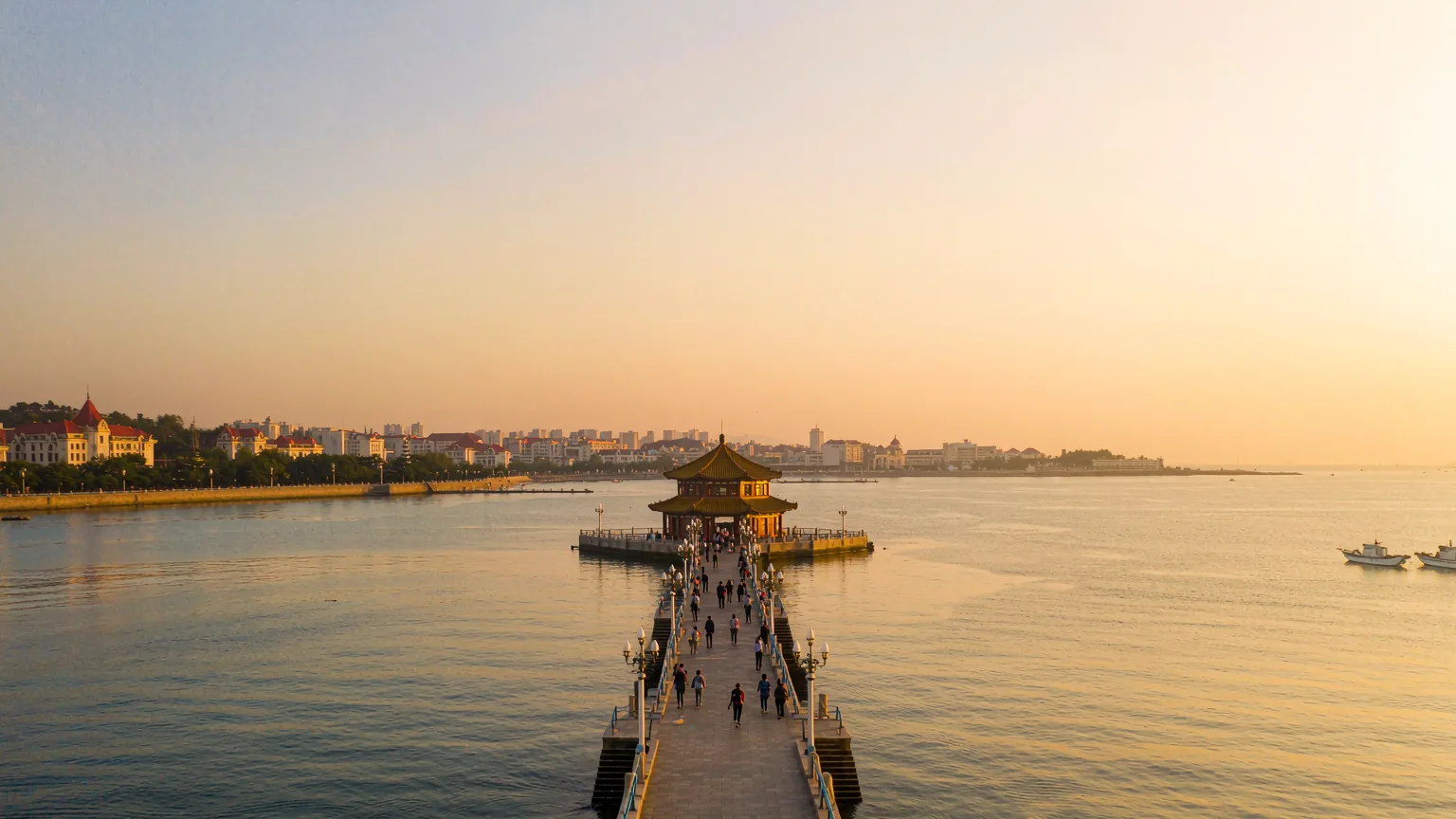
Zhanqiao Pier and Qingdao Bay: The Origin Point of the Urban Plan
Heritage opens at Zhanqiao Pier, the 1892 military jetty where Qingdao began as a city and from whose origin the later urban plan unfolded. From the planks, Qingdao Bay's southern skyline and Tuandao across the water reconstruct the German era's coastal-defense sightlines.
The planks stay quiet early, and Huilan Pavilion's small exhibit, a few yuan, shows old photographs of the port's opening, worth the entry.
The Cathedral and Zhongshan Road: The Face of a Church City
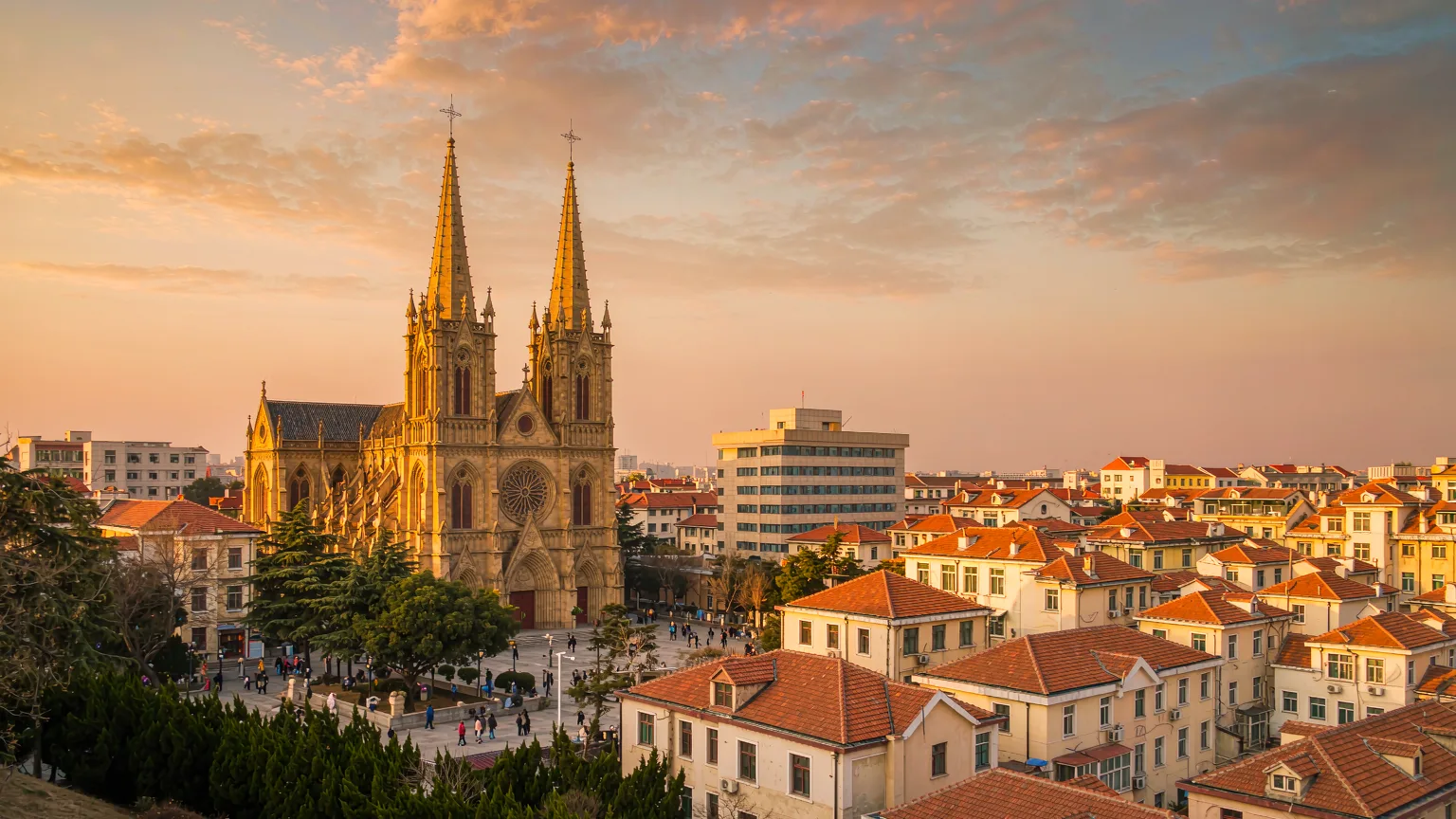
Saint Michael's on Zhejiang Road, finished in 1934, twin towers fifty-six meters, held the old town's height for decades. Enter, about RMB 10, and give ten quiet minutes to the dome murals and the organ; the plaza's angle folds red roofs and sea into one view.
Outside, read commercial heritage down Zhongshan Road, where bank, pharmacy and trading-house facades still show traces of German lettering, the street a complete slice of colonial commerce.
The Former German Prison Museum: The Physical Record of Colonial Justice
After lunch, the former German prison on Changzhou Road, built in 1900 as a castle-like block, stands among the nation's best-preserved colonial judicial buildings. The dim underground water cell and punishment rooms run a dated route through the German and Japanese occupations, wall carvings the most silent testimony.
An hour covers it; decompress afterward around Jiangsu Road, the hillside streetscape itself a stage set.
Signal Hill and the Governor's Mansion: The Geometry of Power on the Hillside
Climb Signal Hill in the afternoon, the revolving deck turning you through the German-era plan: the twin spires, the mansion's red roof and the bay in one legible relation, the most direct place to grasp that Qingdao was designed.
Descend to the Governor's Mansion museum, the 1907 residence keeping its interiors whole, granite facade, painted ceilings and period furniture interleaved, entry about RMB 20.
The Protestant Church on Jiangsu Road and the Old Town's Church Cluster
Day two's architecture line opens at the Protestant church on Jiangsu Road, famed for its green copper spire and clock tower, the century-old mechanical clock still keeping time. Enter for the timber roof and stained glass, the hillside angle calm.
Take in the neighboring building group on the way: the former Governor's Hall facade and the old post office tower, most now in institutional use, exteriors free, interiors by posted rules.
Lao She's Residence and Huangxian Road: A Page of Literary Qingdao
The morning's second stop is Huangxian Road, where Lao She finished Camel Xiangzi in a rented house in 1936. The free residence drops literary history to the scale of one room, manuscripts and a restored study, the courtyard tree witness to all of it.
Afterward take a coffee at the Daxue Road corner, red tile and yellow wall footnoting this literary chapter themselves.
Kang Youwei's Residence and Xiaoyushan: A Scholar's Last Address
The afternoon reaches Kang Youwei's residence on Fushan Branch Road, the late-Qing reformer who bought his last home in Qingdao, the free museum showing his life and manuscripts amid one of the densest samples of international-style villas.
Climb Xiaoyushan park, a few yuan, where the wave-viewing pavilion stacks old town, spires, bay and red roofs into one panorama, the three days' finest single frame.
Badaguan and Huashi House: The International Villas at Dusk
Dusk enters Badaguan, eight avenues each under different street trees, over a hundred international-style villas behind them. The hour turns gentlest as visitors drain and petals or leaves pave the lanes; climb Huashi House, about RMB 10, for the Number Two beach below.
Day two closes on the villa district's quiet, dinner at an old-house restaurant around Taipingjiao, many housed inside heritage buildings.
On to Jimo: A Day of the Old Town and Liuqiang Opera
Day three leaves downtown for Jimo Old Town, rebuilt on its original site and keeping the walled city's layout, the scale of yamen, Confucian temple and gates intact, with snacks and craft shops threading the blocks. Jimo ranks among the Jiaodong peninsula's oldest towns, its upright-magistrate tales two millennia before German Qingdao.
Entry is free with a few ticketed halls; walk gates and yamen in the morning, lunch on Jimo snacks inside the walls.
Liuqiang Opera: The Last Act on the Jiaodong Stage
The afternoon's centerpiece is Liuqiang, the local opera of Jimo and Qingdao's counties, a national intangible heritage sung in dialect and famous for tear-jerking mournful modes. Performances run irregularly at the old town's stage and city theaters, so check schedules ahead; failing a full show, excerpt performances sometimes pop up in the town.
Return to downtown after the show, three heritage days having opened with German architecture and closed on a settlement two millennia older, the historical depth maxed out.
| Getting around |
|
| Budget | Cathedral about RMB 10, prison museum about RMB 25, mansion about RMB 20, Signal Hill about RMB 5, Jimo Old Town free to enter; three days run about RMB 350-600 pp. |
| Best time | Apr-Jun and Sep-Oct are kindest; facades work all seasons, while Monday closures make the day worth dodging. |
FAQs
Are most of Qingdao's old buildings enterable?
The core handful all open: cathedral, prison museum, Governor's Mansion and residence museums, combined tickets a few dozen yuan; offices and military sites show exteriors only. Budget forty-five minutes each including queues and photos.
Which stops need advance booking across three days?
For the free venues: dodge Mondays at the Lao She and Kang Youwei residences, the rest generally walk in; ticketed buildings sell at the door. The real booking is the opera: Liuqiang schedules run tight, so fix day three's date after checking the calendar.
Does the route hold if modern history is not my thing?
Yes, walk it as architecture and streetscape: church windows, villa facades, the old town's slopes and corners forming a world of their own. Badaguan and Signal Hill work as viewpoints regardless of history, and Jimo reads as a quiet northern town, complete either way.
Is Jimo worth an hour's travel, or just a faux-antique mall?
It is a rebuilt old town, and the faux-antique part should be said plainly; but the walled layout and the yamen and temple scale follow the original system, and living content like Liuqiang adds a cultural layer beyond a mere commercial street. Skip it on tight schedules; with slack, it makes a fair half day.