
Qingyang's first lesson should begin in a grotto. Carved in the Northern Wei dynasty, the North Grotto Temple ranks with Maijishan and Binglingsi among Gansu's four great cave complexes, and Cave 165's seven colossal Buddhas, the most complete surviving Northern Wei seven-Buddha set, are simply staggering in scale. It hides quietly below Fuzhong Hill where the Pu and Ru rivers meet, with far fewer visitors than the Hexi Corridor caves and a better viewing experience because of it.
The day pairs solid and soft: the real thing in the caves all morning, then the historical frame at the Qingyang City Museum in the afternoon, linking Longdong's threads from Zhou ancestors' farming to Buddhist grottoes. The drive from downtown takes about an hour, the round trip is easy, and the budget stays near 200 CNY.
Itinerary at a glance
| 08:30 | North Grotto Temple: The Northern Wei Seven Buddhas of Cave 165 |
| 11:30 | Outside the Temple: Fuzhong Hill and the Pu River Valley |
| 13:30 | Lunch on the Way Back: A Bowl of Helao Noodles |
| 15:00 | Qingyang City Museum: Footnotes for the Morning |
| 17:30 | Evening Wind-Down: A Cup of Yellow Rice Wine in Xifeng |
The route, stop by stop
North Grotto Temple: The Northern Wei Seven Buddhas of Cave 165
Cave 165 is the heart of the complex: seven standing Buddhas up to eight meters tall, straight-shouldered and full-faced in classic early Northern Wei style, with attendant bodhisattvas whose drapery clings like wet cloth. Standing inside and looking up, you see carvers fifteen centuries ago turning a whole cliff face into a theater of faith.
Beyond Cave 165, niches from the Northern Wei through the Tang and Song line the cliff, with Cave 240's bodhisattvas and inscriptions of many eras worth visiting one by one. The cliff faces the river valley, and morning light rakes the Buddha's faces so the detail reads sharpest. Tickets run 40 to 50 CNY, and a guide is truly worth hiring; the dating stories do not reveal themselves to untrained eyes.
Outside the Temple: Fuzhong Hill and the Pu River Valley
Do not rush off after the caves; the setting is part of the exhibit. Fuzhong Hill resembles an upturned bell, and before the cliff opens the broad Pu River valley, the back-to-hill, facing-water siting that drew the original monks. Walk the riverside path ten minutes, look back at the whole cliff, and the carvers' choice makes sense.
In spring, apricot and mountain peach bloom line both banks; autumn lays down a layer of gold. Commercial facilities are nearly absent, and that quiet is the biggest difference between this site and the famous caves, also its most luxurious quality.
Lunch on the Way Back: A Bowl of Helao Noodles
Handle lunch on the return or right after arriving, and the first choice is helao noodles: pressed round strands under lamb-sauce broth, with chili oil and pickled garlic, ten to fifteen CNY a bowl. Longdong treats helao as the staple of weddings and funerals alike, and the neighborhood shops generally deliver.
For more, add a Longdong cold plate or scrambled eggs with chives. Stop at seventy percent full; the museum means two hours on your feet, and an overloaded stomach invites a nap.
Qingyang City Museum: Footnotes for the Morning
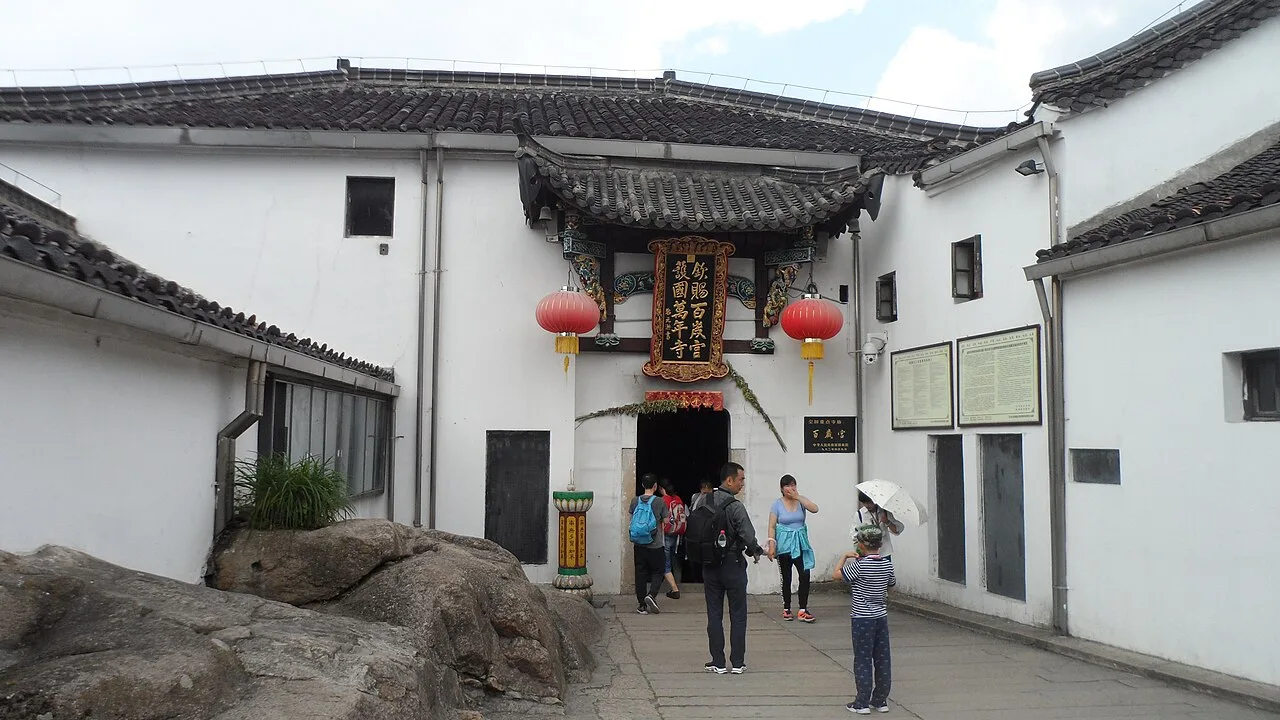
The museum is free, with permanent exhibits running from prehistoric sites through the Zhou ancestors' farming to the Qin direct road and Buddhist grottoes. The Northern Wei statuary you saw at Cave 165 gains dating references here, and as one cradle of Zhou agriculture, where the rise of the Zhou way is said to have begun, Longdong's unearthed pottery and farm tools turn textbook history into objects.
Focus on three halls: prehistoric pottery and jade, the Zhou farming culture exhibit, and the stone sculpture gallery, which answers the morning's caves perfectly. Two attentive hours suffice, and leave time for the souvenir stamp at the service desk.
Evening Wind-Down: A Cup of Yellow Rice Wine in Xifeng
By evening, back in Xifeng's streets, find an old restaurant before dinner. Longdong yellow rice wine, brewed from glutinous millet, turns sweet and gently warming when served hot, paired with a cold crowned-daisy salad or fried dough twists, the local way to end a day. The alcohol is low but lingers, so sip slowly.
Dinner might be an earthen hot pot or clear-broth lamb, forty to sixty CNY per person. Walk the main streets afterwards to digest; between Northern Wei Buddhas, Zhou fields and a cup of rice wine, the day has given Qingyang real depth.
| Getting around |
|
| Budget | About 150 to 250 CNY per person excluding hotels: North Grotto Temple 40 to 50 CNY, museum free, food 50 to 80 per day |
| Best time | April to October brings the best roads and light; the caves run cold in winter, so layer up |
FAQs
Is North Grotto Temple worth the dedicated trip?
Very much so. Seven eight-meter Northern Wei Buddhas have few equals nationally, and the thin crowds make the viewing experience far better than the famous caves.
Why does Cave 165 matter?
It is the most complete surviving Northern Wei seven-Buddha cave in China, exceptional in both scale and condition; the seven-Buddha program carries early Northern Wei belief in sequence, with high scholarly and visual value.
Can elderly parents manage this in one day?
Yes. Slow the pace at the caves, use the museum's elevators and benches, and chartering removes waiting; total walking can stay under ten thousand steps.
Won't the caves be too cold in winter?
The caves feel colder than outside, so add a layer; winter brings almost no visitors, and low-angle light on the cliff makes an alternative photography window.