
Shantou's countryside is an omnibus of emigrant and maritime history: Qianmei village in Chenghai holds a Sino-Western mansion of hundreds of rooms, and Zhanglin port in Dongli was the mother harbor of the red-bow ships whose fleets sailed for Southeast Asia centuries ago; the walled town of Dahao in Haojiang plus Lotus Peak and Lingshan Temple in Chaoyang complete the lines of sea defense, loyalty and faith.
Transport is the main variable: sights spread across Chenghai, Haojiang and Chaoyang directions, public connections eat time, so charter or self-drive is the honest answer. Each day is built as one headliner plus two en-route stops, driving kept under two hours daily.
Itinerary at a glance
| 09:30 | The Chen Cihong Mansion at Qianmei: Lingnan's Foremost Emigrant Estate |
| 14:00 | Zhanglin Ancient Port: Mother Harbor of the Red-Bow Ships |
| 16:00 | Xinxing Street: A Commercial Specimen in the Warehouses |
| 09:30 | Dahao Walled Town: A Pocket City in the Morning |
| 14:00 | Lotus Peak: The Sea Wen Tianxiang Watched |
| 17:30 | Haimen Fishing Port: The Quay at Hauling Time |
| 09:30 | Lingshan Temple: A Tang Morning |
| 14:00 | Zhongshan Park: Green Shade to Digest the Road Home |
| 16:30 | The Promenade and Xiaogongyuan: A City Coda for the Countryside Days |
The route, stop by stop
The Chen Cihong Mansion at Qianmei: Lingnan's Foremost Emigrant Estate
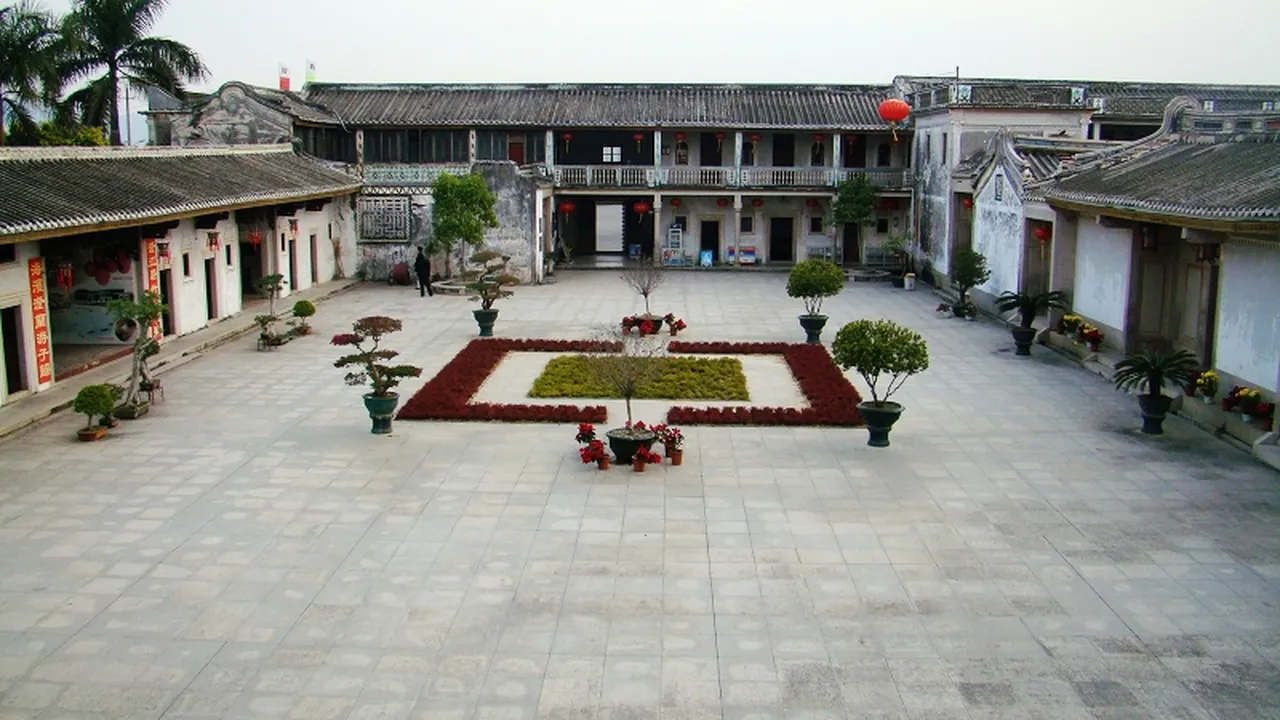
An hour north of the city lies Qianmei in Chenghai. The Chen Cihong family were rice magnates of Thailand, and the mansion complex builds on the Chaoshan four-horses-dragging-a-carriage plan, laced with Nanyang tiles, Western columns and louvers, hundreds of halls and rooms in a maze, hailed as Lingnan's foremost emigrant estate.
The trick is contrast: Chaoshan gilt carving beside Italian ceramic tile, Chinese lime relief beside Nanyang latticed windows, every courtyard a negotiation between two cultures. Allow two hours minimum in flat shoes, since floor tiles and thresholds run uneven.
Zhanglin Ancient Port: Mother Harbor of the Red-Bow Ships
After lunch reach Zhanglin in Dongli town. In Qing times this ranked as eastern Guangdong's greatest port, red-bow ships loading emigrants and cargo for Southeast Asia, the phrase red-bow ship still the spiritual emblem of Chaoshan venture. The harbor's channel and Tianhou temple survive, steles recording former bustle.
The site is compact, its real work imaginative: stand at the channel and swap today's quiet for a thousand sails launching. Ship models and route charts in the exhibition hall tell it clearly, half an hour of reading beating two of drifting.
Xinxing Street: A Commercial Specimen in the Warehouses
Next to the port, Xinxing Street was its commercial annex: warehouse shops lining the route, narrow-fronted and deep, goods flowing from quay straight to store. Walking it, the shape of a Qing logistics system stands nearly intact.
Details carry the visit: merchant names on lintels, heavy timber doors with slides, courtyard scales. Most warehouses still work; move quietly, pocket the camera, and a word with the keepers outweighs any shot.
Dahao Walled Town: A Pocket City in the Morning
Day two opens in Haojiang at Dahao. The Kangxi-era town is astonishingly small, walls enclosing a few blocks, two circuits in half an hour, yet gate, walls and lane fabric survive whole with daily life continuing, a standing specimen of a Qing coastal sentry town.
Morning light runs clean through the gate arches, and tea seats by the wall root are already open. Temples and old shops sit en route, and the heritage fish-ball houses nearby settle lunch before you ask.
Lotus Peak: The Sea Wen Tianxiang Watched
Afternoon heads south to Lotus Peak at Haimen town in Chaoyang. A seaside boulder splits into petals like a lotus, and legend holds that Wen Tianxiang of the Southern Song climbed it scanning for the emperor's fleet, his carved characters still on the stone. The site spreads along the coast, reef, boardwalk and stone peaks the most photogenic ensemble on the Haimen shore.
The appeal is history laid over geology: one rock as landform, martyr memory and viewing platform at once. Afternoon light maximizes the contrast of sea and stone petals, the boardwalk circuit about an hour.
Haimen Fishing Port: The Quay at Hauling Time
Right below Lotus Peak lies the Haimen fishing port, boats returning after five and the sorting of the catch the liveliest scene of the day. Haimen is Chaoyang's fishing stronghold, hairtail, mackerel and squid landing by basket, women grading the catch in circles much as they have for decades.
Dinner goes to a quay-side stall: landed that morning, poached or steamed, the honest test of freshness. Walk the dike afterward, fishing lamps and the lighthouse wavering on the water, then turn in early, since Lingshan Temple wants a morning start.
Lingshan Temple: A Tang Morning
Day three opens at Lingshan Temple in Tongyu town, Chaoyang. Founded in the Tang Zhenyuan era, it ranks among Lingnan's great monasteries, the Tang-era stupa of Master Dadian surviving in the grounds, a millennium of incense set in quiet wooded surroundings.
The temple is best at dawn: chanting, incense and birdsong in rotation. An hour covers it; courtyards between halls invite sitting, and even the faithless can treat it as a first-rate forest walk.
Zhongshan Park: Green Shade to Digest the Road Home
Back in town, give the afternoon to Zhongshan Park. The nineteen-twenties park sets lake, jade-belt bridge and old banyans as its scene, tree shade gently digesting three days of driving and walking.
Local life runs dense: chess tables, opera amateurs, caged birds each holding a corner. Buy an herbal tea, sit lakeside, and file the mansion, port, walled town and temple in your head, the city's murmur pitched just right.
The Promenade and Xiaogongyuan: A City Coda for the Countryside Days
Close on the promenade and the treaty quarter. Evening reopens the inner bay, Queshi's silhouette and ferry lights completing the trip's final of three sunsets. Half an hour's walk reaches Xiaogongyuan as the pavilion's lamps come on and the arcade quarter enters night mode.
The quarter is the right seal for three rural days: from mansion to ancient port to walled town, back at last to the harbor where everything departed. Eat a proper oyster omelette and zongzi at a heritage house by the pavilion, closing the geographic and gustatory threads in one stomach.
| Getting around |
|
| Budget | Entries over three days total RMB 100-150; cross-district travel runs on charter or taxi, RMB 500-800 pp before lodging. |
| Best time | October to December is kindest; the ancient port and fishing villages ignore seasons, while Lingshan rewards avoiding the lunar new-moon and full-moon incense peaks. |
FAQs
Is the Chen Cihong mansion worth a dedicated hour's drive?
Yes, it is the top-tier surviving work of Chaoshan emigrant architecture, nationally ranked in finish and scale. For the architecture-agnostic, pair it with Zhanglin in one day: mansion and harbor tell the same emigration story from two ends, en route and mutually explaining.
Does the plan suit self-driving? How are the roads?
It suits, running mainly on national and provincial roads in good condition; the difficulty is narrow town roads and average parking, tight on weekends at Qianmei and Zhanglin gates though available. Navigation drifts occasionally in townships, so confirm the final stretch with local shops before entering villages.
What etiquette applies at temples like Lingshan?
Step over thresholds, keep voices down, skip photos inside halls; incense and donation boxes are voluntary. Cover shoulders and knees, mind children's hands, and never touch woodcarving or stupa surfaces. Lunar new and full moons plus Buddha's birthday crowd the halls, avoid those dates for quiet.
How should meals be planned across three days for authenticity?
Eat by place: fish balls and horseshoe cake in Dahao, day-boat seafood at Haimen, goose and rice noodles in Tongyu and Chenghai, night congee back in town. Many township shops trade lunch only, so anchoring proper meals at noon and eating light back in town is the schedule least likely to miss.