
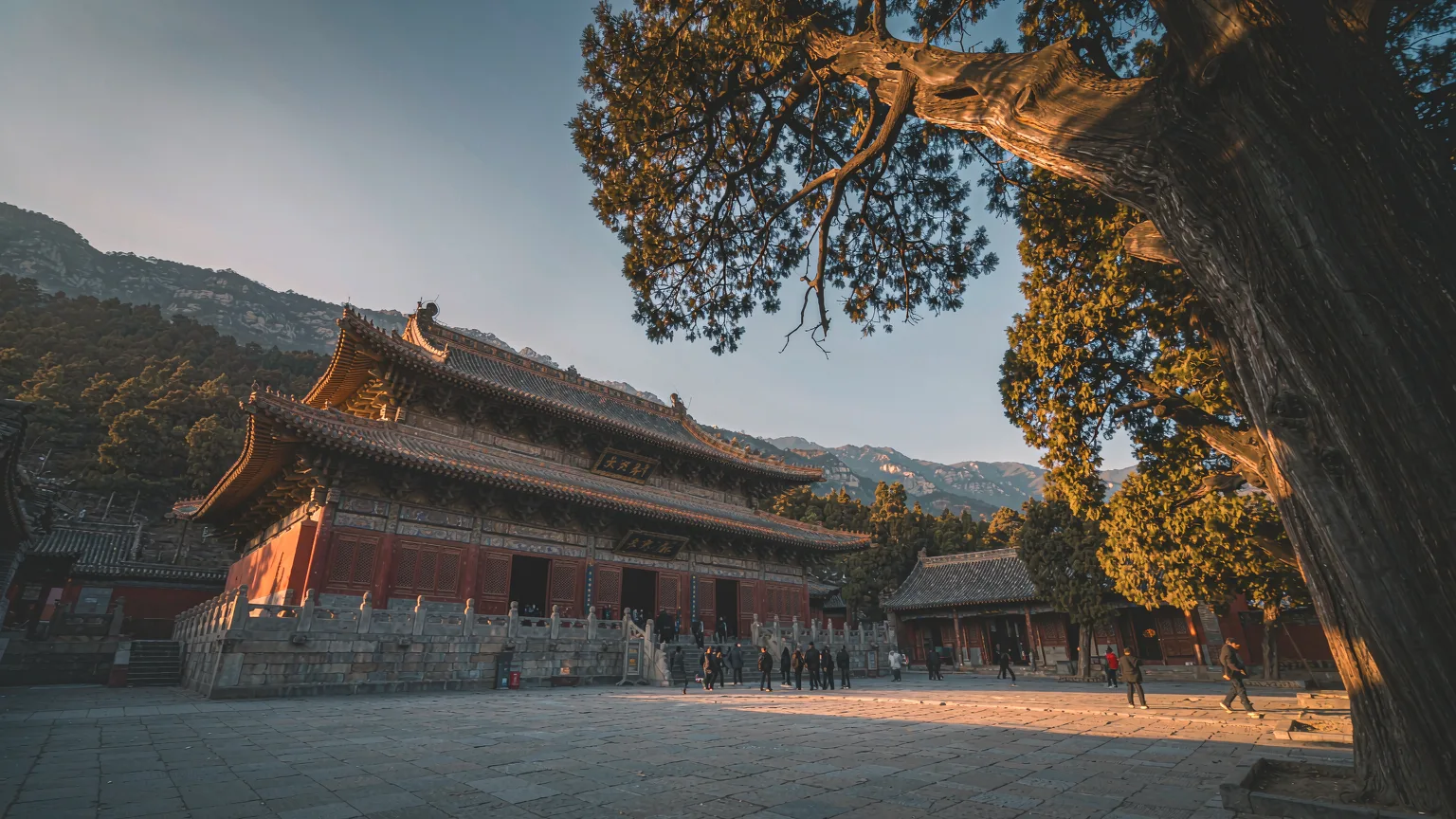
Half of Mount Tai's culture lives at its foot. Imperial rites left Dai Temple a corridor of steles, from Li Si's Qin-era seal-script remnant to towering Tang and Song stones, time queued in rock; the folk side carved the Shi Gandang belief into door lintels and carried shadow puppets, paper cutting and handed-down crafts into town. This route walks both strands, official and vernacular.
Four stops, all in the city, all reached by bus or cab. Give Dai Temple a full two hours, an hour or so to each afternoon venue, and finish by dusk, in time for the Old Street dinner.
Itinerary at a glance
| 09:00 | Dai Temple: Reading the Steles as a General History |
| 11:00 | Taishan Shigandang Museum: How a Stone Became a Belief |
| 14:30 | Tai'an Intangible Heritage Studio: Watching the Craft Live |
| 16:30 | Tai'an Art Museum: A Contemporary Footnote to Mountain and City |
The route, stop by stop
Dai Temple: Reading the Steles as a General History
Reading Dai Temple as a stele gallery is the connoisseur's route: the Qin Mount Tai stone, a surviving remnant in Li Si's hand, slender and taut, stands as near-unique evidence of Qin standard script; the Han stelae of Zhang Qian and Heng Fang rest under the colonnades, where clerical script's turn from square to round can be traced at a glance. Even without calligraphy, the interpretive panels tell each stone's full story.
Beyond the stones, one look at the Song mural in Tiankuang Hall and the bronze pavilion and iron pagoda completes the temple's skeleton. The side courtyards flanking the axis stay hushed and suit a slower pace; two hours covers both the spine and the branches.
Taishan Shigandang Museum: How a Stone Became a Belief
A Shi Gandang is a small stone slab carved with the words Taishan Shigandang, set at street corners to guard households from harm, a folk belief that spread from Mount Tai across the country and overseas Chinatowns. The museum tells it cleanly: Ming and Qing stones, regional typologies side by side, even the hero's shadow-puppet incarnation.
The most moving discovery is often scale: a palm-sized rock carrying ordinary people's plainest wish for safety. The gift counter sells small Shi Gandang ornaments from a few tens of yuan, far sturdier than the gate-side trinkets.

Tai'an Intangible Heritage Studio: Watching the Craft Live
The studio's worth hides in its name, transmission and practice: bearers of paper cutting, dough figurines and shadow-puppet carving keep regular hours here, and visitors watch scissors wander through paper and dough fold into a robe's pleats. Unlike museum glass, this is the craft happening in real time.
Most programs run paid mini-classes; forty minutes of paper cutting leaves with your own piece, and the puppet-coloring session is the children's favorite. Even learning nothing, a few words with the bearers about old Tai'an is the softest reward on this line.
Tai'an Art Museum: A Contemporary Footnote to Mountain and City
The art museum closes the culture line, its permanent and rotating shows centered on Shandong artists, with Mount Tai an unavoidable subject: some paint its cloud seas, others the city at its foot, and viewing them after the real mountain makes a pleasing echo. The halls are compact, an hour suffices.
This is also the quietest stop, nearly empty after four. Step out into dusk, find a dinner table along the way, and digest the day's stones and crafts over the meal.
| Getting around |
|
| Budget | Dai Temple about RMB 20 with the rest free or low-priced; the day runs roughly RMB 50-120 pp. |
| Best time | Year-round; weekday mornings are emptiest, though some venues close Mondays, so check ahead. |
FAQs
Does this culture line suit children?
Yes, the two afternoon venues especially: the studio's paper-cutting and puppet-coloring classes get hands busy, and the Shi Gandang museum tells stories. Dai Temple runs dry for kids, so cap it at ninety minutes and save the reward for the afternoon; the pace holds their attention.
Do the venues need booking or tickets?
Only Dai Temple charges, about RMB 20, buyable on site or booked online; the other three are free, with the art museum and studio requiring ID registration, and groups plus classes worth a call ahead. Crowds rise on holidays, so the opening hour stays calmest.
How much do Monday closures matter, and how to adjust?
The art museum and some venues close Mondays, while Dai Temple and the Old Street do not. On a Monday, deepen the temple visit, add a stroll along Tongtian Street and Hongmen Road, and shift museum stops to the next day; the culture content loses nothing.
Is two hours at Dai Temple worth it for someone who knows nothing about calligraphy?
Yes. The steles are more than script: the Qin stone carries the story of standardized writing, the Han stelae's subjects open a window into Han officialdom, and panels plus audio guides fill every gap. Split the two hours into one of stones and one of murals and architecture, and even a newcomer stays engaged.