
Mount Tai's culture tells two stories: the imperial one, rites reported to heaven with Dai Temple as headquarters, and the folk one, Shi Gandang guardians, puppet stages and living crafts in ordinary lanes. Three days cover both, heritage and craft by daylight, performances at night, strain and ease in balance.
The skeleton is three shows and four venues: shadow puppetry short and sharp, the Fengshan Ceremony a heavyweight open-air production, and the railway-guerrilla drama built as immersion. All shows need advance tickets and season dates sell tight, so book first.
Itinerary at a glance
| 第一天 09:00 | Dai Temple's Tiankuang Hall: A Song Mural at Imperial Rank |
| 第一天 11:00 | The Han Cypress Courtyard: A Timeline Cut in Stone |
| 第一天 14:00 | Taishan Shigandang Museum: Switching from Emperors to the Folk |
| 第一天 16:00 | Taishan Intangible Heritage Center: Gathering the Day's Threads |
| 第二天 09:30 | Tai'an Intangible Heritage Studio: Turning Watching into Doing |
| 第二天 13:30 | Taishan Shadow Puppetry: Learn at Noon, Watch in the Afternoon |
| 第二天 19:30 | The Fengshan Grand Ceremony: The Day's History Staged Live |
| 第三天 09:30 | Chunqiu Ancient Town: A Heritage-Style Walking Street |
| 第三天 13:30 | The Taishan Fenghuo Railway Guerrilla Show: An Immersive Finale |
The route, stop by stop
Dai Temple's Tiankuang Hall: A Song Mural at Imperial Rank
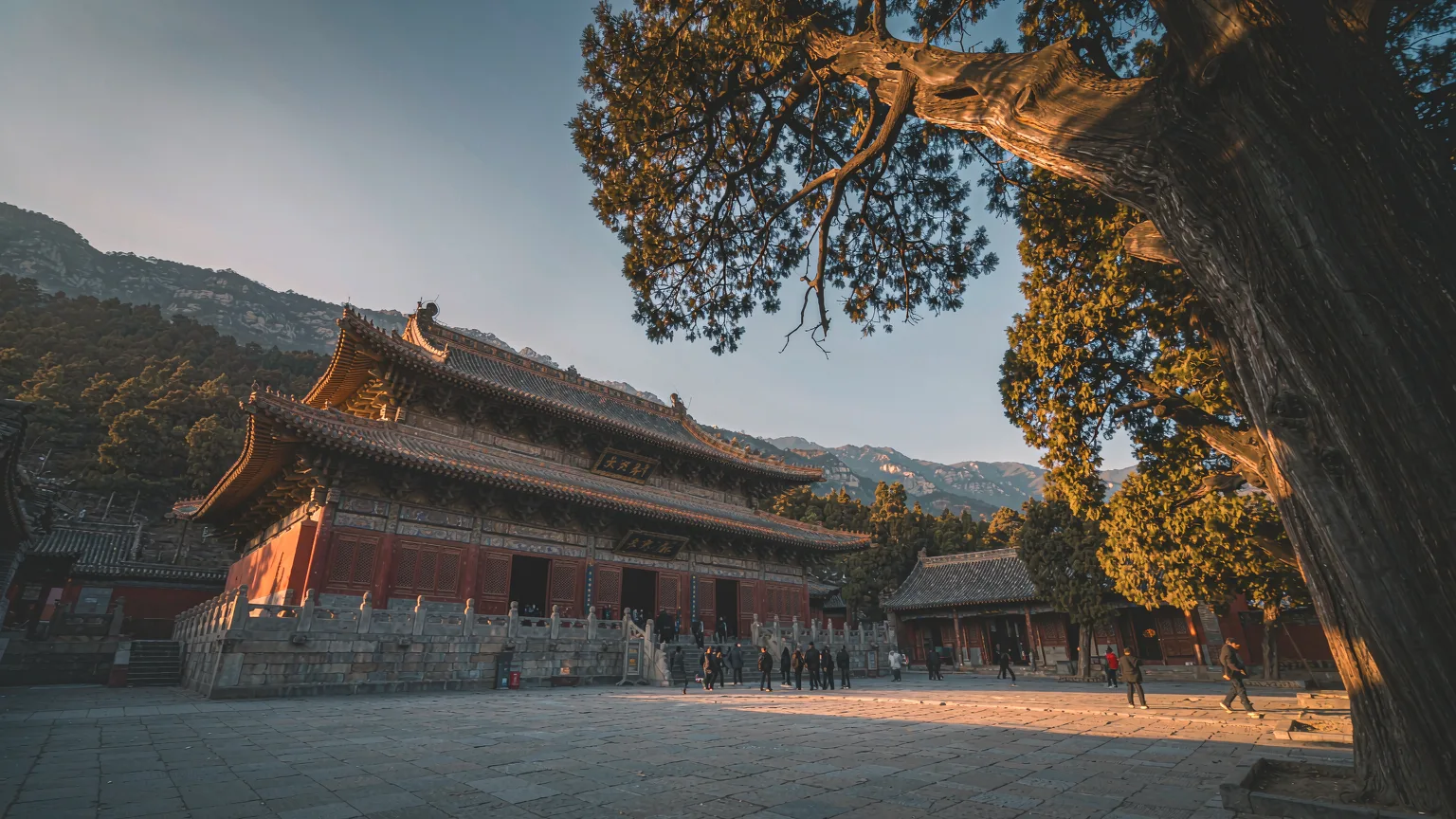
The heritage days start at the temple's core. Tiankuang Hall, a Song-dynasty palace-style building, holds the Procession of the Mount Tai God, more than six hundred figures marching across the walls in ranks of armor, banners and carriages, the visual gateway to understanding the imperial rites.
The broad terrace before the hall and the flanking stele pavilions explain the emperor-mountain bond plainly. Spend ten minutes on the architecture first, then the mural; reverse the order and you see spectacle but miss the system.
The Han Cypress Courtyard: A Timeline Cut in Stone
Enter the Han cypress courtyard east of the hall, trees first, stones second: the cypresses attributed to Emperor Wu have lived two thousand years, trunks coiled like dragons, while the courtyard and east galleries line up steles from the remnant Qin Mount Tai stone through Ming and Qing, Li Si's seal script, Han clerical and Tang regular script along one route, an open-air timeline of calligraphy.
Even non-specialists read them with pleasure: each stone's cracks and re-carvings recount its own biography of lightning, relocation and war, all written in the broken faces. Give this stop fifty minutes and study the Qin stone and two Han stelae closely.
Taishan Shigandang Museum: Switching from Emperors to the Folk
The afternoon's first stop flips the narrative: the morning showed emperors sacrificing to the mountain, this shows ordinary people asking a stone for safety. The Shi Gandang belief born at Mount Tai spread through villages nationwide and overseas streets, and the museum's old stelae, rubbings and regional comparisons trace that route plainly.
The exhibition is compact, an hour enough. Focus on the surviving Ming-Qing stones and gazetteer excerpts to read how the idea of guarding a home shifted across eras, a timeline longer than the show itself.
Taishan Intangible Heritage Center: Gathering the Day's Threads
The center gathers the region's heritage programs in one display, paper cutting, dough figures, shadow puppetry, rubbing and local opera costume, a trailer for the next two days. Objects plus video, under an hour of route.
It works as a map: afterward you know which craft deserves depth, and you aim tomorrow's studio class accordingly. Browse the center's design corner now to benchmark prices against the later venues.
Tai'an Intangible Heritage Studio: Turning Watching into Doing
Day two pivots from watching to doing. Bearers keep studio hours here, with classes in paper cutting, dough figures and puppet carving: forty minutes of cutting yields a finished piece, dough shapes a Taishan doll to carry home, and puppet coloring, the favorite, produces a figure to match against tonight's performance.
Classes run short; pick one or two, since piling on turns depth into a blur. Chatting with the bearers teaches more than the handwork, their lineages holding the ups and downs of Tai'an crafts across decades.
Taishan Shadow Puppetry: Learn at Noon, Watch in the Afternoon
The afternoon's full show sits on another level from the center's excerpts: fifty-odd minutes of complete drama, the ten-in-one feat of one performer driving figures, percussion and narration at once, the clapper-talk rhythm in the singing a pleasure only live.
Having colored a puppet at noon, you will watch the joints and rod positions with new eyes, the itinerary's small design trick. Stay for the backstage visit after the curtain: the donkey-hide texture demands proximity.
The Fengshan Grand Ceremony: The Day's History Staged Live
The evening ceremony is the line's climax: staged in an open-air theater at the mountain's foot along the real landscape, it traces emperors' rites through dynasties, hundreds of performers, machinery and light turning the morning's steles and murals into living spectacle, the First Emperor's columns, Emperor Wu's retinue, the Tang and Song plenitude advancing scene by scene.
Coming after Dai Temple transforms the experience: the mural's static procession moves across the mountain projection, and stored knowledge converts directly into viewing pleasure. About eighty minutes total, with cabs back to town in twenty.
Chunqiu Ancient Town: A Heritage-Style Walking Street
Day three slows down with half a day at Chunqiu Ancient Town. The restored complex runs a Spring-and-Autumn theme of folk display and market life, opera stage, workshops and snack lanes packed close, quietest in the morning for an unhurried walk.
Set expectations at relaxed rather than stunning: inside the antique shell, the working workshops and local snacks carry real content, the smithy and tofu workshop worth stops. Treat it as the digestion ground of three heritage days, with teahouse rests as needed.
The Taishan Fenghuo Railway Guerrilla Show: An Immersive Finale
The heritage line's last show, Taishan Fenghuo, stages the railway-guerrilla story in a purpose-built venue: trains, blasts and horsemanship unfold close enough that sound and light land directly on the seats.
It pairs deliberately with the Fengshan Ceremony: one tells of emperors and heaven, the other of ordinary people and nation, both narratives genuinely rooted in this ground. With this show, the three days of cultural threads close their loop.
| Getting around |
|
| Budget | Tickets and shows about RMB 300-500 before meals and lodging; the trip runs roughly RMB 700-1200 pp. |
| Best time | Apr-Oct is best as the Fengshan show runs seasonally; weekdays thin out both venues and theaters. |
FAQs
Are all three shows really necessary?
No. The core is the Fengshan Ceremony, in a class of its own for scale; the puppet show is light and echoes the daytime workshops, worth keeping; the guerrilla drama is a taste call, swappable for climbing or the Old Street. Keeping slack in budget and time improves the whole plan.
How do I buy show tickets most reliably?
The Fengshan Ceremony sells out in season, so book three to five days ahead on official channels with your section chosen; puppet tickets sell on site, though weekend afternoon shows reward early buying. Trust official platforms only, since street-sold discount tickets carry real risk, and carry ID with every e-ticket.
Does this heritage line work with children?
Yes, and better than climbing for young kids: hands-on studio classes and puppet interactivity are natural highs, and the ceremony's spectacle holds even preschoolers. Cap museum stretches, keeping Dai Temple under two hours, and spend afternoons on the participatory stops.
How should rain adjust the itinerary?
Museums, the studio and puppetry are all indoors and immune; the Fengshan Ceremony is open-air, playing through drizzle but canceled in heavy rain, so note the refund rules at purchase. Swap the ancient town and guerrilla show forward against indoor stops, keeping outdoor slots for the fair-weather hours.