
Water is in Wuyuan's name, and this line walks every shape of it: an islet bay, a village stream, a Song-era gallery bridge, a gorge of falls, and an underground river. Three days without repeated water, one temperament per day.
The route organizes by east and northwest: day one Moon Bay with Likeng and Wangkou, day two the Rainbow bridge and Wolong Gorge, day three the Lingshi caves with Jujing village and Shicheng. The sights scatter widely, so a charter is strongly advised, since buses would eat the schedule.
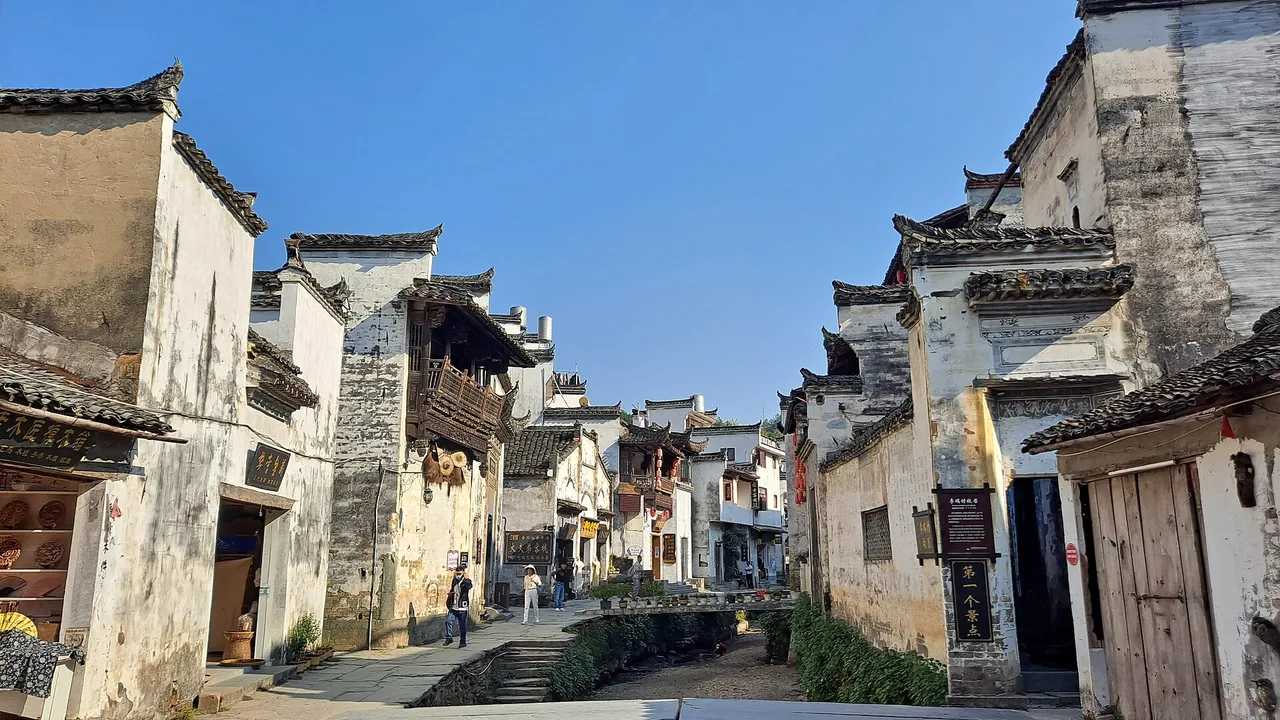
Itinerary at a glance
| 09:00 | Moon Bay: A Crescent Opening |
| 10:30 | Likeng: The Specimen of Little Bridges and Running Water |
| 14:00 | Wangkou: The Clan Hall and Landing on the Yongchuan |
| 09:00 | The Rainbow Bridge: An Eight-Hundred-Year Gallery |
| 11:30 | Qinghua Old Street: Lunch beside the Bridge |
| 13:30 | Wolong Gorge of Dazhangshan: The Depth of Falling Water |
| 09:00 | The Lingshi Caves: The River Underground |
| 11:00 | Jujing Village: The Roundest Village |
| 14:00 | Shicheng: Cheng Village's Morning Mist and the Great Maples |
| 16:30 | Yuanyang Lake: The Winter Guests' Lake |
The route, stop by stop
Moon Bay: A Crescent Opening
Twenty minutes from town, Moon Bay arrives early. The Xingjiang river wraps a crescent islet here, and before the mist lifts the water lies flat as a mirror, rippled only when a raft crosses. The free platform sits roadside, half an hour well spent.
A short raft ride into the bay captures the full arc. Morning light runs frontal and reflections stay complete, which is exactly why it opens the day.
Likeng: The Specimen of Little Bridges and Running Water
Likeng is the textbook village of little bridges over running water: the Shenming stream threads the village, lined by houses and dozens of small stone bridges. At mid-morning villagers still beat laundry at the banks and the commerce has not fully woken.
Look for the Shenming pavilion and the Dafu mansion, with the side lanes quieter than the main drag. Its commercialization draws complaints, yet its density of water scenery ranks first in Wuyuan, and arriving early shows the gentle version.
Wangkou: The Clan Hall and Landing on the Yongchuan
The afternoon reaches Wangkou, the village unrolling along the Yongchuan with bluestone landings stepping into the water; history made it a transshipment wharf where goods rose and fell by boat. The Yu clan hall carries Wuyuan's densest carving, barely a blank span left between beams.
After the hall, walk the river: women washing greens at the landings, bamboo rafts, white walls across the current. Wangkou's water is water that worked, wharf smoke and all, a different species from Moon Bay's scenic crescent.
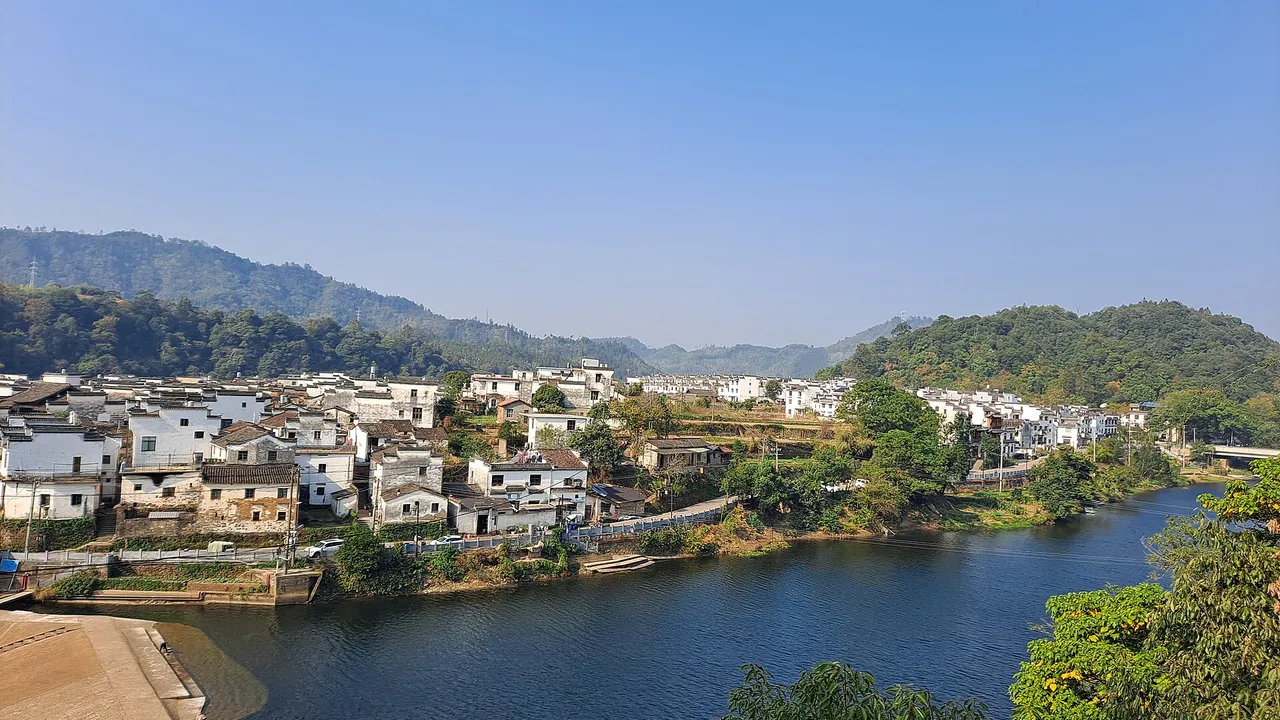
The Rainbow Bridge: An Eight-Hundred-Year Gallery
Day two stars the Rainbow bridge at Qinghua town, raised in the Southern Song and among the best-preserved covered bridges anywhere. Eleven gallery rooms form one long timber corridor, and the pointed pier cutwaters have shrugged off eight centuries of floods. You walk inside the gallery while scenery enters through the window openings.
Below, the water spreads wide, and dawn mist walking the surface is the bridge's most photogenic hour. The stone pound and waterwheel beside it still turn, Song-dynasty hydraulics giving a live demonstration.
Qinghua Old Street: Lunch beside the Bridge
Qinghua is the supply town of the northern line, its old-street kitchens cooking for locals. Lunch runs Wuyuan homestyle, thick tofu soup, rice-flour pork and seasonal stream fish, a presentable table at thirty to forty yuan per head.
Walk ten minutes off the meal along the street, where timber doors and old shopfronts out-density the county town. The afternoon's main event, Wolong Gorge, waits twenty minutes northwest.
Wolong Gorge of Dazhangshan: The Depth of Falling Water
Wolong Gorge is a canyon of Dazhangshan where falls string along a granite bed: walking in from the mouth, pools, rapids and cascades alternate, and the White Dragon fall deep inside drops tens of meters, its roar echoing off the walls. The summer high-water season is its peak form.
The trail hugs the water, walkways alternating with splash platforms, about two hours through the core. The gorge runs five degrees below town, natural air conditioning in summer.
The Lingshi Caves: The River Underground
Day three goes underground. The Lingshi complex holds thirty-plus karst caves, and the open Hanxu cave stacks flowstone in layers, with a dark river at its floor; the three magic minutes come by small boat out of the cave, rock ceilings sliding past the gunwales.
The caves hold a steady eighteen degrees, warm in winter and cool in summer. Lighting follows the routed path, so stay with the markers, fifty minutes end to end.
Jujing Village: The Roundest Village
Jujing is called China's roundest village: a stream circles the houses into a perfect ring, the ancestral hall at the center, homes laid like growth rings. The viewing deck sits on the facing hillside, a ten-minute stair away, and the overhead angle is its one correct viewing mode.
The circle's logic is defense, the water ring doubling as a moat. After the panorama, walk half the ring inside, where the outward view differs completely from the overhead one.
Shicheng: Cheng Village's Morning Mist and the Great Maples
Shicheng pairs Cheng and Dai villages under a hundred ancient maples. Its fame rests on the late-autumn dawn, when cooking smoke and morning mist flood the grey tiles and red maples develop inside the fog like film, shutters chattering everywhere. Out of season it is simply a quiet Anhui-south village.
Arrive in the afternoon to scout tomorrow's dawn stands; with only this one day, evening smoke offers the reduced edition. Farmhouse lodging at the village entrance is essential, since shooting the mist means sleeping in it.
Yuanyang Lake: The Winter Guests' Lake
The water line's last stop is Yuanyang Lake. Each autumn and winter, flocks of mandarin ducks fly down from the north to winter here, appearing in pairs across the water, the region's river system slipping in an easter egg. The shore path runs level, with dawn and dusk the birding hours.
Out of season the open water still earns a pause: after three days of gorges and streams, closing on one wide, quiet surface sets the tempo perfectly. From there, return to town or the rail station.
| Getting around |
|
| Budget | The area pass (about RMB 210) covers most stops; three days run RMB 600-1000 pp before lodging. |
| Best time | Summer carries the fullest water and the grandest falls; autumn adds Shicheng's dawn mist and red maples. |
FAQs
Does the three-day water line work in winter?
Yes, with winter bonuses of its own: ducks on the lake, clearer water, thinnest crowds. The cost is the dry season, muting Wolong's falls. Trade accordingly: in summer give the gorge a deep half day, in winter compress it and raise the weight of Shicheng's mist and the duck lake.
What exactly does the Wuyuan area pass include?
The pass (about RMB 210, five days) covers Jiangwan, Wangkou, Likeng, Xiaoqi, Sixi-Yancun, the Rainbow bridge, Wolong Gorge, the Lingshi caves, Shicheng, Wengong Hill and a dozen more; Huangling, the Xiyuan garden and Moon Bay's platform sit outside. On this route everything but Moon Bay scans the pass, so buy it on day one.
Which day is hardest, and can it flex?
Day two runs hardest, the Rainbow bridge plus a mountain gorge hike stacked on a post-lunch drive. The fix: compress Wolong's core to an hour out-and-back and bank the legs for the caves on morning three. Overall the load flattens with one habit, starting early.
What should seniors watch for on the water line?
Four points: gorge and cave paths run slick, making grippy shoes non-negotiable; the Jingjing deck has many steps, so view the half-circle from the bridge instead; the cave boat passage needs ducking; and a charter removes every transfer, far kinder than buses. Leave Shicheng's dawn shoot to early risers while seniors wake naturally.