
Wuyuan's village line reads people; this nature line reads landforms: Jiangling fans terraces down a kilometer of slope, Qingyuan hides in a valley pinched between ridges, Wolong strings falls over granite, and Shicheng turned morning mist into an annual event. Three days, not one ancestral hall.
Structure it as flower day, gorge day, mist-and-maple day: in spring lead with Jiangling and Qingyuan, in autumn save Shicheng and Changxi for the finale. The northern and eastern roads bend hard, so a charter with a driver who knows them is a hard requirement.
Itinerary at a glance
| 08:30 | Jiangling: A Kilometer of Terraced Depth |
| 11:00 | Qingyuan: A Peach-Blossom Spring in the Gorge |
| 14:30 | Wolong Gorge: A Waterfall Chain on Granite |
| 09:00 | The Lingshi Caves: Karst and the Dark River |
| 14:00 | Jujing and Changxi: The Round Village and the Maple Path |
| 05:45 | Shicheng's Morning Mist: The Ritual of Rising Early |
| 10:30 | Qinghua Town: The Northern Line's Rest Stop |
| 14:00 | Yuanyang Lake: Closing on Open Water |
| 16:30 | Moon Bay: One Last Look on the Way Back |
The route, stop by stop
Jiangling: A Kilometer of Terraced Depth
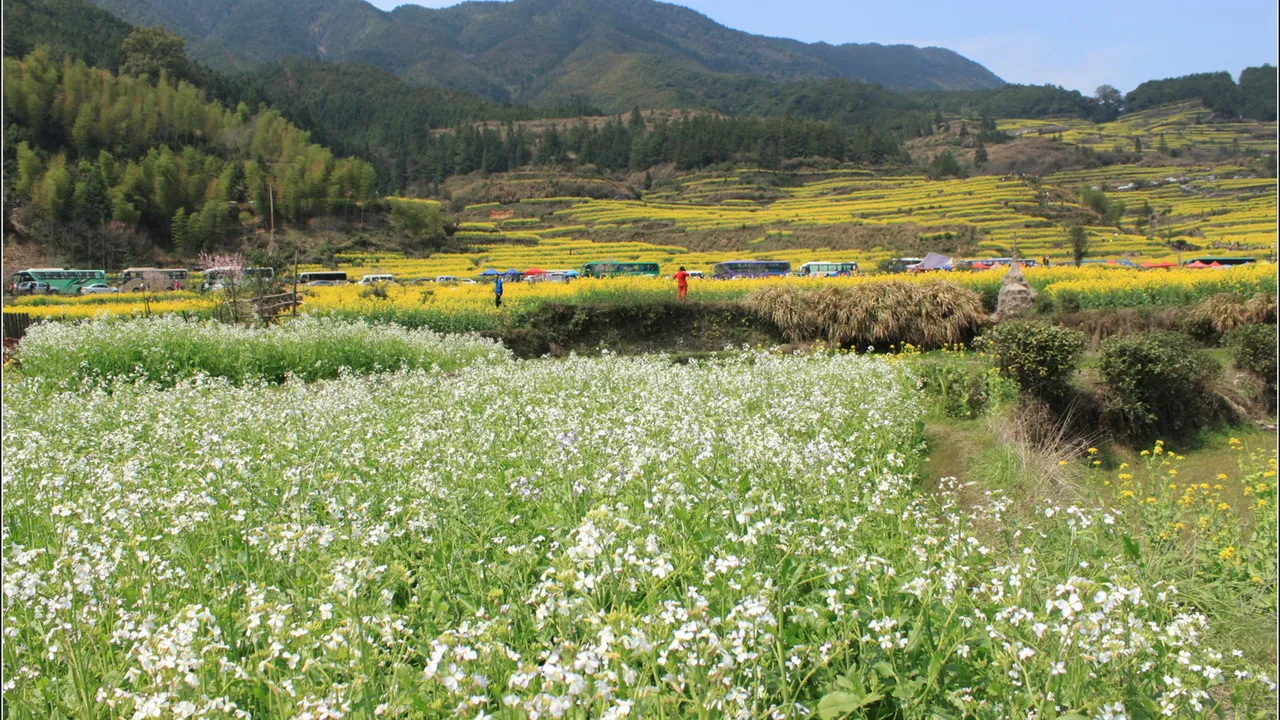
Jiangling is Wuyuan's sacred ground for rapeseed: terraces stack from the valley floor at five hundred meters up the slope, and in bloom season the whole hillside flows gold. The viewing deck crowns the top, and looking down, the field ridges read like contour lines come alive.
The bloom's best hour is early morning: mist half-veils the terraces until sunrise sweeps light across the slope. Descend the ridge paths to the valley floor, since walking inside the flowers beats hovering above them.
Qingyuan: A Peach-Blossom Spring in the Gorge
Qingyuan hides on a valley floor pinched between ridges, reached by one winding road. The village strings along its stream, thousand-year camphors and pear trees mingled with the houses, pear blossom sharing frames with rapeseed in season. Its distance has preserved the most intact quiet of any Wuyuan village.
The sight is not architectural grade but cohabitation: stream, bridge, tree and house grown into one body. Hikers can follow the old post road from Qingyuan toward Guankeng, one of the loveliest mountain paths in Wuyuan.
Wolong Gorge: A Waterfall Chain on Granite
The day's second half goes to Wolong Gorge, where the granite bed stacks a chain of falls and deep pools, and at high water the White Dragon fall's roar rolls echoes down the canyon. The trail rides the waterline, walkways, stepping stones and splash platforms in rotation.
The core takes two hours, and spare legs can climb to the rim deck for the whole gorge in one glance. Five degrees cooler than town, the canyon is a friend to summer hiking.
The Lingshi Caves: Karst and the Dark River
Morning two slows the tempo with a cave. Inside the open Hanxu cave, flowstone unfolds in lit layers, and the three minutes boating out along the floor's dark river are the visit's easter egg. A steady eighteen degrees inside means the cave feels identical rain or shine.
The complex historically drew literati carvings, ink traces of many dynasties still on the walls. Karst lovers should add half an hour for the draperies and cave flowers in close-up.
Jujing and Changxi: The Round Village and the Maple Path
The afternoon pauses half an hour at Jujing, the stream-ringed circular village seen whole only from the hillside deck across the water. Then drive to Changxi, a deep-mountain village whose old post road runs under two-hundred-year maples.
The maple season falls late November into early December, a two-hour walk on leaf-strewn paths between red crowns. Out of season, Changxi still works as a quiet mountain hike, green shade and streams carrying it.
Shicheng's Morning Mist: The Ritual of Rising Early
Day three rises for the mist. Cheng village at Shicheng sits ringed by ancient maples, and at dawn cooking smoke merges with fog over the rooftops, maples developing inside the haze as sunrise light rakes through, one of Chinese rural photography's annual signature scenes.
Stands sit on two hillside decks outside the village, scouted the night before. Mist is luck, but a clear dawn still offers the smoke version, and the window closes by 7:30.
Qinghua Town: The Northern Line's Rest Stop
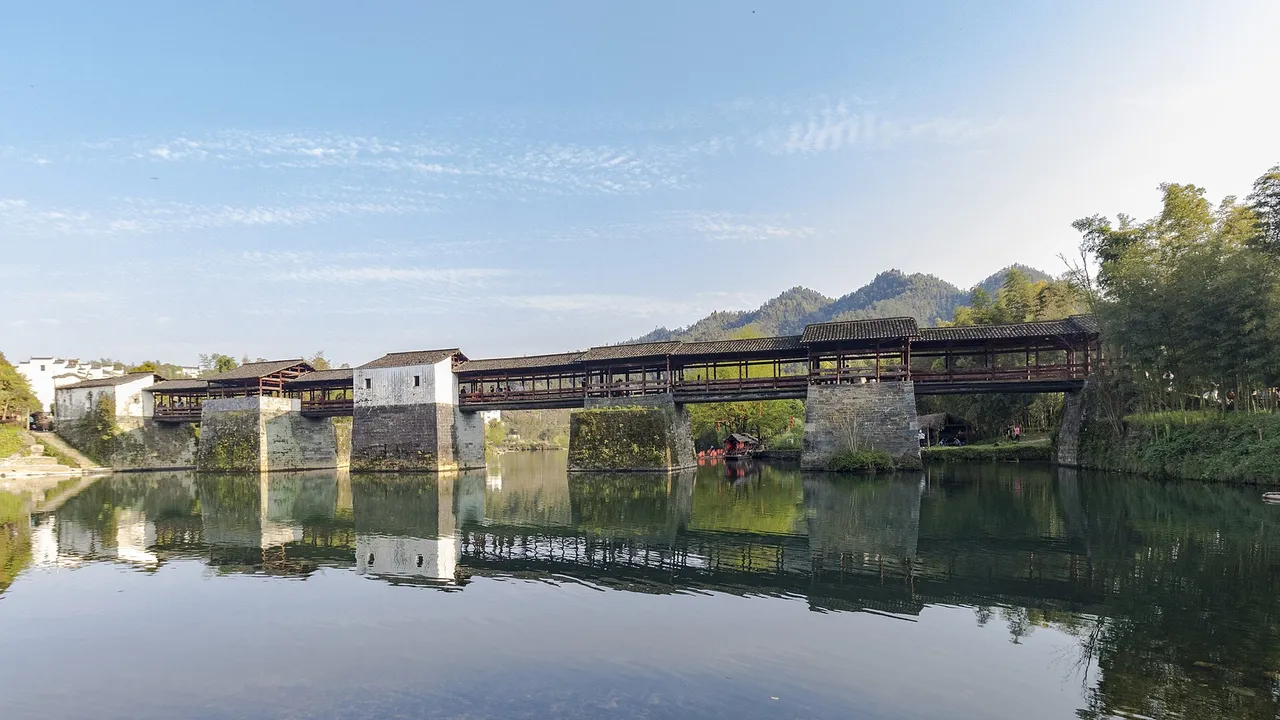
After the mist, eat a hot breakfast back in Qinghua and restock. The Rainbow bridge sits at the town's edge, and if the first days skipped it, now is the moment, collecting the eight-hundred-year gallery and the misty village inside a single day.
Qinghua is the northern transport hub where buses and charters converge, the easiest place to reshuffle vehicles and luggage before any next line.
Yuanyang Lake: Closing on Open Water
The afternoon goes to Yuanyang Lake, where wintering mandarin ducks float in pairs, liveliest at dawn and dusk. Travelers with long lenses stake an hour of birds; the rest walk the shore path, easing the three-day wild tempo to a close.
The open view invites idling as sunset lands on the water. Forty minutes back to town, close the trip over piano-pack carp for a full-flavored final note.
Moon Bay: One Last Look on the Way Back
Stop at Moon Bay on the ride home. Three days ago it may have been a line on an itinerary; having now seen Wuyuan's mountains, water, mist and maples, the crescent reads differently, the geographic footnote of the whole trip.
Evening dyes the water gold-red as rafts head in for the night. Twenty minutes suffices, then straight back to town or the rail station.
| Getting around |
|
| Budget | The area pass plus a few separate tickets run RMB 600-1000 pp over three days; the charter dominates spending. |
| Best time | Mid-March to early April for Jiangling's flower terraces, mid-November to early December for Shicheng's mist and Changxi's red maples. |
FAQs
Spring or autumn: if only one works, which?
It depends on the goal: spring's Jiangling bloom is Wuyuan's single biggest spectacle, unmatched in scale, while autumn's mist and maples reward slow looking. Photographers pick autumn for layers and forgiveness, families pick spring for predictable bloom and long days. Summer's greens and winter's ducks each hold their own fans between the two.
Does the nature line drop the culture entirely?
Not entirely: Qinghua, Jujing and Qingyuan all carry village texture even in passing. But yes, the weight sits on landscape, so culture seekers can swap the afternoon duck lake for Wangkou's clan hall, on the way and structurally painless.
What if Shicheng's mist never shows?
Mist gambles on weather, and two blank dawns in a row happen. Two fallbacks: shoot the morning smoke-and-maple version, weaker layers but valid, or convert the Shicheng day wholesale into the Changxi hike, which ignores mist entirely. Any good design holds a rain-fog Plan B for this line from the start.
What is lodging like in the remote villages?
Farmhouse beds in Qingyuan and Changxi are clean but plain, private baths spreading though hot water and Wi-Fi never guaranteed round the clock. The standard play: sleep in deep villages only the one night the mist demands, and return to Qinghua or town chain hotels otherwise. Lodging-sensitive travelers lose nothing basing in town.