
In 2017 Gulangyu entered the World Heritage list as a historic international settlement, yet Xiamen's heritage map far exceeds one island: in Jimei, Kah Kee architecture sets Minnan roofs on Western bodies, at Qingjiao Ciji Palace the sea-god Baosheng Dadi is worshipped on both shores of the strait, and the arcade columns of Zhongshan Road house fortunes made across the southern seas. Three days, three places, the complete map.
The plan partitions by geography: sea on day one, north on day two, old town on day three, with no doubling back. The heavy items cost nothing or one combo ticket, and the true expense is queuing, so every schedule leans early: the first ferry to Gulangyu, buses before nine to Jimei, opening time in the old town.
Itinerary at a glance
| Day1 08:00 | Sanqiutian Pier and the Villa Lanes of Gulangyu |
| Day1 10:00 | Sunlight Rock: The Island's Highest Point and Oldest Inscriptions |
| Day1 13:00 | Shuzhuang Garden and the Piano Museum: A Garden on the Sea, Pianos in the Garden |
| Day1 15:30 | The Octagonal Tower and the Organ Museum: The Red-Roofed Landmark |
| Day2 09:00 | Jimei School Village: Kah Kee Architecture, Minnan Roofs on Western Bodies |
| Day2 11:00 | Tan Kah Kee Memorial Museum and Aoyuan Garden: The Ledger of an Emigrant Patriarch |
| Day2 15:00 | Qingjiao Ciji Palace: The Ancestral Court of Baosheng Dadi |
| Day3 09:00 | Nanputuo Temple: The Faith Origin on the Heritage Map |
| Day3 10:30 | Overseas Chinese Museum: Completing the Emigrant Story |
| Day3 13:30 | Zhongshan Road Arcades and the Eighth Market: Living Heritage off the List |
The route, stop by stop
Sanqiutian Pier and the Villa Lanes of Gulangyu
Take the first boat and walk from Sanqiutian pier up Guxin Road toward Bishan Road, the quietest stretch of the core zone: former consulates, churches and rows of villas behind bougainvillea, where veranda-style buildings were invented as shading for island climates, and by the third lane the pattern shows.
The entry to understanding the heritage value sits in the details, the pairing of louvers, arches and local red brick, the negotiated result between emigrants of a dozen nations and Minnan craftsmen. No need to rush; these lanes are designed for getting lost.
Sunlight Rock: The Island's Highest Point and Oldest Inscriptions
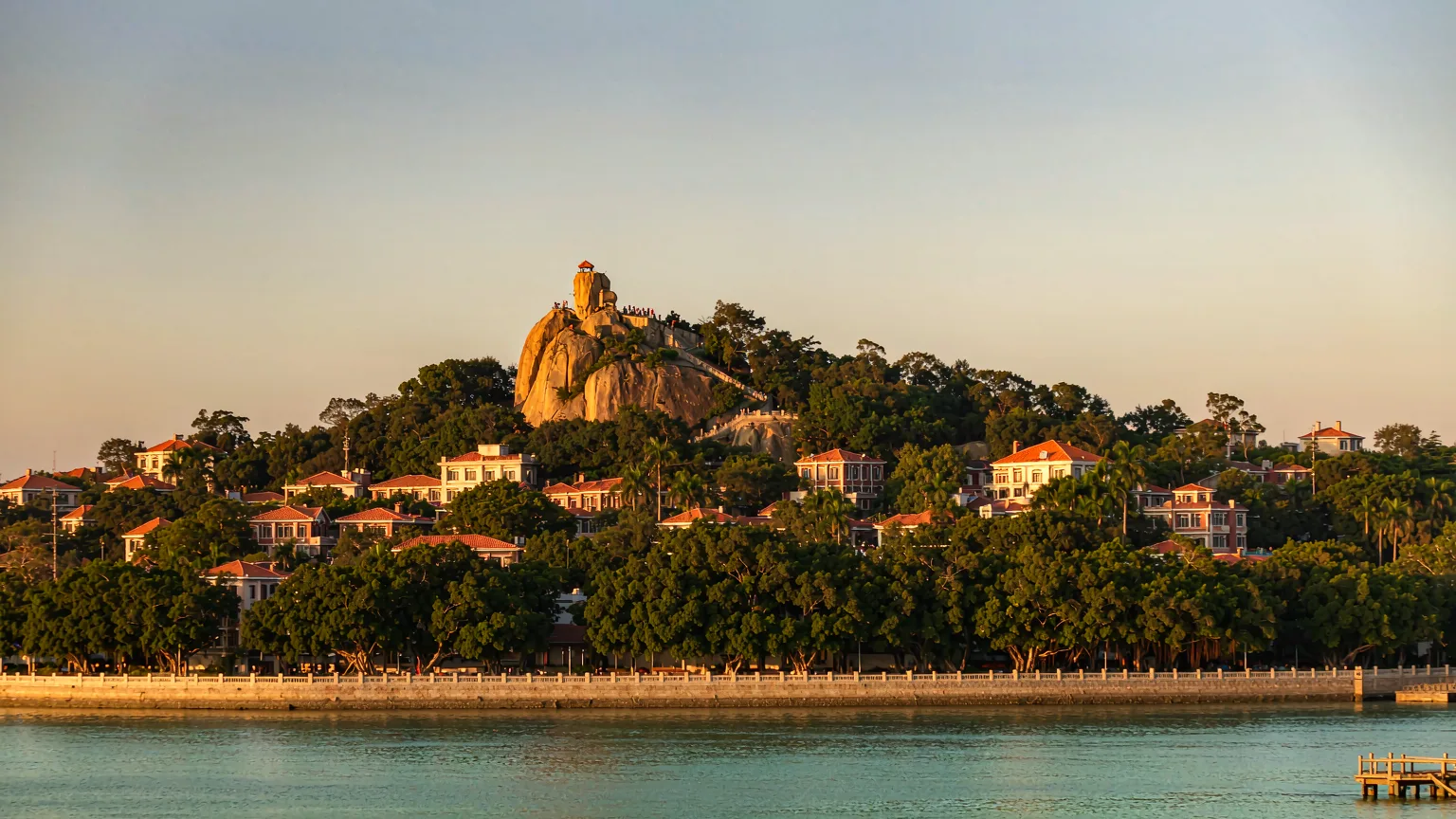
Sunlight Rock is the island's high point, under a hundred meters yet enough to command the red rooftops and the Lujiang channel. The cliff inscriptions stack from the Ming onward, and the old naval-platform site and Koxinga relics push the rock's story back to the seventeenth century. Summit before ten for slanted light and thin crowds.
Descend by the small eastern loop past an old burial ground and church remnants, a stretch with few visitors and deep tree shade, one of the quiet corners of the heritage zone.
Shuzhuang Garden and the Piano Museum: A Garden on the Sea, Pianos in the Garden
Afternoon belongs to Shuzhuang Garden, the summit of Gulangyu's landscape art: Lin Erjia borrowed the sea to build the garden, the forty-four bend bridge slicing the water into the courtyard, wave sound audible under the arches at high tide. The Piano Museum inside holds more than a hundred antiques, from early square pianos to vintage Steinways, with recital excerpts at set times.
Linger ten minutes mid-bridge watching the tide thread through, the cheapest and most luxurious seat on the island. Do not touch the instruments, and kill the flash indoors.
The Octagonal Tower and the Organ Museum: The Red-Roofed Landmark
The Octagonal Tower is the red dome on Gulangyu's skyline, now the Organ Museum, housing dozens of pipe and reed organs, the largest pipe organ nearly touching the ceiling. Pianos in the morning, organs in the afternoon: a single day completing the keyboard family, an arrangement few places in the world can match.
The spiral stair is itself an exhibit; from the atrium, look up at the dome murals and ventilation windows, where the designer folded cooling and beauty into one set of components.
Jimei School Village: Kah Kee Architecture, Minnan Roofs on Western Bodies
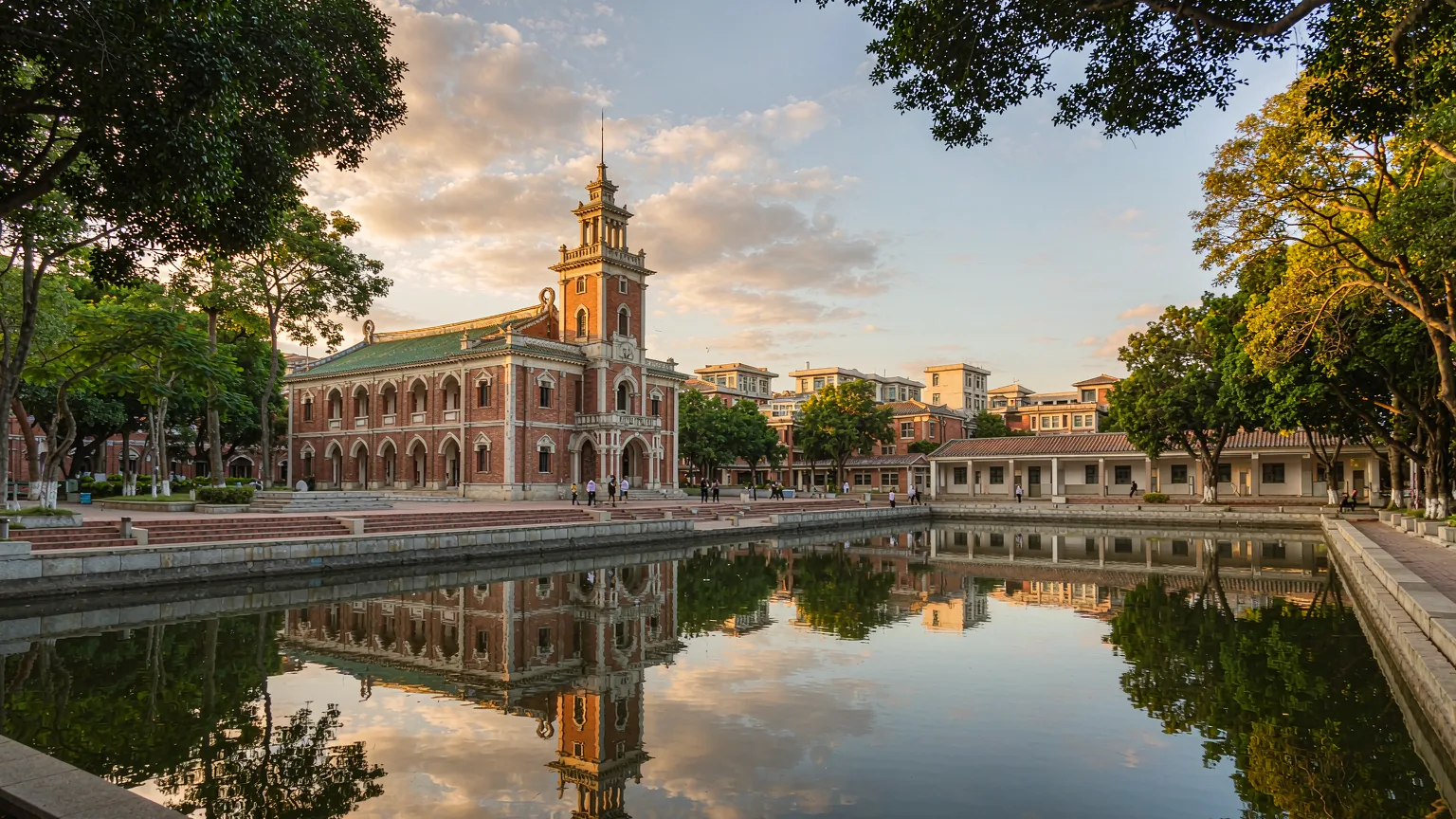
Day two crosses the water north to Jimei. In the school village Tan Kah Kee funded, buildings like Daonan and Nanxun set Minnan swallowtail ridges atop reinforced-concrete Western bodies, a mix locals nickname wearing a suit with a bamboo hat. The village still lives as working schools, class bells audible in the corridors.
Circle the dragon-boat pond, facing the sea, where schoolhouse reflections complete themselves in the early hours. On festival days the banks fill with teams from both shores for the races.
Tan Kah Kee Memorial Museum and Aoyuan Garden: The Ledger of an Emigrant Patriarch
The memorial museum lays out Tan Kah Kee's life as a public ledger: what schooling cost, what the war relief received, what he allowed himself for meals, the account books and letters in the cases giving the phrase devoting his fortune to schools actual numbers. At Aoyuan Garden, carved-stone galleries cover Chinese history wall by wall in Jimei craftsmanship.
The liberation monument and Tan's tomb share one axis at the garden's center, dense with stone detail and worth a slow hour.
Qingjiao Ciji Palace: The Ancestral Court of Baosheng Dadi
In the afternoon head to Qingjiao Ciji Palace in Haicang, one of the ancestral courts of the Baosheng Dadi faith, honoring Wu Tao, a Song-dynasty physician. The palace climbs the hillside on long steep steps flanked by stone and porcelain-relief carving without a spare inch, Minnan craftsmanship all on the roofline. Pilgrims from both strait shores and Southeast Asia return here, the censer smoking all day.
For architecture and folk faith, the herb garden behind and the medicine-lot exhibition deserve a slow look, since the heart of the cult was always a healer's mercy.
Nanputuo Temple: The Faith Origin on the Heritage Map
Day three returns to the main island, starting at Nanputuo. This famous Minnan temple belongs to the same cultural map as Gulangyu's churches and Jimei's schools: the tradition of monks running schools and free clinics goes back a century. The central axis and hillside inscriptions photograph best in the morning, and if the Buddhist academy inside holds an open class, sitting in is worthwhile.
The mid-hill platform on Wulao Peak frames temple, university and sea in one view, the right spot to grasp the back-to-hill, facing-the-sea layout.
Overseas Chinese Museum: Completing the Emigrant Story
Walk twenty-odd minutes from Nanputuo to the Overseas Chinese Museum and complete the other half of the Tan Kah Kee story seen yesterday in Jimei: what his fortune funded was not only schools but this museum built for emigrant history. The qiaopi letters and boat papers move most, one letter carrying one family's separation.
If you toured the Jimei memorial yesterday, ninety minutes here covering just the letters and the Southeast Asia galleries suffices, landing neatly on lunch.
Zhongshan Road Arcades and the Eighth Market: Living Heritage off the List
The last stretch goes to arcades and market. The South Seas arcades of Zhongshan Road are facades built from emigrant fortunes, with veteran signs stacked over one another in the lanes of Jukou and Dazhong; turn into the Eighth Market, where the market calls of seafood and dried goods have kept the same tune for a century. Heritage is not only what gets listed but what stays in use.
End the three days with a bowl of shacha noodles or peanut soup under the arcade shade, watching the lane crowd come and go, more like Xiamen than any viewing deck.
| Getting around |
|
| Budget | Ferry about RMB 35-50 round trip, the combo ticket about RMB 90, the rest mostly free with booking; three days run about RMB 400-700 pp with meals. |
| Best time | October to April is kindest; both Gulangyu and Jimei dread holiday crowds, so aim for weekdays. |
FAQs
Will queueing ruin three days, and how do I dodge the peaks?
The answer is three earlies: first ferry onto the island, into the school village before nine, into museums at opening. On holidays Gulangyu queues run by the hour, while weekdays keep them near twenty minutes; Jimei and Qingjiao Palace barely queue midweek. Keep your slack for day three, where dropping any stop costs nothing.
What if I cannot book a Gulangyu ferry slot?
Three ways: camp the release window for cancellations; book a later daytime sailing outside the nine-to-eleven rush; or reverse the order, doing Jimei and the old town first and saving the island for a final early boat. The visitor departure from Dongdu Cruise Center stays fixed, so buy only on official channels.
Does the route still work if I skip temples and care little for religion?
Yes. Nanputuo and Qingjiao Palace read perfectly as architecture, carving and landscape, with the faith as decoration; the Jimei stops and Gulangyu are pure building and history, no religion required. The truly irreplaceable day is Gulangyu; everything else has substitutes.
How do I soften the intensity for elderly parents?
Three reliefs: on Gulangyu skip the Sunlight Rock climb for Shuzhuang Garden and lanes; at Qingjiao Palace keep to the front hall away from the long steps; cap daily walking near eight thousand steps, using buses for any long leg. A hot spring or teahouse each afternoon works as recovery, pace over checklist.