
Seven days close Altay into one geographic loop: two days based in the city, its mountain first, then south to Koktokay for pit and canyon; day three back in Burqin packing the Russian street, Wucaitan and the night market into one; days four and five inside Kanas reading water through the bays, the lake and the pavilion, and the border through Baihaba; the last two in Hemu, staying the night for one morning mist before the drive out.
The right posture is one center of gravity a day and a lodging node every two or three. The route is season-sensitive: in snow the canyon and lake country restrict and skiing takes the stage, while summer opens everything, so choose your version before building the plan.
Itinerary at a glance
| 09:30 | Jiangjun Mountain Ski Field: The Mountain That Opens the Week |
| 14:30 | The Birch Forest Park: A Green Afternoon inside the City |
| 10:30 | Kekesuli Lake: The Breathing Point toward the Mining Town |
| 13:30 | The No. 3 Mine Pit: A Rim-Side Lesson in the Merit Mine |
| 16:00 | The Irtysh Grand Canyon: Water Sound beneath the Bell Peak |
| 11:00 | The Old Wharf Street: Burqin's Morning |
| 18:00 | Wucaitan: Northern Xinjiang's Most Famous Sunset Post |
| 21:00 | The Burqin Riverside Night Market: The Smoke-and-Fire Night before the Mountains |
| 12:00 | Wolong Bay: Kanas' First Reading |
| 13:30 | Moon Bay: The Arc and the Water's Gradation |
| 15:30 | Shenxian Bay: The Mist Foreshadowed and the Evening Lake Country |
| 08:30 | Kanas Lake and the Fish Watching Pavilion: The Whole and the Near |
| 14:30 | Baihaba: Border Permit and the River beyond the Line |
| 12:30 | Hemu Village: Log Cabins, Birch and Sunset on the Hadeng Ridge |
| 07:00 | The Hemu Mist Platform: The Week's Final Morning |
The route, stop by stop
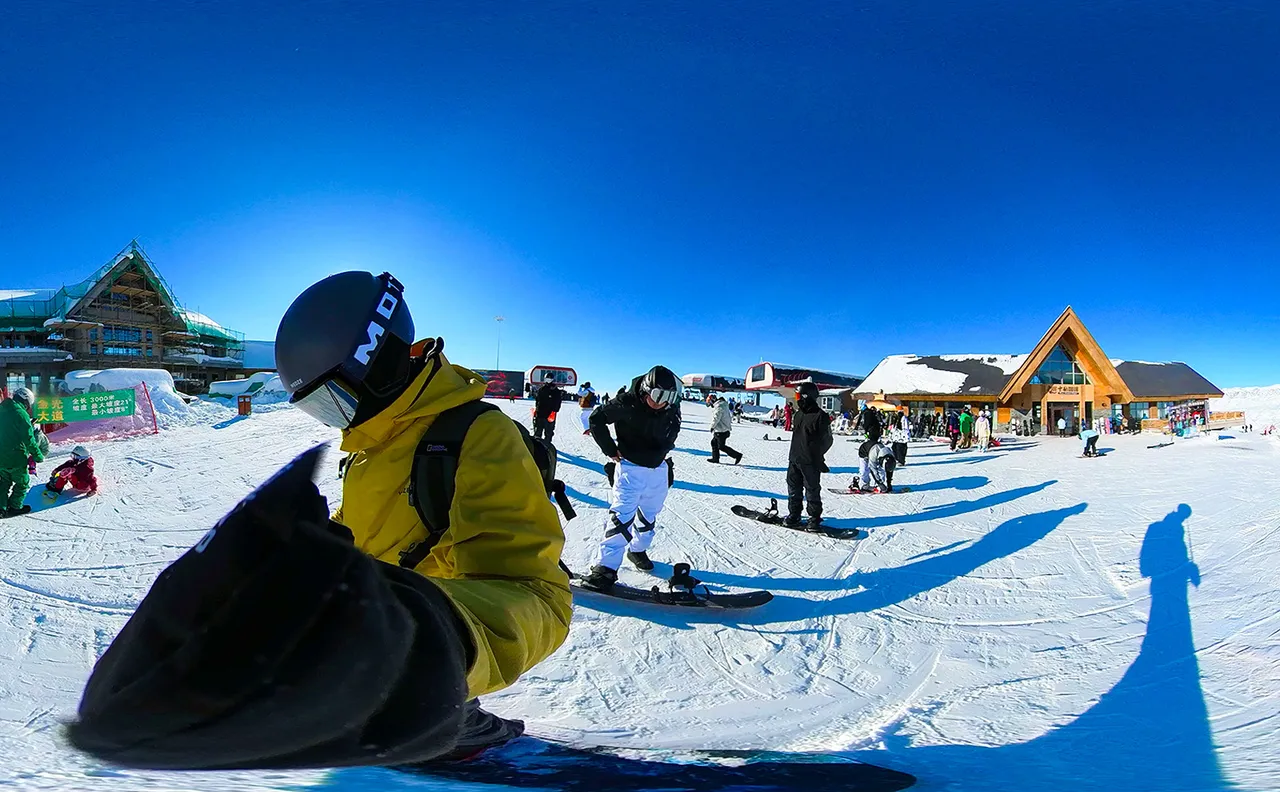
Jiangjun Mountain Ski Field: The Mountain That Opens the Week
Land in Altay and open on Jiangjun Mountain. In snow season ride three morning hours: lifts from the edge of town, dry light snow, full rental, instructors by the hour for beginners, a rare city field where skiing runs straight into lunch.
The summer version climbs for the town view instead: the Kelan and the Altai range in one frame, slopes gilding before sunset. The cradle-of-skiing display below earns a first look, fur skis and rock-art replicas telling the mountain's story plainly.
The Birch Forest Park: A Green Afternoon inside the City
After lunch, the birch park is the city's easiest outdoor hour. White trunks in stands across the Kelan's flats with boardwalks threading through, deep shade and breeze in summer, gold and translucent in September, sunlight sifting through the canopy like a built-in diffuser.
The main loop takes an hour, and photographers can give backlit trunks half an hour more. Walk the Kelan riverside back toward the center at dusk, dancers, families and chess players each holding a stretch; dinner happens at the riverside market, and sleep comes early with three hours of driving tomorrow.
Kekesuli Lake: The Breathing Point toward the Mining Town
Day two heads south with Kekesuli as the first stop. Reed islets float on the surface, waterfowl crowd the shallows, herds drink at the shore, and the morning lake lies flat as a mirror, wrinkling only in wind. Half an hour on the boardwalk suffices.
This is the transition from city pace to mining-town pace: with the wetland read first, the mountains and the mine ahead land with their full weight.
The No. 3 Mine Pit: A Rim-Side Lesson in the Merit Mine
Reach Koktokay town at midday and the pit first. The spiral walls wind down two hundred meters to the floor, where beryllium, lithium, tantalum and niobium once fed a nation's ledger in hard years, the miners' hand-cut winters of minus forty written on the rim boards.
Walk the rim slowly and build the sense of scale. Buy the pit-and-canyon combo here, asking exactly what it covers and when the last shuttle runs; town lunches are home-style with honest portions.
The Irtysh Grand Canyon: Water Sound beneath the Bell Peak
The afternoon climbs the canyon. The shuttle follows the Irtysh upstream past granite peaks of every shape to the Bell Peak, dropping like a vast bell with over three hundred meters of relative height; boardwalks track the river its whole length, and September's birch turns gold.
Turn at the Bell Peak viewpoint, about two hours round trip. Summer's long days allow pushing on to Burqin after, but the conservative play sleeps in Koktokay town and runs north next morning.
The Old Wharf Street: Burqin's Morning
Day three returns to Burqin with mountain preparation before browsing. The old wharf street, converted from a border-trade memory, hides rows of imported goods shops behind Russian facades: big loaves, kvass, honey and candies, trail food and gifts at once.
Pick by origin, back label and date, and eat the loaf fresh since it keeps poorly. Buy water and snacks, store big luggage at the hotel, and enter Kanas light.
Wucaitan: Northern Xinjiang's Most Famous Sunset Post
By evening Wucaitan flips the register to dry heat: yardangs striped red, yellow and violet by the setting sun, the Irtysh bending below, birches gilded across the water, two landscapes sharing one river. The boardwalk fills with people waiting for the light.
Keep an hour on each side of sunset, yardangs first, then the birches. Fix hat against the wind, and twenty minutes back to town lands you right at the night market.
The Burqin Riverside Night Market: The Smoke-and-Fire Night before the Mountains
The riverside market burns from dusk deep into night: skewers by the handful, fish by the piece, baked buns for starch, with local kvass. The Irtysh pike is the order to make, charcoal-crisp outside and tender within under cumin and chili.
Locals treat it as supper and social club, plastic stools the best seats. Pay by counting sticks and watching the scale; let the hotel handle tomorrow's breakfast and split luggage tonight into car bag and daypack.
Wolong Bay: Kanas' First Reading
Day four enters from Burqin, tickets and shuttle at Jiadengyu, reaching the first bay near midday. Wolong's shoe-shaped shoal lies in blue-green water, the mixed spruce-and-birch island's outline complete, side light splitting the surface into bright and dark halves.
Take the boardwalk to the waterline for a close look at the color, cooler than the platform; keep the stop under forty minutes, since the bays build in sequence and your best attention belongs later.
Moon Bay: The Arc and the Water's Gradation
Moon Bay is Kanas' cover shot: the river bends a flawless arc, water grading green through blue to milky teal, the footprint-shaped patches on the shoal carrying an old telling. The one o'clock light frames the whole bend in a single take.
Walk the boardwalk ten minutes toward the lake and look back from higher ground, the best angle for the arc; the path is gentle, moving slowly beats standing still and firing frames.
Shenxian Bay: The Mist Foreshadowed and the Evening Lake Country
Shenxian's fame is its morning mist, the midstream islet floating like an immortal's residence; at midday you get the clear post-fog version, calm water and sharp reflections. Tonight you sleep in the lake country, and if you can rise tomorrow, the thick-mist cut is the real feature.
Handle a light meal at the bay-side service point and board into the lake country; walk the shore boardwalk by evening, cabin lights and stars coming on together.
Kanas Lake and the Fish Watching Pavilion: The Whole and the Near
Day five opens with the climb: a mountain transfer and a stairway stretch put Kanas whole beneath you, bay curves against the snow peaks opposite, the only angle that teaches the lake's scale. The monster legend stays unsolved, and the view outranks the mystery.
Descend to the lakeside boardwalk, where the milky teal shows its suspended mineral grains up close, the hue only glacier melt produces; at the lake's head, where water leaves to carve the bays, lake and bays resolve into one relation.
Baihaba: Border Permit and the River beyond the Line
The afternoon transfer heads to Baihaba, where the border permit is the hard gate: apply at the designated point with your ID, simple but mandatory, while foreign passport holders follow local entry rules. The village is a mixed Tuva and Kazakh log-house settlement with Kazakhstani mountains across the line.
From the border canyon viewpoint read the boundary river and the far shore, and watch the marker quietly. Baihaba runs quieter than the lake country, its evening baseline of chimney smoke and cowbells; sleep in the village or return lakeside as the shuttle board dictates.
Hemu Village: Log Cabins, Birch and Sunset on the Hadeng Ridge
Day six transfers into Hemu on a winding mountain road, just over an hour. Tuva cabins line the Hemu River, log walls with moss in the seams and winter firewood stacked in the yards; take the bridge and the birch first, then climb twenty minutes of boardwalk to the Hadeng platform.
Sunset reads mountains first, then village: chimney smoke rising, the river bending past the roofs, the last light landing on the water. Wait five minutes for the blue hour as cabin lights come on, sleep in the village, and let tomorrow's mist close the whole week.
The Hemu Mist Platform: The Week's Final Morning
Climb Hadeng again at half past six. Night moisture gathers into a fog belt in the valley, cabins and birch developing out of it layer by layer, sunrise gilding the fog's crown before it drifts and thins, the village looking freshly washed.
Mist peaks within an hour after sunrise and runs steadiest in autumn. After the fog, breakfast at the cabin and exit by late morning for Burqin or Altay, three to four hours of road closing the week's long chapter.
| Getting around |
|
| Budget | Entry and shuttles total about RMB 700-900 pp; a seven-day car runs RMB 4,200-5,500, six nights RMB 900-2,000 per head. |
| Best time | June to September runs the scenery cut, peaking in mid-September gold; from November the skiing cut takes over, with Jiangjun Mountain and Hemu's Jikepulin as home ground. |
FAQs
Is seven days too long, and can it shrink?
It shrinks: drop Baihaba and squeeze Koktokay into a day trip for the standard five-day loop. Adding more stops is the wrong direction; the week's value lives in the mist, the lake's quiet mornings and Hemu's nights, and that slack is the depth.
What is the rough budget for the seven days?
Per two sharing: charter about RMB 4,200-5,500, tickets and shuttles RMB 700-900 per head, six nights RMB 900-2,000 per head, meals RMB 80-150 per head daily, roughly RMB 8,000-11,000 per person, with ski gear and lift tickets extra in winter.
How should the plan change for snow season?
Swap the core: lake country and canyon give way to skiing, the week becoming Jiangjun Mountain and Hemu's Jikepulin fields plus city rest days; mind closure risk, cold-weather kit and short daylight, hire drivers with winter experience, and build weather slack into every day.
Choosing between Baihaba and Hemu if forced?
Both are Tuva log villages, differing in temperament: Baihaba is quieter with border scenery but needs the permit, while Hemu is bigger with more reliable mist and sunrise and fuller services. First visit, take Hemu; for the border experience, Baihaba, and on seven days you naturally take both.