
Hangzhou claims two entries in a thousand years of history: the lake, and Longjing tea with the Buddhist tea culture around it. Lingyin Temple dates to the Eastern Jin dynasty, one of the oldest in the south, while the cliffs of Feilai Peak carry more than 340 Buddhist carvings from the Five Dynasties through the Yuan, including the Southern Song laughing Maitreya that defines Jiangnan grotto art.
A few kilometers south, the villages where Longjing grows still sit ringed by tea terraces, with the China National Tea Museum tucked midway along this cultural belt. The day links the two threads: grottoes then temple halls in the morning with an optional tea stop at Yongfu Temple, vegetarian noodles at midday, the museum's Shuangfeng galleries in the afternoon, then one bus stop to Longjing Village for properly sourced pre-Qingming tea in a farmer's home. Hilly but bus-friendly, moderate on the legs.
Itinerary at a glance
| 07:30 | Feilai Peak Grottoes: Three Hundred Buddhas Before the Crowds |
| 09:00 | Lingyin Temple: Reading the Halls in Order |
| 11:00 | Yongfu Temple and Tianzhu Road: Tea Beside the Temple |
| 13:30 | China National Tea Museum: Homework Before the Cup |
| 15:30 | Longjing Village: A Proper Cup in a Farmer's Home |
The route, stop by stop
Feilai Peak Grottoes: Three Hundred Buddhas Before the Crowds
Feilai Peak is a lone limestone hill whose name comes from an Eastern Jin monk who insisted it had flown here from India. Its cliffs and hollows hold over 340 Buddhist carvings from the Five Dynasties through the Yuan, the largest grotto complex in the south. Three stops are essential: the Five Dynasties figures in Qinglin Cave, the Northern Song luohans in Yuru Cave, and across Cold Spring Creek, the Southern Song plump Maitreya that serves as the mountain's cover photo.
At 7:30 am you nearly have the valley to yourself, and the raking light inside Qinglin Cave reveals folds in the robes that noon flattens. The loop along Cold Spring Creek takes about an hour, past pavilions praised by the poets Bai Juyi and Su Shi, with story-dense signboards worth reading as you go.
The 45-yuan ticket does not include Lingyin Temple, which charges a separate incense ticket. Do the carvings first: after 8:30 am tour groups flood the single trail and strolling becomes queuing.
Lingyin Temple: Reading the Halls in Order
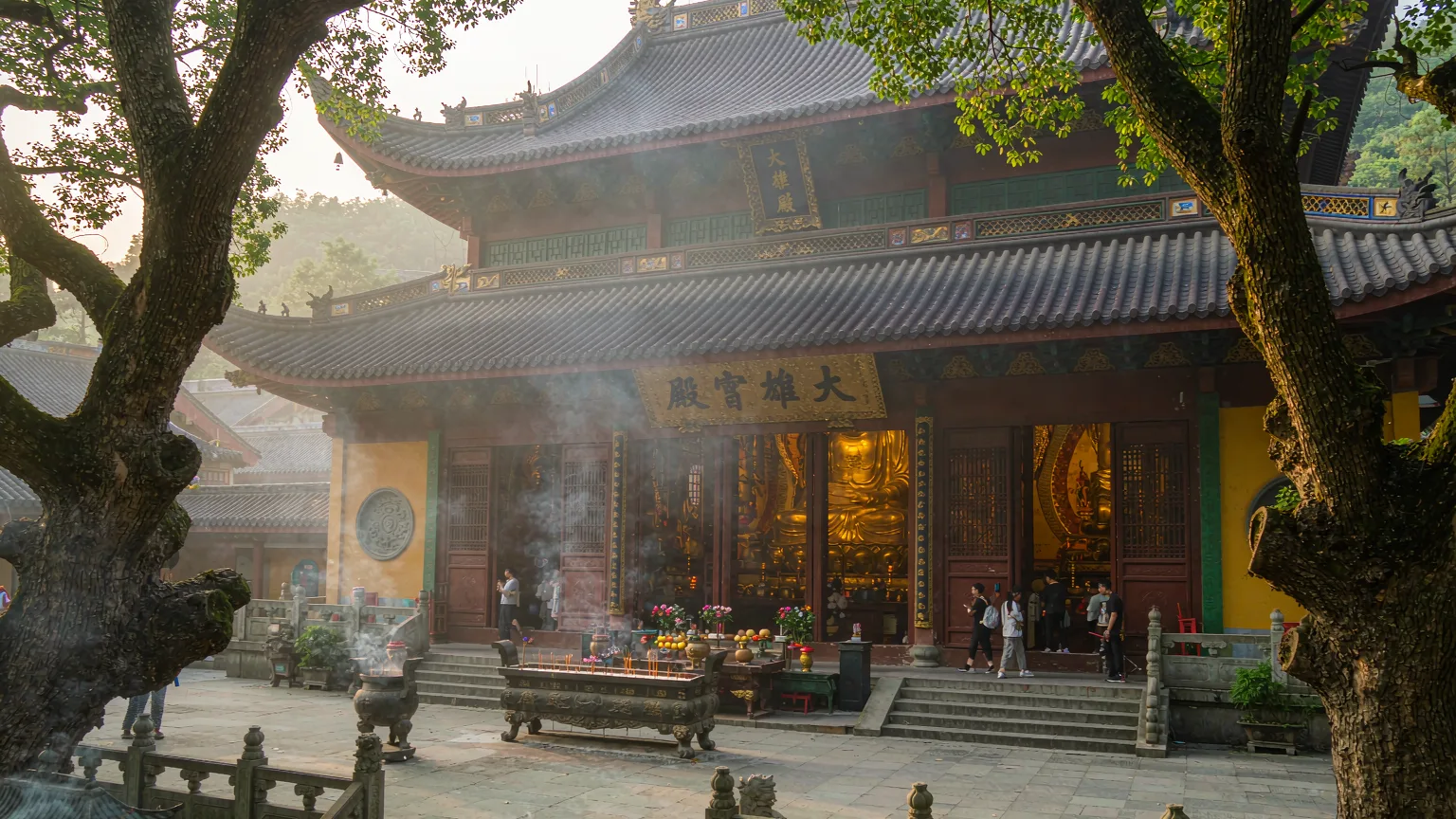
Founded in the Eastern Jin era roughly 1,700 years ago, Lingyin rises along a central axis: Heavenly Kings Hall, the Great Hall and the Medicine Buddha Hall stepping uphill, flanked by side halls and a luohan court. The Song stone pagoda and sutra pillars near the first hall are the site's oldest survivals, and the 24.8-meter Sakyamuni in the Great Hall, carved from camphor wood in the 1950s, remains among China's largest seated wooden Buddhas.
Entry needs a separate 30-yuan incense ticket beyond the Feilai Peak admission, which includes three sticks of incense. Walk the axis uphill, but keep turning to the sides: Jigong Hall honors the eccentric monk said to have taken his vows here, and the bronze ranks of the Five Hundred Luohans deserve their own twenty minutes.
The temple's vegetarian canteen sells luohan noodles for about 25 yuan from 10:30 am, thin on crowds and big on flavor. With spare legs, a 20-minute climb behind the temple reaches the sea-viewing pavilion, which on clear days frames the Qiantang River.
Yongfu Temple and Tianzhu Road: Tea Beside the Temple
A 10-minute path up from Lingyin's west wall reaches Yongfu Temple, a complex of four courtyards stepped into the hillside. Often mistaken for a Japanese-style garden, it is in fact the original Tang-Song mountain-temple layout. The Fuquan Tea House inside serves Longjing at 40 to 60 yuan a cup facing the valley, the quietest half hour in the whole Lingyin area.
Descend to Tianzhu Road heading south, past the Amanfayun resort woven into Faxi old village, along flagstones, a creek and old camphor trees, the loveliest pilgrimage stretch in Hangzhou. Faxi Temple, famous for prayers about love, is free with booking, and its vegetarian mooncakes draw year-round queues.
Lunch is noodles at Bailuoqiao or along Tianzhu Road, 20 to 35 yuan with a side of vegetarian goose. The walk takes about 90 minutes under dense shade, comfortable even in summer.
China National Tea Museum: Homework Before the Cup
The museum's Shuangfeng branch hides between Longjing Road and Jiqing Hill, free to enter, and it is China's only national museum devoted to tea. The galleries walk you from Tang-dynasty boiled tea through Song whisked tea to Ming-Qing steeped tea, dense with real and replica teaware; the Lu Yu and the Classic of Tea section rewards slow reading, and even changes how your later cup tastes.
The building sits in a garden ringed by experimental plots labeled by cultivar, Longjing 43 versus the native cluster variety. Visitors can practice at the aroma stations, and free brewing demonstrations often run on weekends, so check the day's board.
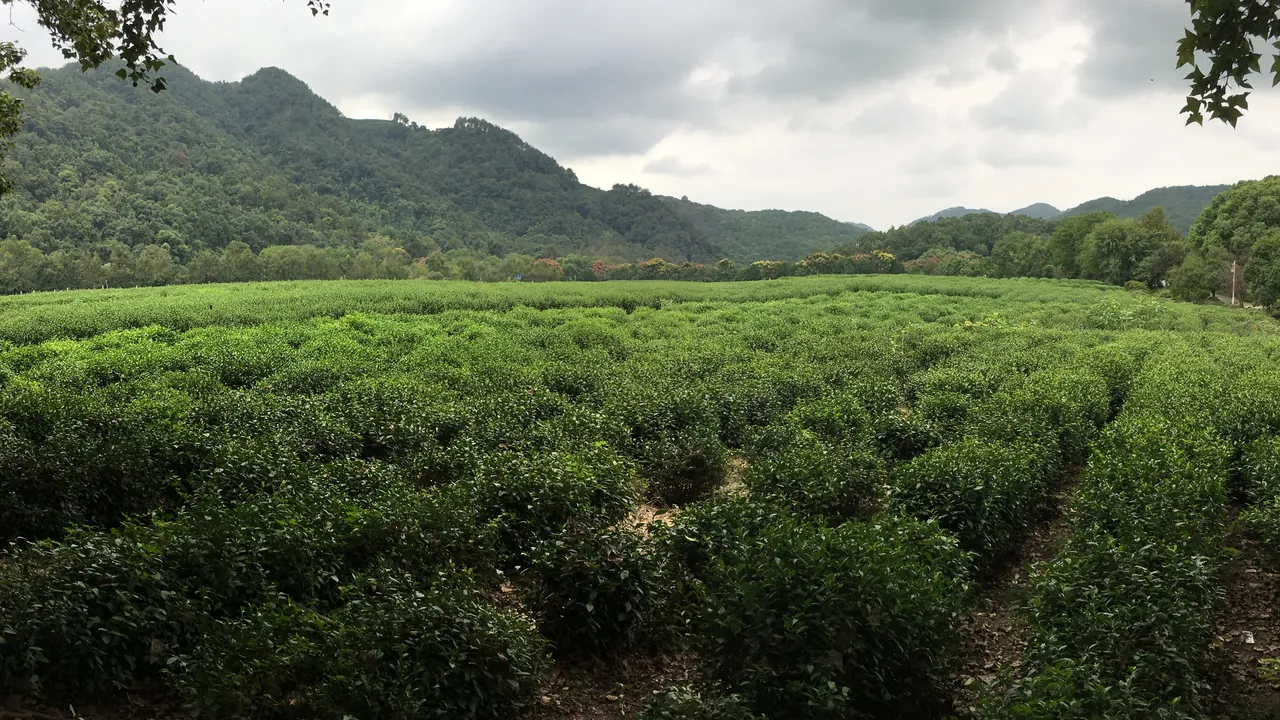
An hour captures the essentials, two at most. From the gate, hop a bus two stops to Longjing Village, or walk 25 minutes through the tea terraces, the most photogenic stretch of the whole day.
Longjing Village: A Proper Cup in a Farmer's Home
Longjing Village is the core producing area of Shi Feng Longjing, folded into a valley of stacked tea terraces. The eighteen imperial tea bushes that Qianlong the emperor consecrated stand fenced at the village entrance by Hugong Temple, the traditional first stop. Nearly every house receives guests: sit down and the farmer will line up tastings by grade and picking date, from 50-yuan everyday cups to pre-Qingming Shi Feng at thousands per 500 grams.
Taste comparatively: drink a pre-Grain-Rains cup, then a pre-Qingming one, and the difference in freshness explains itself. Ask for grade and picking date; anything vague is a red flag, since genuine pre-Qingming Shi Feng starts in the thousands per 500 grams and no 30-yuan version exists. Sitting is free, though buying a 50 to 150 yuan tin of the season is fair support.
With spare time, climb the Shili Langdang trail behind the village for a 40-minute overlook of the tea valley before a bus or taxi down; evening wind through the terraces is a fine close.
| Getting around |
|
| Budget | About 180 to 320 yuan per person: Feilai Peak 45 yuan plus the Lingyin incense ticket 30 yuan, the tea museum free, village tastings 50 to 150 yuan, food and transit the rest. |
| Best time | March to May, the harvest season, adds fresh-roasting scenes; on weekdays, arrive at Feilai Peak by 7:30 am to dodge most groups, and book village tastings for 2 to 4 pm. |
FAQs
Why does Lingyin charge two separate tickets, and what is the incense ticket?
Lingyin sits inside the Feilai Peak scenic area, so the 45-yuan area ticket goes to the park authority and the 30-yuan incense ticket goes to the temple for upkeep and free incense, a common arrangement at old Chinese monasteries. Budget 75 yuan total for the temple, or 45 if you only want the grottoes. Buy the incense ticket on site by QR code, or pre-book both tickets on official channels in peak season and show each QR code at its gate.
How do I avoid fake or outsourced Longjing when buying in the village?
Three checks. First, sanity-check the price: genuine core-area pre-Qingming Shi Feng runs into thousands per 500 grams, so any cheap pre-Qingming claim is false. Second, ask for origin labels and that year's picking date; village cooperatives and farmer-sellers are both legitimate, and a side-by-side brewing is a fair request. Third, start small with a 50 to 150 yuan tin of the season's pre-Grain-Rains tea, build your palate, and only chase expensive pre-Qingming next year. Always get a receipt naming grade and price.
How different is the visit during harvest season versus the off-season?
The difference is sensory: in late March and early April, pickers dot the terraces, woks fire in every doorway, and the whole valley smells of roasted beans, the only theatrical weeks of the year, paid for in crowds and tight transport. Off-season, the terraces stay green, the village and museum quiet down, tea prices soften, and you can linger over tastings. If your goal is understanding tea culture rather than spectacle, weekdays from November to February are arguably richer; to watch roasting, target late-March weekdays over post-Qingming weekends.
Is this culture day suitable for older relatives who rarely hike?
Yes, and it is easier than the lake loop. The only sustained climbing is Lingyin's central axis stairs and the optional Taoguang path, which you can skip outright: take the area shuttle or a taxi to the temple gate, ride back down to Tianzhu Road for noodles, and drop the Yongfu uphill section. The tea museum is flat with elevators, and the village tasting is fully seated. Total walking stays under 3 kilometers, stairs cluster at two halls and take under 30 minutes at an easy pace, with hot tea and seats never far away.