
Seven days is the threshold for reading Nanjing: three days gets you conclusions, seven gets you arguments. The route works by stratigraphy, days one and two excavating Purple Mountain's Six Dynasties and Ming strata, day three returning downtown for Republic and Six Dynasties, day four walking the street-level folk layer, day five descending to the old south for Ming walls and daily life, day six going suburban to Niushou, day seven elastic, Qixia in autumn, Tangshan when tired.
The core strategy is slowness: half a day for each flagship venue, every booked slot staggered, aimless walks by lakes and lanes threaded between. After seven days you will know the city better than most local guides, not a boast, simply what this much layered history guarantees.
Itinerary at a glance
| D1 08:30 | Sun Yat-sen Mausoleum: Walking the Axis Properly |
| D1 10:30 | Ming Xiaoling and the Stone Elephant Road: The Ming Opens |
| D1 14:00 | Meiling Palace: First Slice of the Republic Layer |
| D1 15:30 | Linggu Temple: The Beamless Hall and Deep Pines |
| D2 09:00 | Nanjing Museum: A Full Day for the Survey |
| D3 09:00 | The Presidential Palace: The Republic Layer at Full Volume |
| D3 14:00 | Six Dynasties Museum: Celadon and Rammed Earth |
| D3 16:30 | Jiming Temple, Taicheng and Xuanwu Lake: Three Layers in One Close |
| D4 09:30 | Yihe Road and the Avant-Garde Bookshop: The Street Layer's Morning |
| D4 14:00 | Chaotian Palace: The City Museum inside a Confucian Temple |
| D4 16:30 | The Gan Xi Residence: Dusk among Ninety-Nine and a Half Rooms |
| D5 09:00 | Zhonghua Gate and Dabao'en Temple: The Wall Layer by Day |
| D5 14:00 | Laomendong, the Exam Museum and the Qinhuai Night |
| D6 09:00 | Niushou: A Full Suburban Day |
| D7 09:00 | The Elastic Close: Qixia Maples or Tangshan Springs |
The route, stop by stop
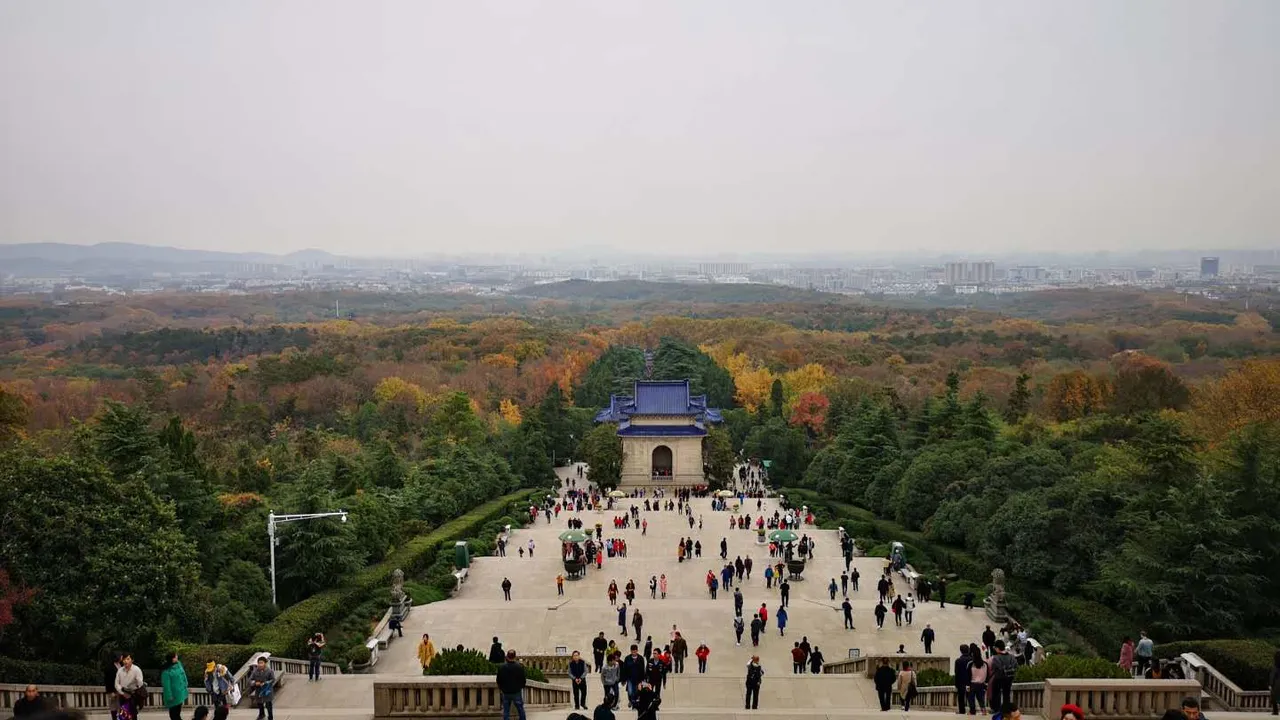
Sun Yat-sen Mausoleum: Walking the Axis Properly
Seven days still open at the mausoleum, but this time with a whole morning. Enter at opening, take the 392 steps in three easy stages, study the carvings and reliefs piece by piece, and shoot the mountain panorama from several angles.
After descending, complete the Music Stage and Liuhui Pavilion, the corners one-day tours skip and the compound's loosest pleasure. Lunch along the Mausoleum Road, with the afternoon starting from the mountain's foot.
Ming Xiaoling and the Stone Elephant Road: The Ming Opens
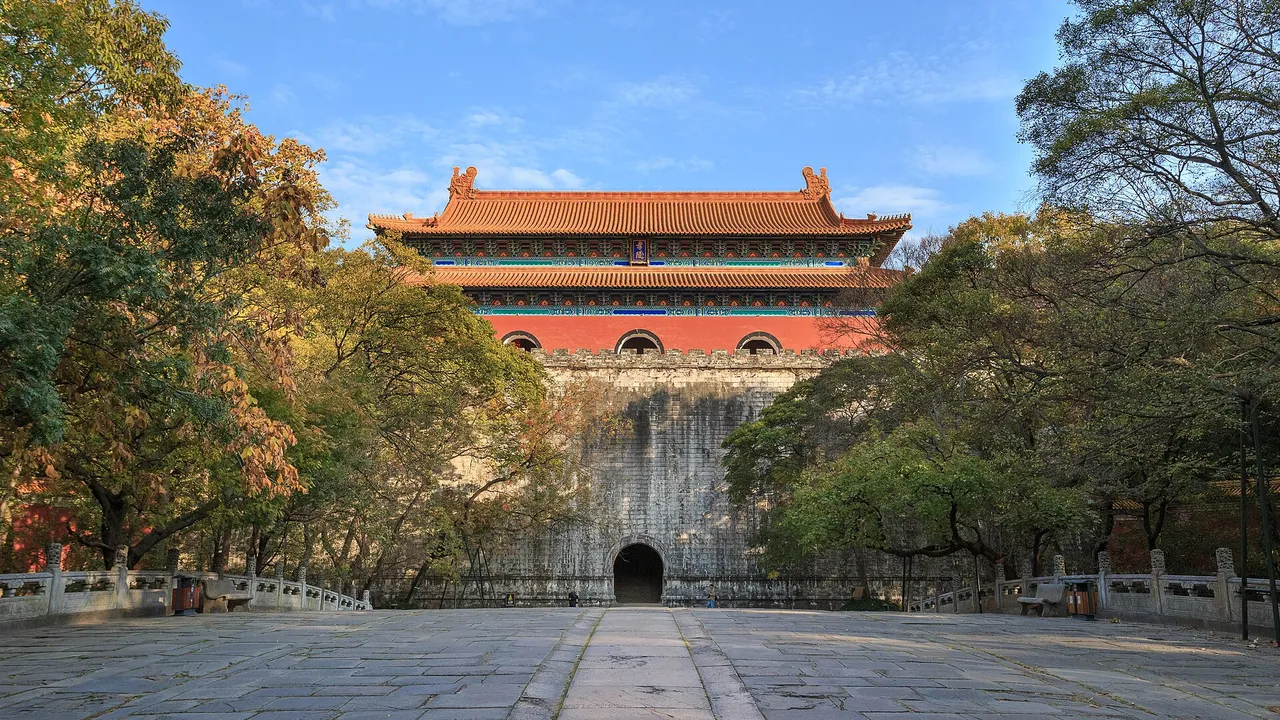
Late morning enters Ming Xiaoling, this time with a guide: the standing-and-crouching code of the way's beasts, the scale of the hall's column bases, the siting of the Square City and Ming Tower, every detail of Ming tomb grammar deliberate. Autumn's color on the sacred way is a bonus.
After surveying the tomb from the Ming Tower, walk the sacred way in reverse, from the stone figures back to the Great Golden Gate, a wholly different view. As crowds build toward noon, close the session for lunch.
Meiling Palace: First Slice of the Republic Layer
Day one's second half starts at Meiling Palace, cutting formally into the Republic narrative. The villa's interiors brim with detail: Song Meiling's painting room, the kitchen, the elevator and underground escape passage, rendering 1930s elite material life quite concretely.
The painted glass and reception room upstairs are the photography prizes, and after exiting walk a stretch of the Mausoleum Road, that famous plane-tree row being this era's legacy.
Linggu Temple: The Beamless Hall and Deep Pines
Close day one at Linggu. The Beamless Hall stands entirely of brick, not one timber beam, the largest such structure in China; behind it the Linggu Pagoda climbs nine levels, the whole mountain below. In late autumn osmanthus scent arrives with the sound of pines.
Crowds thin dramatically here, and the early-evening woods suit the day's final hour well. The shuttle runs from the temple to the metro, landing downtown in time for dinner.
Nanjing Museum: A Full Day for the Survey
Day two gives the museum a whole day, the itinerary's only one-venue day. Morning runs the History Hall chronologically, slow-reading the gold beast, the Seven Sages mural and the silver-inlaid hu; afternoon takes the art and digital halls, luck-dependent specials, with the Republic Hall as the relaxed close.
The in-house cafeteria is cheap and ample, no need to leave. The secret to four halls in a day is a water break each hour, since the courtyards and linked galleries are themselves part of the show.
The Presidential Palace: The Republic Layer at Full Volume
Day three returns to the central axis, two full hours at the palace: beyond the central axis, the viceroy's exhibits in both wings, the restored garden, and the provisional president's office each reward attention. Every era of tenants here merits its own guided session.
Across Changjiang Road the Six Dynasties Museum takes the afternoon, two timelines unfolding in one day, exactly the pairing that answers why Nanjing served as both Six Dynasties and Republican capital.
Six Dynasties Museum: Celadon and Rammed Earth
The afternoon museum deserves a slow gear: the Pei-team spaces make every object a protagonist, the celadon lotus vase's glaze, the face-tile expressions, the Eastern Jin ox cart's details, ten minutes each never dragging.
The basement wall cross-section anchors the building; standing before fifteen-century-old rammed earth, the Six Dynasties stop being textbook nouns. Two hours allows two full circuits.
Jiming Temple, Taicheng and Xuanwu Lake: Three Layers in One Close
Day three's dusk folds three layers into one frame: Jiming Temple first, then the Taicheng wall, finally the slope down to Xuanwu's south shore. From the ramparts, south sees a Six Dynasties temple beside Republic-era towers, north sees lake and hills, five dynasties in one sightline.
The lakeside dusk belongs to strollers, twenty minutes toward Liangzhou and back, with dinner toward Hunan Road or the hotel. Of the seven days this is the highest-value close.
Yihe Road and the Avant-Garde Bookshop: The Street Layer's Morning
Day four walks the street layer. The Yihe Road villas sit quietest in the morning, door plates and courtyard walls of two hundred Republic houses worth reading street by street; setting out with a Nanjing-themed book adds ceremony, since the Wutaishan branch of Librairie Avant-Garde sits on this line's extension.
The shelter space is the city's most famous reading scene, so give it the morning's second half, browsing, coffee, stamping postcards, the pace fully slack.
Chaotian Palace: The City Museum inside a Confucian Temple
The afternoon reaches Chaotian Palace, the largest complex in Jiangnan, its red walls and glazed roofs a veteran backdrop for local portrait and wedding photos. The city museum inside displays Six Dynasties and Ming pieces at high quality with thin crowds.
Afternoon is the right slot for light: western sun on the red walls saturates after four o'clock. Yechan Hill is low, a five-minute climb surveying the whole complex's axis.
The Gan Xi Residence: Dusk among Ninety-Nine and a Half Rooms
Close day four at the Gan Residence. When slanted sun enters the courtyards and horse-head walls shadow the flagstones, the whole character of this Qing mansion lives in light. At the folk-craft counters for velvet flowers, brocade and paper-cuts, artisans often work in person.
Deep reading means watching architecture: the ring-corridor forms, the fire-wall curves, the lintel carving motifs, with real comparisons of Hui versus Nanjing vernacular at hand. On exit, the Confucius Temple district is walkable for dinner.
Zhonghua Gate and Dabao'en Temple: The Wall Layer by Day
Day five descends south. Zhonghua Gate's barbican system only reads from atop the wall: three enclosed courts in layered defense, soldier caches vaster than imagined. Eastward along the ramparts, the temple's glazed pagoda and Laomendong's grey tiles share a frame.
The Dabao'en ruins park renders the Ming royal temple's underground with striking modernity, crypt and site displays working with sound and light. The two stops neighbor each other, half a day exactly.
Laomendong, the Exam Museum and the Qinhuai Night
Afternoon and night run together in the old south. Lunch and craft-shop browsing in Laomendong's lanes first; at three enter the exam museum for a two-hour immersive line, exiting facing the Mingyuan Tower ruins; then Wende Bridge and Wuyi Lane light up, the river's night an extension of the day.
Dinner is improvisation in the quarter, duck vermicelli, soup dumplings, sweet taro. The night garden of Bailu Island Park lies en route, and strong legs can close a full old-south loop.
Niushou: A Full Suburban Day
Day six belongs wholly to Niushou. Morning at the Buddha Crown Palace, two full hours under the dome; afternoon takes Hongjue Pagoda, the Zheng He tomb and the Chan vista by shuttle. Spring's cherry orchard and bamboo, autumn's hillside color, each season gives its own gift.
The suburban day runs deliberately wide, with an unhurried lunch at the hill restaurant or a farmhouse. Niushou's scale always feels rushed in a day trip; only a seven-day frame lets it breathe.
The Elastic Close: Qixia Maples or Tangshan Springs
Day seven is the route's valve. In deep autumn the first choice is Qixia: climb among maples and the Thousand-Buddha cliffs in the morning, call at Yanziji for the Yangtze in the afternoon, return by dusk; in other seasons or under fatigue, switch to a half day at Tangshan's springs, handing seven days' wear back to the hot water.
A second closing option is the repeat visit: return to whichever place the past six days loved most, and many will pick Xuanwu Lake or Yihe Road. The trip's last stop need not be grand; comfort beats completeness.
| Getting around |
|
| Budget | Seven days of tickets run RMB 450-600 pp plus about RMB 80 in-city transit, with suburban charters or taxis extra and meals as lavish or plain as you like. |
| Best time | Year-round works: spring and autumn are the standing answer, late November catches maple and ginkgo together, and summer leans on museums and night outings. |
FAQs
Does the seven-day line repeat the three-day deep route?
The skeleton overlaps but the depth differs: seven days split the mountain into two, expand the museum to a full day, and add Yihe Road, Chaotian Palace, Yueya Lake and two suburban stops. Alumni of the three-day line can treat this as a gap-filling list, resuming from day three or four rather than starting over.
How do I reshuffle for rain across seven days?
Seven days carry ample slack: on rain, pull the indoor venues forward, the museum, Six Dynasties, exam museum, temple ruins, and push the open-air mountain and wall days back. The springs are themselves a rain activity, Tangshan stepping in anytime. Check the next day's forecast each evening and swap a day ahead, never impulsively on the morning.
What budget should seven days assume?
Mid-range math: tickets five to six hundred, in-city transit under one hundred, meals one to two hundred daily, lodging elastic at two to five hundred a night, and suburban charter four to six hundred a day, halved if shared. Two travelers over seven days land between four and eight thousand yuan, the swing set mostly by lodging and suburban transport mode.
Is seven days necessary for a first visit?
Style decides: those who like reading one city thoroughly will find seven days fully justified; serial city-hoppers do better with four days here plus neighbors. The compromise is five days plus one suburban day, covering the core and one taste of the countryside. The seven-day frame suits slow travelers with patience for history and lanes.