
Seven days are Taiyuan's full answer: not just the three classic lines but also the usually skipped Longshan Daoist caves, Taishan's Tang crypt, Juwei Mountain and the Dou shrine. Five days advance at one hill per day, day six gathers the old city's heritage, day seven returns to street life and the river.
The logic is depth over count: every sight gets a complete half day, seen fully and understood. Keep one base near Zhonglou Street all week, run mountain mornings, and swap rain days with museum days so legs and eyes stay fresh to the end.
Itinerary at a glance
| Day 1 · 09:00 | Jinci Temple: Where the Week Begins |
| Day 1 · 15:30 | Taiyuan Ancient County Town: A Complete Ming County Specimen |
| Day 2 · 08:30 | Tianlongshan Grottoes: Where the Buddha Head Came Home |
| Day 2 · 13:30 | Longshan Grottoes: The Comparative Lesson in Daoist Carving |
| Day 3 · 08:30 | The Mengshan Great Buddha: A Complete Northern Qi Morning |
| Day 3 · 13:30 | Taishan Longquan Temple: The Tang Crypt and the Glazed Gateway |
| Day 4 · 09:00 | Shanxi Museum: A Whole Morning of Underground Shanxi |
| Day 4 · 14:00 | China Coal Museum: Seeing Shanxi's Bedrock Clearly |
| Day 5 · 08:30 | Juwei Mountain and Duofu Temple: Foliage and Murals |
| Day 5 · 11:30 | The Dou Shrine and Erlong Mountain: Half a Day in Shanglan |
| Day 6 · 09:00 | Yongzuo Twin Pagodas: A Morning with the City Totem |
| Day 6 · 11:00 | Chongshan Temple and the Confucian Temple: Both Sides of Dilianggong Street |
| Day 6 · 14:30 | Chunyang Palace: A Nine-Palace Afternoon |
| Day 7 · 09:30 | Qinglong Ancient Town: The Last Lesson on the Old Trade Road |
| Day 7 · 15:30 | Souvenirs on Zhonglou Street, Farewell on the Fen: The Week's Close |
The route, stop by stop
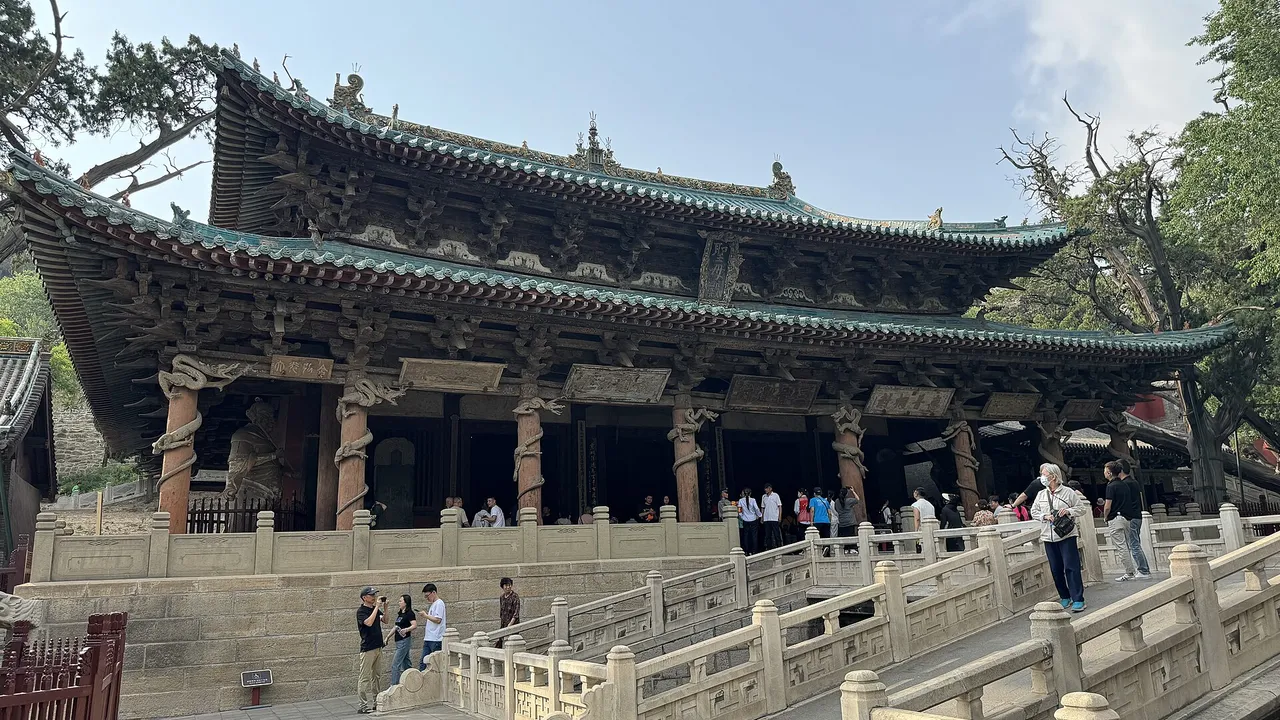
Jinci Temple: Where the Week Begins
The deep week still opens at Jinci, the key to all Jinzhong: the Northern Song Holy Mother Hall, its Song clay attendants, the Flying Bridge and the Never-aging Spring are coordinates that will echo through every later day.
Give it a full three hours, covering the axis, the Fengsheng Temple to the south and the Tang-shuyu shrine to the north. After 3 pm the groups drain away and the porch goes quiet again, the hour for detail shots.
Taiyuan Ancient County Town: A Complete Ming County Specimen
In the afternoon transfer to the county town and read a Ming county's skeleton whole: cross streets, yamen, Confucian temple, city-god temple and barbican all present, the best physical textbook of grassroots urban China.
Climb the walls toward dusk for a half circuit as the moat lights come on. Budget permitting, sleep tonight in a courtyard inn inside the walls, when the empty cross streets at dawn belong to guests.
Tianlongshan Grottoes: Where the Buddha Head Came Home
Day two's mountain line opens at Tianlongshan. The Eastern Wei to Tang figures carry elegant lines, and the repatriated Northern Qi Buddha head of Cave 8, displayed in the gallery at its original site, is the mountain's most moving single exhibit.
The twin-peak boardwalks take ninety minutes, folding in the Shengshou Temple on the ridge before descending. Slanted morning light models every drapery fold, so give the figures your longest looks.
Longshan Grottoes: The Comparative Lesson in Daoist Carving
From Tianlongshan bend north up Longshan. The Yuan-dynasty Daoist caves form China's largest surviving Daoist grotto set, built under the Quanzhen adept Song Defang, the niches carving Daoist patriarchs and Quanzhen masters.
Straight from Buddhist carving, the contrast reads at a glance: plain, restrained, nearly free of jeweled ornament. The coffered ceiling of the Xuhuang niche is the mountain's finest work and rewards a crouch.
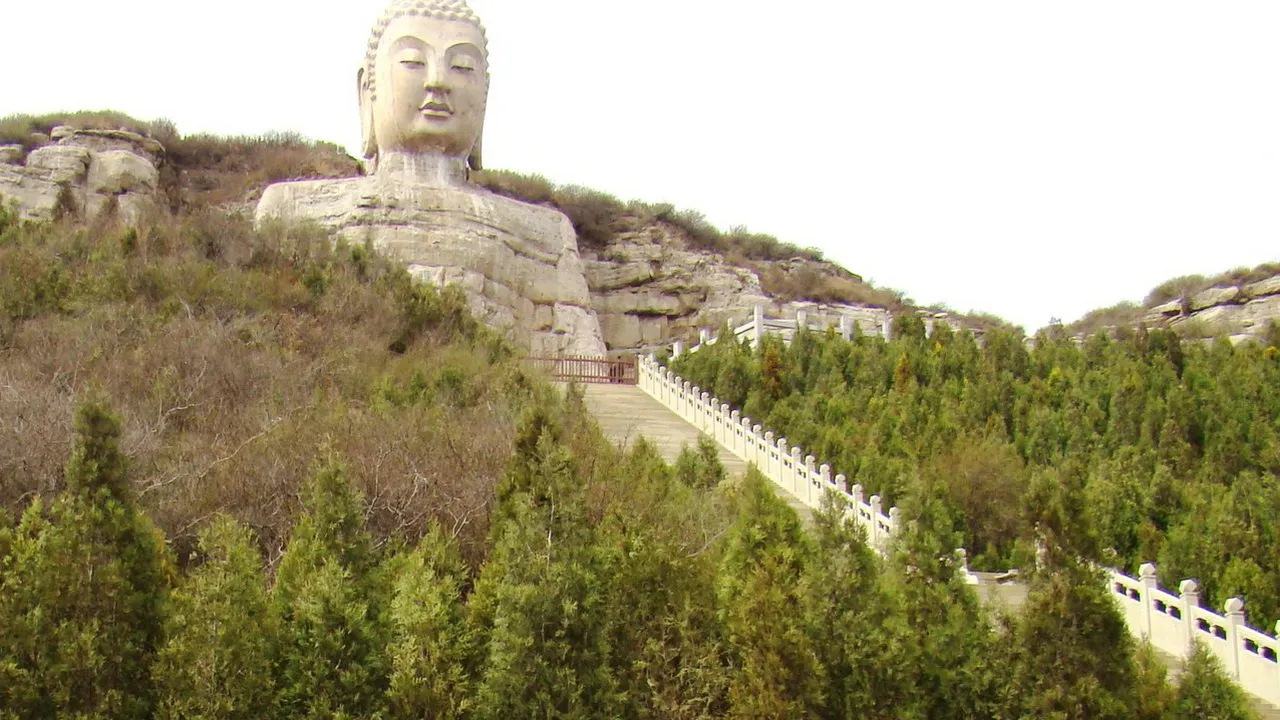
The Mengshan Great Buddha: A Complete Northern Qi Morning
Day three returns to the western ridge. Carved from the cliff in the Northern Qi Tianbao era, the Mengshan Buddha tops sixty meters including its restored head, a century older than Leshan's, the face most complete in morning haze from the worship platform.
Take in the Kaihua temple ruins and the paired Northern Song Lianli towers to grasp the Buddha's full monastic setting, then descend the stream-side trail, smoke trees matching the cliff color in autumn.
Taishan Longquan Temple: The Tang Crypt and the Glazed Gateway
Twenty minutes east of Mengshan lies Taishan. The Tang reliquary of golden coffin within silver casket, unearthed in 2008, displays at its original site, the crypt form echoing Famen Temple, a landmark of Tang Buddhist archaeology in Shanxi.
The axis climb takes about twenty minutes, with the glazed entry gateway and the summit lookout as two compulsory pauses. From the top platform, Jinyang Lake and the western hills read clearest in the afternoon air.
Shanxi Museum: A Whole Morning of Underground Shanxi
Day four turns museum. The grottoes and the great Buddha of the past three days finally get their documentary coordinates: the bird zun anchors the Jin state's origin, the Yu Hong sarcophagus the Silk Road's eastern end, and the chronology slots your week into three thousand years.
Spend the morning on the master galleries and bronzes, saving half an hour for the shop to catch what days one to three left unbought. Lunch in Changfeng, with the Coal Museum next door for the afternoon.
China Coal Museum: Seeing Shanxi's Bedrock Clearly
The afternoon goes underground. The simulated shaft reproduces tunnel and working face at full scale, and the ten minutes riding the mine car into darkness teach what Shanxi is more directly than any lecture.
After surfacing, take in the ancient coal carvings and the 4D cinema, about two hours total. Families should add an hour, since children ask the most questions here of the whole trip.
Juwei Mountain and Duofu Temple: Foliage and Murals
Day five shifts to the northern hills. Juwei's foliage ranks among Taiyuan's Eight Scenes, the whole slope burning with smoke trees in late October; the stone-step loop takes two hours, the ridge lookout facing straight down the Fen valley.
Midway, Duofu Temple keeps Ming murals of the Buddha's life in slope-side halls with few visitors. Save the murals for just before descending, when slanted light through the doorway shows every detail.
The Dou Shrine and Erlong Mountain: Half a Day in Shanglan
Descend into Shanglan village, where the Yuan offering hall of the Dou shrine carries an eight-trigram coffered ceiling, a sleeper hit of Shanxi architecture; ancient cypresses shade the cold spring behind.
Lunch at a village farmhouse, then climb nearby Erlong Mountain, an hour round trip on boardwalks, the summit facing the Fen reservoir. All three stops chain on foot, the loosest day of the seven.
Yongzuo Twin Pagodas: A Morning with the City Totem
Day six gathers the old-city line, starting with the twins. Two Ming brick pagodas top fifty meters, every timber detail ground out of brick; climb the spiral and watch Taiyuan slide from old to new through the slots.
The peony garden east of the yard blooms in late April, Zixiaxian and the pagodas in one classic frame. The morning session is emptiest, no queue for the climb.
Chongshan Temple and the Confucian Temple: Both Sides of Dilianggong Street
Fold back to the old city's southeast. Chongshan's early-Ming Dabei Hall keeps a thousand-armed Guanyin over eight meters; three minutes away the Confucian Temple, now the Shanxi Archaeology Museum, holds hushed ponds and stelae corridors.
Dilianggong Street between them honors the Taiyuan-born statesman Di Renjie, its gateway worth a look. Lunch on knife-cut noodles at a nearby veteran, with the afternoon inside two metro stops.
Chunyang Palace: A Nine-Palace Afternoon
In the afternoon return to Chunyang Palace by Wuyi Square. The Ming Taoist compound builds the nine-palace, eight-trigram cosmos into five courtyards, the final octagon perched on spiraling stairs, climbing like walking a maze, unique among Chinese temples.
As the Shanxi Art Museum, its stone sculpture lines up by era. The rear stelae corridor inlays rubbings after Fu Shan's own hand, unmissable for calligraphy lovers, one last signature of the Taiyuan line before closing.
Qinglong Ancient Town: The Last Lesson on the Old Trade Road
Day seven runs north to Yangqu. Qinglong Town, a stage-post stronghold on the Ming-Qing trade road, spreads its five-li street up the slope with gate forts, stage and ancestral halls intact, footnoting the draft banks and manors of earlier days.
The morning town is quiet, brick-carved gatehouses clustered mid-street, their details sharpest against the light. The hand-pulled beef noodles are the house dish; lunch happens right on the long street.
Souvenirs on Zhonglou Street, Farewell on the Fen: The Week's Close
In the afternoon return to the old city and buy the week's souvenirs in one sweep: frozen Laoshuku yuanxiao, vacuum-packed Liweizhai meats, bulk aged vinegar from Ninghuafu and Shuanghecheng pastry boxes, all within five minutes' walk of one another, with dinner landing on the Food Street.
By evening, taxi to the Fen and slip onto the path by the boat docks, sunset and the light ribbons warming the water. The mountains and pagodas of seven days line up along the current, and the city's skeleton and warmth have both passed through your hands.
| Getting around |
|
| Budget | Entries total about RMB 400-500; seven days with transport and meals run RMB 2,500-3,500 per person. |
| Best time | May and September-October are best; the week reserves slots for foliage and peony seasons, and the museum day dodges Mondays. |
FAQs
Do seven days invite repetition and fatigue?
The flow is engineered: the hill days stagger across the first five, grottoes, Buddha, crypt and foliage each owning a day with no visual overlap. Fatigue clusters on the climbs of days three and five, so keep those afternoons free or end them by lake and river to dissolve it.
How should rain swap the schedule?
Seven days carry redundancy: the museum day, old-city day and shopping finale all swap freely with hill days. Cancel mountains in rain, and avoid the half-open-air caves and crypt too; moving Juwei or Mengshan to a clear day costs nothing in comprehension.
Which stops really need a guide?
Three earn it: Jinci, densest in anecdote per square meter; the Taishan crypt, whose Tang Buddhist archaeology needs a voice; and the Shanxi Museum, where the master galleries halve in efficiency without one. Everywhere else, panels and audio guides suffice.
How should lodging and luggage work across seven days?
Fix one hotel by Zhonglou Street or Duanmen stations for the whole week: a straight run toward Jinci, the three old-city stops on foot or one metro stop, and late mountain returns still covered by the last trains. Leave bags at the hotel, travel light, unpack once.