
Five days is the complete answer for Wulan: the first two soak in Chaka Salt Lake, shooting from sunrise through mirror, sculptures and stars, playing the trump card in full; day three returns to Qinghai Lake for the big water and a sunrise; day four Jinzihai's dune wetland; day five Halihatu's cypress valley before the town close.
Versus a packed three days, nothing here rushes: the salt lake gets two dawn chances and a weather cancellation can simply reschedule, the five-day plan's hidden edge. Charter five days with Chaka town as the anchor.
The five-day line holds its rhythm on anchors: Chaka town anchors everything, every day trip leaving and returning here. Confirm the evening return with the driver each morning, night driving on gravel being this line's only hard risk.
Itinerary at a glance
| 06:30 | Sunrise at the Salt Lake: First Chance at the Mirror |
| 09:30 | Wading the Mirror of the Sky: Stepping into the Reflection |
| 14:00 | The Salt Sculptures: A White-Giant Afternoon |
| 19:30 | Platform Sunset and Town-Edge Stars: Day One's Double Close |
| 08:00 | Xiangpi Pass: The Threshold to Qinghai Lake |
| 11:00 | Heimahe on Qinghai Lake: First Meeting with the Great Water |
| 19:30 | Heimahe Sunset and the Night There |
| 06:30 | Heimahe Sunrise: Qinghai Lake's High Point |
| 15:00 | Jinzihai: The Dune-Ringed Wetland |
| 09:30 | Halihatu Forest Park: The Cypress-Valley Finale |
The route, stop by stop
Sunrise at the Salt Lake: First Chance at the Mirror
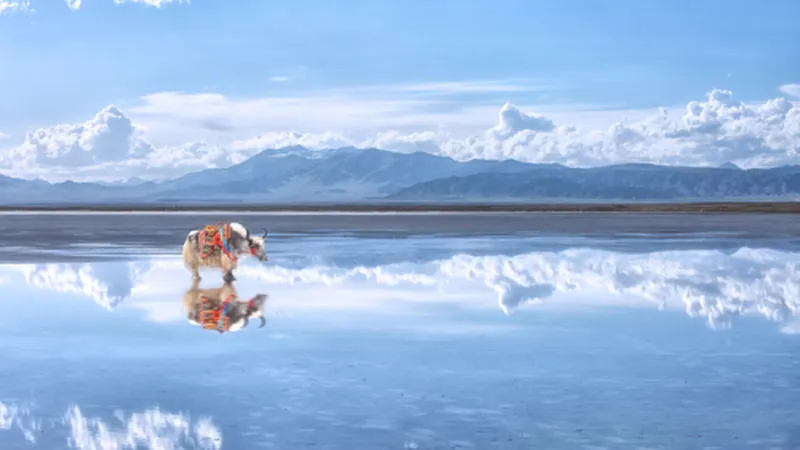
The five-day plan grants the lake two dawns, day one being the scouting run. Windless, the sky and clouds invert whole on the shallow brine, the pale-gold light of sunrise capping every photograph; scattered photographers keep frames clean, earlier meaning cleaner.
After sunrise, breakfast and a nap in town, re-entering the park around nine or ten with legs saved for wading and sculptures.
Wading the Mirror of the Sky: Stepping into the Reflection
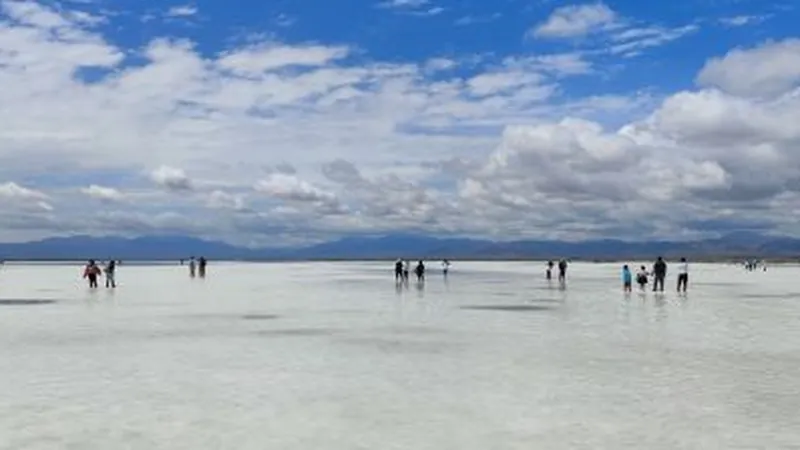
The morning's formal wading: rent covers and walk in, salt crystals fusing to crust under the shallow brine; ten meters out, turn, and your reflection beside the clouds is the canonical Chaka frame. Before ten the water stays glassy, earlier meaning cleaner.
Never cross the warning line and rinse eyes with fresh water at any splash; treat the first wading as feel, saving composition for the second dawn.
Read the reflection by finding clouds first: cloudy mornings give the mirror its layers, cloudless skies turn it flat; ripples reveal wind two or three minutes ahead, so land the moment it starts.
The Salt Sculptures: A White-Giant Afternoon
The afternoon reads the sculptures in the softer light past the zenith. Great figures of the Queen Mother of the West and Genghis Khan glow cold white, weathering and repairs their true growth rings; the side angle, light passing through the salt grain, outclasses the head-on view.
One circuit takes forty minutes; the white ground reflects hard, so pull exposure down a stop and keep sunglasses on.
Platform Sunset and Town-Edge Stars: Day One's Double Close
Dusk lifts you to the platform, pans and harvest rails turning golden silhouettes; after dark retreat to the town edge for the Milky Way. Chaka's light pollution is minimal, and past ten the stars mirror in distant shallows, the lake's gift to night owls.
The lakeside sheds heat fast, so cap stargazing at half an hour; sleep early, one more dawn remains.
Xiangpi Pass: The Threshold to Qinghai Lake
Day three climbs Xiangpi Pass near 3,800 m, the watershed between the salt-flat world and the great-lake world. A blue thread of Qinghai Lake already shows southward, prayer flags snap in wind, and cloud shadows wheel across the slopes at visible speed.
Cap the stop at twenty minutes, move gently, dress warm; mild breathlessness is normal, easing on descent.
Heimahe on Qinghai Lake: First Meeting with the Great Water
Noon lands in Heimahe, the lake after lunch. Qinghai Lake runs so large the far shore dissolves, blue water landing in layers, a different language from Chaka's white. Amble the shore among birds skimming the waves, summer rapeseed edging it all in gold.
The lakeside sits near 3,200 m and blows hard, so walk slow and rest often; keep out of the slick shallows.
The Heimahe shore is stony underfoot, so favor boardwalks or the meadow's edge; town shops restock sunblock and oxygen cans fairer than the scenic gate, supply first, lake second.
Heimahe Sunset and the Night There
Sleep in Heimahe, at the shore half an hour before sunset for the west bank's golden half hour, lake and sky burning gold-red. The town quiets early; mutton noodle soup and kang-pot, then bed, tomorrow's sunrise being the whole point of the night.
Book heated rooms ahead, weekend prices doubling in season; a light first night's insomnia at 3,200 m is normal.
Heimahe Sunrise: Qinghai Lake's High Point
At the shore by 6:30, the sun lifts behind the far ridge, dyeing clouds first then flooding the water, the surface recoloring in seconds. This is the five-day plan's only Qinghai Lake sunrise, worth every minute of the early alarm.
Breakfast in town after, then the return along the lake road with the water riding the windows, rapeseed gilding both sides in season.
Jinzihai: The Dune-Ringed Wetland
Day four's afternoon reaches Jinzihai, freshwater at the desert's rim held in crescent dunes, birds, reeds and sand-lines in one frame, the Qaidam's most contrasting image. Mongolian herders have held it sacred for generations, legend tying it to buried gold.
Walk the rim, keep out of the wetland and leave birds alone; afternoon light layers the dunes, and spare time invites one dune climb for the panorama.
At dusk Jinzihai sometimes draws horse herds down to drink, animals released by herders; shoot from a distance without pressing them, the wetland's bog looking dry but stepping deep, so keep to hard ground where roots show.
Halihatu Forest Park: The Cypress-Valley Finale
Day five's morning enters Halihatu, the juniper woods and streamside trail the only green chapter of the five days. From white salt pan to blue great lake to gold dunes, the deep green of cypress closes the palette at exactly five colors.
The trail runs two to three kilometers under two hours; afternoon showers frequent the woods, so carry rain gear, and spend the late day buying keepsakes in town.
Halihatu's trailhead keeps a ranger register, leave names and headcount before entering; signal flickers in the woods, so fix the meeting time hard, and latecomers wait in place rather than wander.
| Getting around |
|
| Budget | A five-day charter runs RMB 3,000-4,000 per car, with tickets, beds and meals about RMB 1,200-1,800 pp; two-plus nights in Chaka town save most. |
| Best time | June-September is prime, holding mirror, rapeseed and forest-steppe at once; off-season the five days can compress to four. |
FAQs
How much more does five days cost than three, and is it worth it?
Charter costs run RMB 1,200-1,600 higher, RMB 300-400 per person shared, plus two more nights, a gap of five to six hundred per head. What it buys is two dawn chances at the lake and an unhurried clock with high weather tolerance; for photographers, clearly worth it.
Is one day enough for Qinghai Lake?
For this plan's aims, yes: the Heimahe shore, sunset and sunrise collect the lake's three classic frames, while a full circuit needs another two or three days outside Wulan's brief. To add more, extend a half day along the west loop road.
Which of the five days is hardest, and how can it flex?
The Qinghai Lake out-and-back is the grinder: two crossings of Xiangpi Pass plus a sunrise, four hours round trip. The fix is sleeping at Heimahe from day two's afternoon, then after sunrise heading straight for the Jinzihai direction, deleting one full leg.
Does the five-day plan suit elders and children?
Yes, altitude accepted: the line holds 3,100-3,800 m at a naturally easy pace, and elders and children add three things, shorter pass stops, a daily nap, and a portable oxygen can in the bag. Wading is optional; the reflection reads just as fully from the boardwalk.