
A day in Chaozhou's old town never needs rushing: the stone archways of Paifang Street run gate after gate, the incense of Kaiyuan Temple has burned since the Tang, and in the afternoon you cross Guangji Bridge, watching the eighteen shuttle boats open and close on schedule, before ending at Han Wengong Shrine on the east bank. The whole line is walkable and unhurried.
Only one leg is long: getting in from Chaoshan high-speed rail station, shared by Chaozhou and Shantou. An airport-style express bus runs about fifty minutes to the old town. Wear soft shoes for the stone lanes, and when legs tire, any teahouse will pour you a cup of Fenghuang dancong oolong, which is exactly how Chaozhou should be tasted.
Itinerary at a glance
| 09:00 | Paifang Street: Daily Life under the Archways |
| 10:30 | Kaiyuan Temple: A Quiet Late Morning in a Tang Monastery |
| 14:00 | Guangji Tower and Guangji Bridge: Eighteen Boats, Twenty-Four Piers |
| 17:00 | Han Wengong Shrine: Eight Centuries of Gratitude across the River |
The route, stop by stop
Paifang Street: Daily Life under the Archways
On Taiping Road the stone archways stand one after another, two dozen or so Ming and Qing-style memorial gates honoring scholars and officials. Most were re-erected later in original form, but the arcade shops flanking the street are alive, selling preserved citrus, fermented-bean cakes, hand-pulled red clay teapots and Chaozhou embroidery, all honest local crafts.
Start from the north end and walk south without buying yet; read the street's structure first. The real Chaozhou lives in the side lanes around Xima and Yi'an Roads, where residents shop for vegetables and grandmothers brew gongfu tea at their doorsteps, scenes closer to the city's grain than any archway.
Kaiyuan Temple: A Quiet Late Morning in a Tang Monastery
Turn off Paifang Street into Kaiyuan Road and the temple waits at its quiet end. Founded in the twenty-sixth year of the Tang Kaiyuan era, it is honored locally as the foremost monastery of eastern Guangdong; the vast Hall of Heavenly Kings and the stone sutra pillars before the main hall carry a thousand-year scale. Incense never stops, yet order holds, and voices drop on their own.
Details beat dimensions here: corner woodcarving, glazed ceramic ridge figures, couplets on stone columns, all everyday showcases of Chaozhou craft. If a chanting session is on, stand in the cloister and listen to Chaozhou Buddhist music, an unexpected gain for most visitors. Forty minutes covers it.
Guangji Tower and Guangji Bridge: Eighteen Boats, Twenty-Four Piers
After lunch return to Dongmen Street and climb Guangji Tower first. This three-story gate tower crowns the old wall's main gate; from its railing the Han River, the bridge and Han Mountain line up in one view, the most dignified vantage in the city. Pass through the gate arch below and you stand at the bridge's western end.
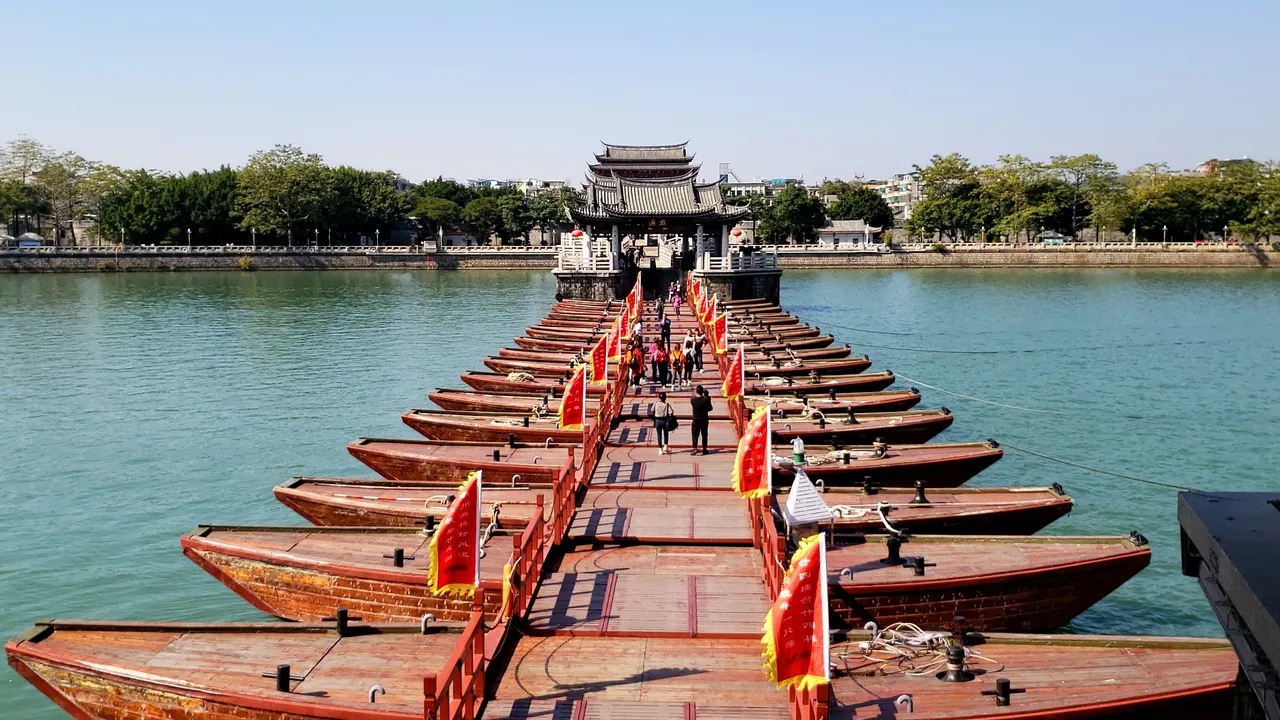
Begun in the Southern Song, Guangji Bridge is a rare hybrid of beam bridge and pontoon: stone piers and beams at both ends, with eighteen shuttle boats lashed mid-river as a floating span, hence the saying of eighteen boats and twenty-four piers. By day the boats join and pedestrians cross as if on solid ground; at dusk the pontoon opens on schedule for river traffic and reassembles next morning, a mechanism refined over eight centuries and still the bridge's real wonder.
Han Wengong Shrine: Eight Centuries of Gratitude across the River
Step off the bridge's east end and the shrine sits at the mountain's foot. Han Yu governed Chaozhou for only eight months, yet the city has remembered him for over a thousand years: the mountain took his surname, so did the river, once wild, now the Han. It is the earliest surviving shrine to Han Yu in the country, rising terrace by terrace, and looking back from its courtyards frames river and bridge in one composition.
An hour suffices. The steles inside reward slow reading, and the terrace out front is the single best camera position for Guangji Bridge. Hold this stop for dusk: when the light bounces off the water and gilds the bridge towers, the day closes on its calmest note.
| Getting around |
|
| Budget | Entries across the old town total about RMB 40-70; with meals a day runs about RMB 200-300 pp. |
| Best time | October to December is the kindest weather; on holidays Paifang Street packs hard, so aim for the bridge before noon or after 3 pm. |
FAQs
What is the easiest way from Chaoshan station to Chaozhou's old town?
Take the express bus line from the station forecourt, which runs straight to the old town in about fifty minutes for roughly RMB 10, timed to arriving trains. With heavy luggage or a group of three, a taxi at about RMB 80 and forty minutes wins. Board only at the official zones and ignore touts.
When does the Guangji Bridge pontoon open? Can I cross at night?
The pontoon detaches at a set evening hour to release river traffic and reassembles the next morning; check the day's posted schedule. While open, no one crosses on foot, so a night return means the upstream road bridge by taxi. Build that return time into your plan.
With only one day, how do I choose between Han Wengong Shrine and Jilue Huang Ancestral Hall?
First visit, pick the shrine: it shares one frame with the bridge and the river, fits the dusk slot naturally, and completes the landscape. The ancestral hall's woodwork is superb but suits a dedicated craft lover; on a tight day skip it or give it a brisk half hour another time.
What should I know about joining gongfu tea in Chaozhou?
Gongfu tea comes in tiny cups served hot, poured by the host in seating order; thank the pourer by tapping two fingers on the table, no fuss needed. The tea is Fenghuang dancong, high in aroma and brisk in effect, so avoid it on an empty stomach and late brews cost sleep. Teahouses in town run RMB 30-80 a head, and a sitting lasts half an hour at least, so arrive unhurried.