
Datong's heritage density ranks near the top of northern Chinese cities: Yungang alone is a Northern Wei national project, the two great Liao-Jin temples pair with a Ming princely screen and walls, and three days walk one dynasty line: Northern Wei, Liao-Jin, Ming-Qing.
The theme here is dating: along one circuit you learn to tell Liao's open clarity from Jin's density, Northern Wei vigor from Ming order. Day one gives Yungang and the wall, day two the temples and the princely survivor, day three the museum and the Drum Tower, the order itself a chronology.
Itinerary at a glance
| Day 1 · 08:30 | Yungang Grottoes: A Close Reading of the Tanyao Five Caves |
| Day 1 · 11:30 | Caves 5 and 6 and the Five-Color Caves: Yungang's Second Half |
| Day 1 · 18:00 | Datong's City Wall: The Ring of Lights at Night |
| Day 2 · 09:00 | Huayan Temple: Daxiongbao Hall and the Sutra Repository |
| Day 2 · 14:00 | Shanhua Temple: The Field Site for Comparing Liao and Jin |
| Day 2 · 16:00 | The Nine-Dragon Screen and the Dai Palace: Survivors of Ming Princely Order |
| Day 2 · 17:30 | Fahua Temple: Closing the Liao-Jin Day beneath the White Stupa |
| Day 3 · 09:00 | The Datong Museum: Putting Two Days behind Glass |
| Day 3 · 14:00 | The Liang Sicheng Memorial: An Academic Footnote to Three Days |
| Day 3 · 16:00 | The Drum Tower: The High Close to Three Heritage Days |
The route, stop by stop
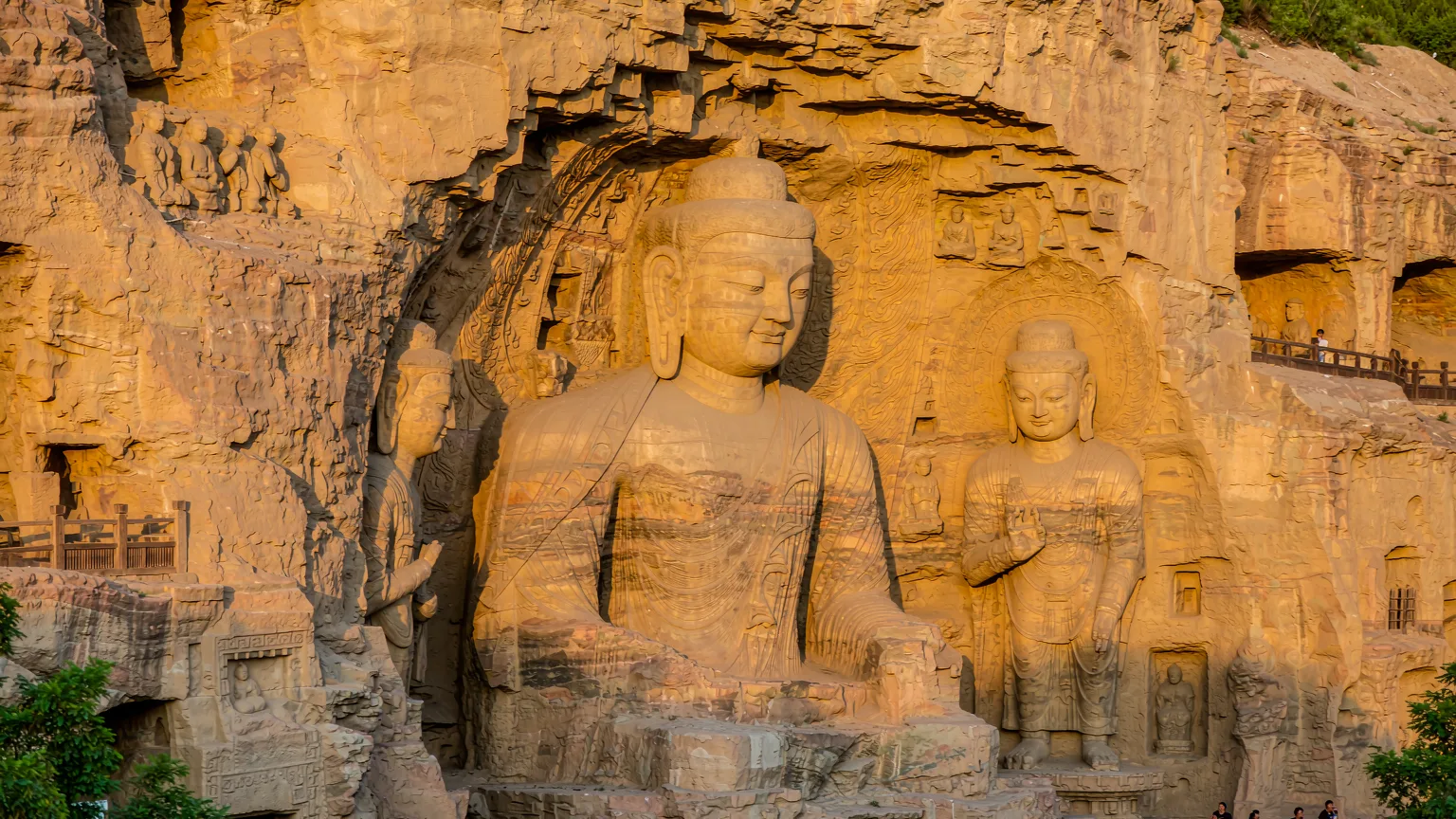
Yungang Grottoes: A Close Reading of the Tanyao Five Caves
Open the three days with a full Yungang. Head west at opening to the Tanyao Five Caves; the reading of the great Buddhas as five Northern Wei emperors stays debated, but the imperial grandeur does not: every fold of the cassock is power cut by chisel.
Morning light from the east gives the open-air Cave 20 colossus its fullest facial modeling. Three hours reads the five caves and the middle group properly, and a guide earns the fee, since the Northern Wei story needs a voice.
Caves 5 and 6 and the Five-Color Caves: Yungang's Second Half
Walk back from the Tanyao caves into Yungang's second half. Caves 5 and 6 form a pair, their central pillars carved on all faces with the Buddha's life story, among the best-preserved color at the site; Caves 9 through 13, the Five-Color group, pack later pigments wall to wall.
Cave 12, the famous music cave, records the Northern Wei orchestra in stone. Save your best legs for this stretch: steps and sills abound and the density runs high, two slow hours fitting it exactly.
Datong's City Wall: The Ring of Lights at Night
Return at dusk and close the Northern Wei day on Ming defenses. The 7.2-kilometer circuit runs whole again with restored walls and corner towers, climbing free.
At night the light ribbons unroll along the parapets; walk a stretch of the south wall from Yongtai Gate and turn to take in both Huayan's roofs inside and the Yuhe river out. Buddhas by day, walls by night: this is where Datong's depth comes from.
Huayan Temple: Daxiongbao Hall and the Sutra Repository
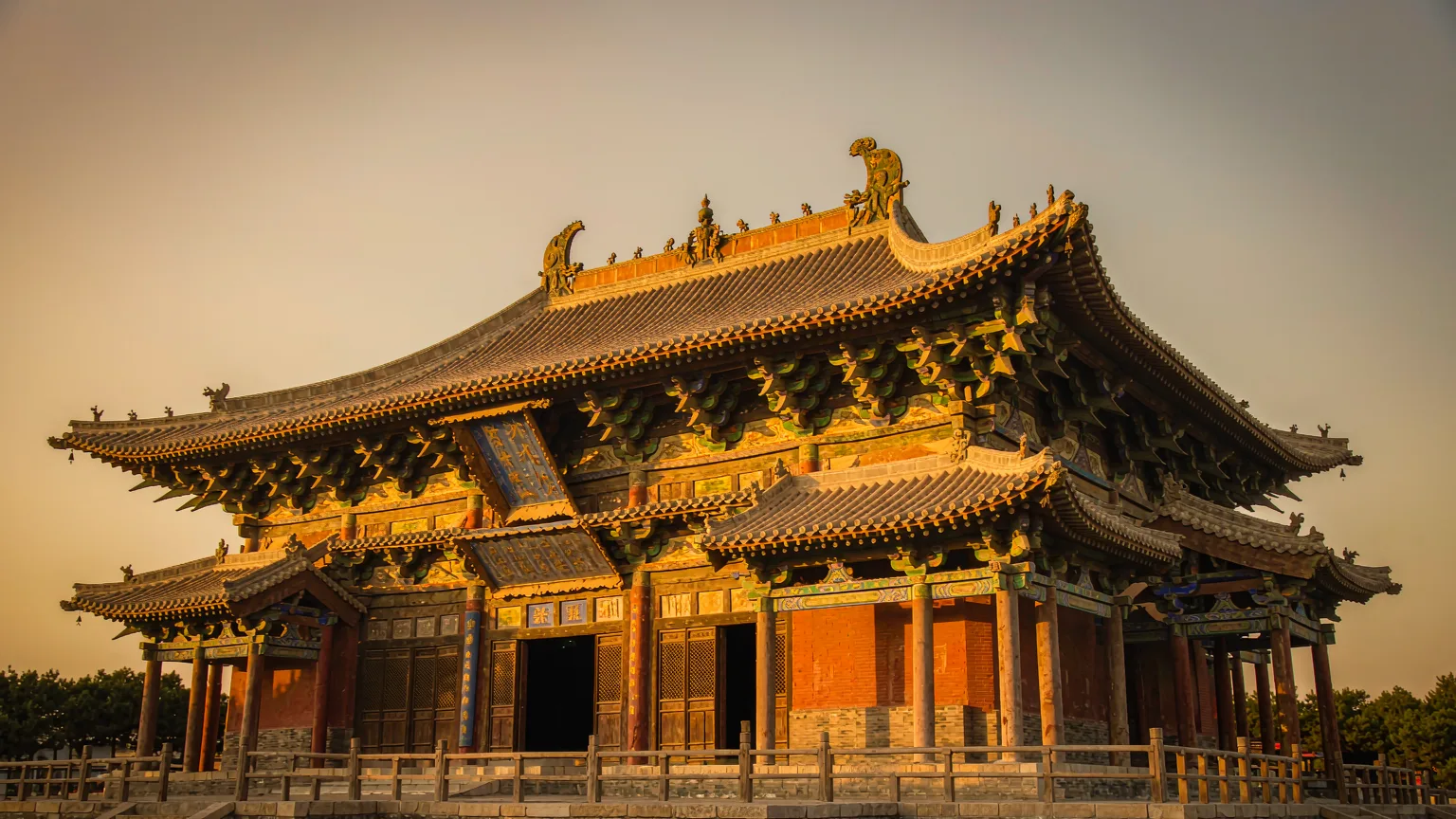
Day two's Liao-Jin line opens at Huayan. The upper Daxiongbao hall runs nine bays, among the largest surviving Liao-Jin Buddha halls; the lower Bhagavat Sutra Repository is original Liao, its wall of celestial pavilions the piece Liang Sicheng called unique under heaven.
The palm-together smiling bodhisattva stands inside the repository, graceful and sidelong. Three minutes separate the halls; give the pair two hours to read the roof ornaments, the reduced-column framing and the figures one by one.
Shanhua Temple: The Field Site for Comparing Liao and Jin
In the afternoon walk south to Shanhua. Its four principal buildings, gate hall, Three Sages hall, Puxi pavilion and the great hall, stage themselves in phases across one yard: Liao's open clarity in dialogue with Jin's density across a single square.
The twenty-four heavenly attendants in the great hall are the climax, every robe fold and face its own drama. Coming straight from Huayan, your dating eye is open, and the differences in roof pitch and bracket sets start reading themselves.
The Nine-Dragon Screen and the Dai Palace: Survivors of Ming Princely Order
Back at the old center from Shanhua. The Nine-Dragon Screen was the front wall of prince Zhu Gui's Ming palace, 45.5 meters of over four hundred glazed blocks churning nine dragons, three centuries older than Beijing's Beihai screen.
The Dai palace beside it rose again in recent years as a full reconstruction, its compound plan worth a walk at posted prices. Screen plus palace together make the physical form of Ming enfeoffment in a regional city legible at a glance.
Fahua Temple: Closing the Liao-Jin Day beneath the White Stupa
Day two closes at Fahua Temple on the northeast. The dome-shaped white stupa, first raised in the Yuan, glows through the restored courtyards, the most photogenic tower inside the walls.
Dusk softens the light for a twenty-minute circuit. From Huayan to Shanhua to the stupa, a day spans Liao, Jin and Yuan building idioms, and the dating homework finishes itself on the walk.
The Datong Museum: Putting Two Days behind Glass
Day three's morning goes to the city museum. Yungang and the two temples finally get documentary coordinates here: the Pingcheng figure ranks, Silk Road relics and Liao-Jin units turn the standing city into a complete chronological stack.
The processional army from the Sima Jinlong tomb anchors the museum, hundreds of figures in marching order. Two hours covers all, Pingcheng first, Liao-Jin-Yuan after, and arriving with questions doubles the yield.
The Liang Sicheng Memorial: An Academic Footnote to Three Days
In the afternoon return to the foot of the east wall for the small, sharp Liang Sicheng Memorial. In 1933 Liang and Lin Huiyin surveyed Datong's buildings and Yungang, and the displays keep their field drawings and photographs: every hall of the past two days has a drawing here.
Placing the memorial last is deliberate: only after the buildings themselves do the measured drawings reveal what unique under heaven really weighed. An hour suffices, and the dense captions reward slow reading.
The Drum Tower: The High Close to Three Heritage Days
The final stop is the Drum Tower. This Ming three-tiered tower stands on Gulou East Street, the zero point of the old skyline; climb it or simply stand beneath, because the point is position: the four streets radiating from it are every line these three days have walked.
If the climb is open, the axis toward Sipailou reads most complete from the top. Descend to night snacks on Gulou East Street, and Datong's three days close over charcoal and vinegar, from Northern Wei Buddhas to a Ming tower.
| Getting around |
|
| Budget | Entries total about RMB 250-350, Yungang the biggest line; three days with transport and meals run RMB 800-1,200 per person. |
| Best time | May-June and September-October are best; museums close Mondays, and Yungang demands the opening hour. |
FAQs
What order makes the most sense for three days?
Run it by dynasty: Northern Wei first (Yungang and the wall), then Liao-Jin (the temples and princely survivor), closing with the museum and Drum Tower. The museum sits last on purpose; labels read twice as well after the buildings, though reversal costs only the pleasure of matching things up.
Do I need guides or audio devices?
Two earn a guide: Yungang, whose carving program and imperial context need a voice, and Huayan, dense with repository and column tricks. Elsewhere panels suffice, with shared-guide options at Shanhua and the museum; decide by the day's energy.
Is the Dai palace worth its ticket?
Depends on taste: it is a recent full reconstruction, valuable for plan and mass rather than original fabric. Worth entering for Ming princely institutions or teaching kids urban functions; the screen alone already carries most of the historical message.
Which day works best as the rain backup?
Day three flexes best: museum and memorial are fully indoor and the tower barely matters. Give Yungang the first clear day, run the two temples in light rain since visits sit indoors, and on heavy rain simply swap days one and three.