
Datong's nature runs hard: the granite spine of the Northern Peak, volcanic cones by the Sanggan, loess terraces wind-carved into pillars. Three days grade by hardness, climbing and the hanging temple first, volcanoes and earth forest second, two lakes softening the close.
Transport is the hard part: Heng and the Hanging Temple lie in Hunyuan county, the volcano field and earth forest in Yunzhou district, with thin public transport, so charter or drive; overnight at the springs in Hunyuan saves the round trip on day two.
Itinerary at a glance
| Day 1 · 08:30 | Mount Heng: A Morning on the Northern of the Five Peaks |
| Day 1 · 13:30 | The Hanging Temple: Fifteen Hundred Years on a Cliff Face |
| Day 1 · 17:00 | Hunyuan's Tangtou Hot Springs: A Warm Night below the Mountain |
| Day 2 · 09:00 | The Datong Volcano Field, Langwo Cone: Walking a Dead Volcano |
| Day 2 · 11:30 | The Volcano Field, Jinshan Cone: The Most Colorful of the Craters |
| Day 2 · 14:30 | The Datong Earth Forest: Loess as the Wind Carves It |
| Day 2 · 17:00 | Sanggan River National Wetland Park: Wetland below the Volcanoes |
| Day 3 · 09:00 | Wenying Lake Ecological Park: The Great Mirror of the Eastern District |
| Day 3 · 14:00 | The Yuhe Ecological Park: From the Old East Wall to the Riverbank |
The route, stop by stop
Mount Heng: A Morning on the Northern of the Five Peaks
Mount Heng is the Northern Peak of the Five, its summit ridge topping two thousand meters. Stone steps climb from the gate through pine wind and Taoist halls, past the giant Hengzong cliff inscription, the mountain's signature, to the hall platform facing the Hunyuan basin.
The round trip runs four hours, with a cableway erasing most of the climb. Heng's appeal is stance: the ridge ranks like a screen, less cultured than Tai or sheer as Hua, a mountain closer in temperament to the frontier passes.
The Hanging Temple: Fifteen Hundred Years on a Cliff Face
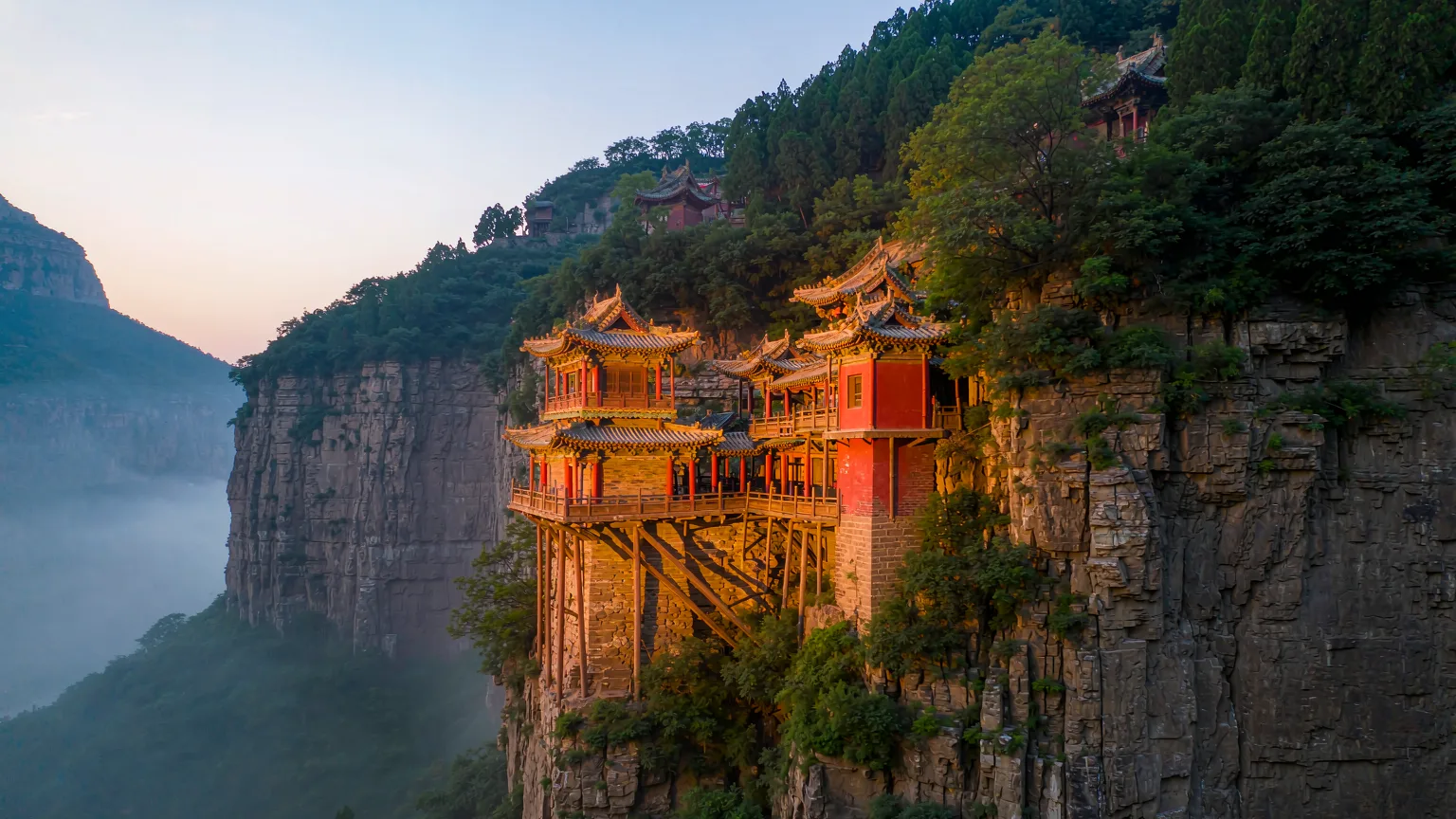
Ten minutes down from Heng lies the Jinlong gorge. The Hanging Temple clings halfway up Cuiping cliff, founded in the late Northern Wei, its posts and beams set into the rock, with the three characters for hanging, marvel and ingenuity serving as its entire manual.
Inside, the Three-Religions Hall seats Buddha, Laozi and Confucius together, a rare shared altar in China. The climbing walkways are narrow and capped; vertigo sufferers can gaze up from the valley floor, an equally stunning angle.
Hunyuan's Tangtou Hot Springs: A Warm Night below the Mountain
Soaking after the climb is the route's hidden design. Hunyuan's Tangtou springs trace to the Northern Wei, hot and mineral-rich, and one soak zeroes out a climbing day's aches.
Resort hotels like the Northern Wei Tanggong open to guests and walk-ins alike. Rest early after the bath: day two's volcano line starts from Hunyuan, saving over an hour versus setting out from Datong city.
The Datong Volcano Field, Langwo Cone: Walking a Dead Volcano
Day two's geology line opens in Yunzhou district. This is North China's largest Quaternary volcanic field, a dozen dead cones scattered along the Sanggan valley, Langwo the biggest of them.
Boardwalks spiral from the base to the crater rim, an hour around. The cone's strata band clearly in sunlight, basalt rubble crunching underfoot, the most direct place to feel that the planet once had a pulse here.
The Volcano Field, Jinshan Cone: The Most Colorful of the Craters
Ten minutes by car from Langwo stands Jinshan. Mineral oxidation bands its slopes in ochre and gold, richest when slanted light cuts across before evening, the photographic headliner of the field.
Jinshan runs smaller than Langwo, twenty minutes on foot to the rim. Seeing both cones in sequence explains how one magma source prints different forms in different eruptive phases.
The Datong Earth Forest: Loess as the Wind Carves It
In the afternoon, reach the earth forest at Duzhuang in Yunzhou. Wind and water have carved the loess terraces into stands of pillars and walls like castles or woods, Datong's most unexpected geological scene.
Evening is the hour: slanted light draws every edge of the columns, silhouette and warm tone online at once. The walking loop takes an hour, and photographers routinely spend it through to sunset.
Sanggan River National Wetland Park: Wetland below the Volcanoes
In the evening, run south to the Sanggan. This feeder of the Hai river system spreads into wetlands across Yunzhou, reeds and open water framing distant volcano cones, a soft scene rare for the frontier.
Swans and geese stop over in spring and autumn, rewarding binocular-grade birding. Walk the boardwalks to sunset, and the geology day closes on birdsong.
Wenying Lake Ecological Park: The Great Mirror of the Eastern District
Day three eases back into town. Wenying Lake is the eastern district's largest body of water, its free park flipping the museum and new skyline into full reflection, home turf for runners and riders.
The loop runs about five kilometers on foot or rented bike. The water lies calmest in the morning for photos, softening the hard volcanoes and wetlands of the day before.
The Yuhe Ecological Park: From the Old East Wall to the Riverbank
Close the afternoon walking the linear parks along the Yuhe. The river slides past the old town's east, its green banks running from the wall's base toward Wenying Lake, stitching old city to new.
The stretch beneath the east wall works best: restored Ming brick on one side, river and wetland on the other, the frontier dusk gilding both. The three days close here, and evening trains from the old town remain comfortably catchable.
| Getting around |
|
| Budget | Entries and hot springs total about RMB 400-600; with transport and meals, three days run roughly RMB 1,000-1,500 per person. |
| Best time | May-June and September-October are steadiest; Heng's summit is windy, and winter climbing demands sub-zero gear. |
FAQs
Can Heng and the Hanging Temple share one day?
Yes, and it is the standard play: climb Heng in the morning (three hours with the cableway), eat Hunyuan liangfen at the base, queue for the Hanging Temple before 1 pm, then close with the springs. Without the cableway, split the pair across two days.
Is climbing the Hanging Temple worth the queue?
Worth doing once, but not worth obsession: the climb teaches how thin the boards are, while the building's total effect reads better from the valley floor. In peak-season queues past an hour, take the distant view first and add the climbing ticket when the line thins.
Do the volcano field and earth forest work in winter?
Yes, in another register: snow on the cones and pillars composes strikingly clean with almost no visitors. The cost is wind, cold and slick boardwalks, so dress below minus ten and compress the visit into the two hours around midday.
Is three days feasible without a car?
Barely, with a discount on experience: the Hunyuan direction has coaches and shared rides, while the Yunzhou cones and earth forest lack real public transport. Solo, mix public links plus local shared rides for Hunyuan and a half-day charter for Yunzhou, slightly cheaper than full charter but far more coordinating.