
Seven days are Datong's full answer: two days by dynasty across Northern Wei and Liao-Jin, a museum-and-lake catch-up, mountains and geology on days four and five, wall forts on six, and the old town's lanes closing seven. It is the one-day trip's three lines stretched to full length.
The routing's key move is one night in Hunyuan: day four takes Heng, the Hanging Temple and Hunyuan's old town, and day five runs straight from Hunyuan to Yunzhou's volcanoes and earth forest, saving two round trips to the city. Base at the old town throughout, Hunyuan the single exception, luggage light and rhythm steady.
Itinerary at a glance
| Day 1 · 08:30 | Yungang Grottoes: An Opening That Earns the Whole Day |
| Day 1 · 18:30 | Datong's City Wall: A Night Framing Wei and Ming |
| Day 2 · 09:00 | Huayan Temple: A Complete Liao-Jin Morning |
| Day 2 · 11:00 | The Nine-Dragon Screen and the Dai Palace: Ming Princely Order in the Flesh |
| Day 2 · 14:00 | Shanhua Temple: The Field Site for Liao-Jin Comparison |
| Day 3 · 09:00 | The Datong Museum: Putting Two Days behind Glass |
| Day 3 · 14:00 | Wenying Lake Ecological Park: A Lake-Borne Rest on Museum Day |
| Day 4 · 08:30 | Mount Heng: A Climbing Morning on the Northern Peak |
| Day 4 · 13:30 | The Hanging Temple: Fifteen Hundred Years on a Cliff |
| Day 4 · 16:00 | Hunyuan Old Town: An Evening of Yong'an and Yuanjue |
| Day 5 · 09:00 | The Volcano Field, Langwo Cone: Walking a Dead Volcano's Rim |
| Day 5 · 14:30 | The Earth Forest: Loess Castles and Woods |
| Day 6 · 09:00 | Deshengbu Fort: The Gate of the Longqing Market Peace |
| Day 6 · 14:00 | Shoukoubu Fort: Apricot Blossoms Framing the Wall |
| Day 7 · 10:00 | Fahua, Dongnanyi and Gulou East Street: The Old-Town Close |
The route, stop by stop
Yungang Grottoes: An Opening That Earns the Whole Day
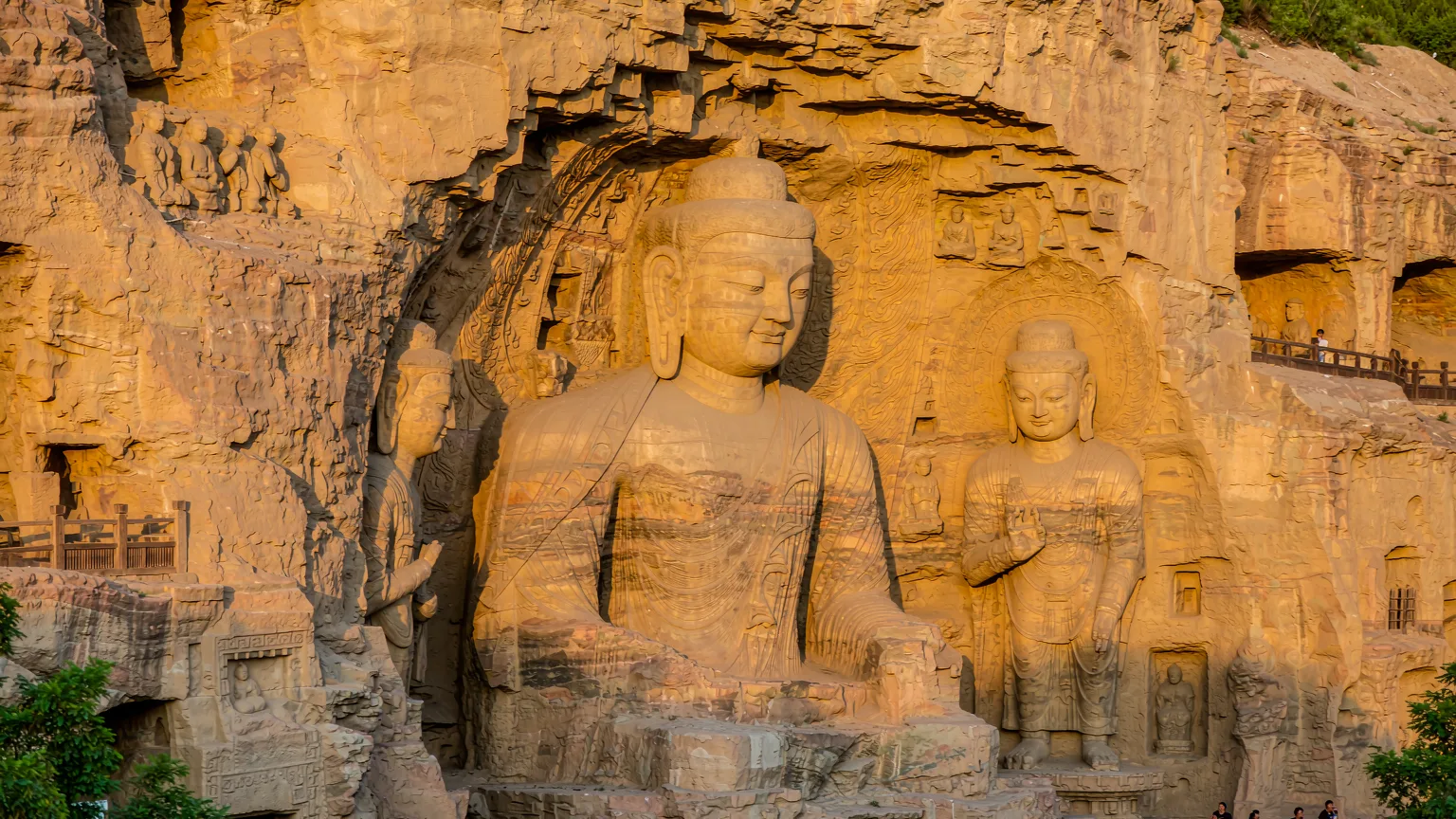
Day one of the seven belongs entirely to Yungang. Enter west at opening for the Tanyao Five Caves; the open-air Buddha of Cave 20 is the shared cover image of grottoes and city alike, its face fullest in morning light on the cliff.
In the afternoon return for the central pillars of Caves 5 and 6, the painted Five-Color group, closing on the music cave's Northern Wei orchestra. A guide earns the fee: the imperial Northern Wei context needs a voice.
Datong's City Wall: A Night Framing Wei and Ming
Return at dusk and climb at Yongtai Gate. A day among Northern Wei Buddhas ends on walls raised by the Ming, light ribbons unrolling along the 7.2-kilometer circuit, corner towers against the sky.
A stretch of the south wall suffices. Buddhas by day, walls by night is the first lesson in Datong's depth, and the next six days keep returning to this frame.
Huayan Temple: A Complete Liao-Jin Morning
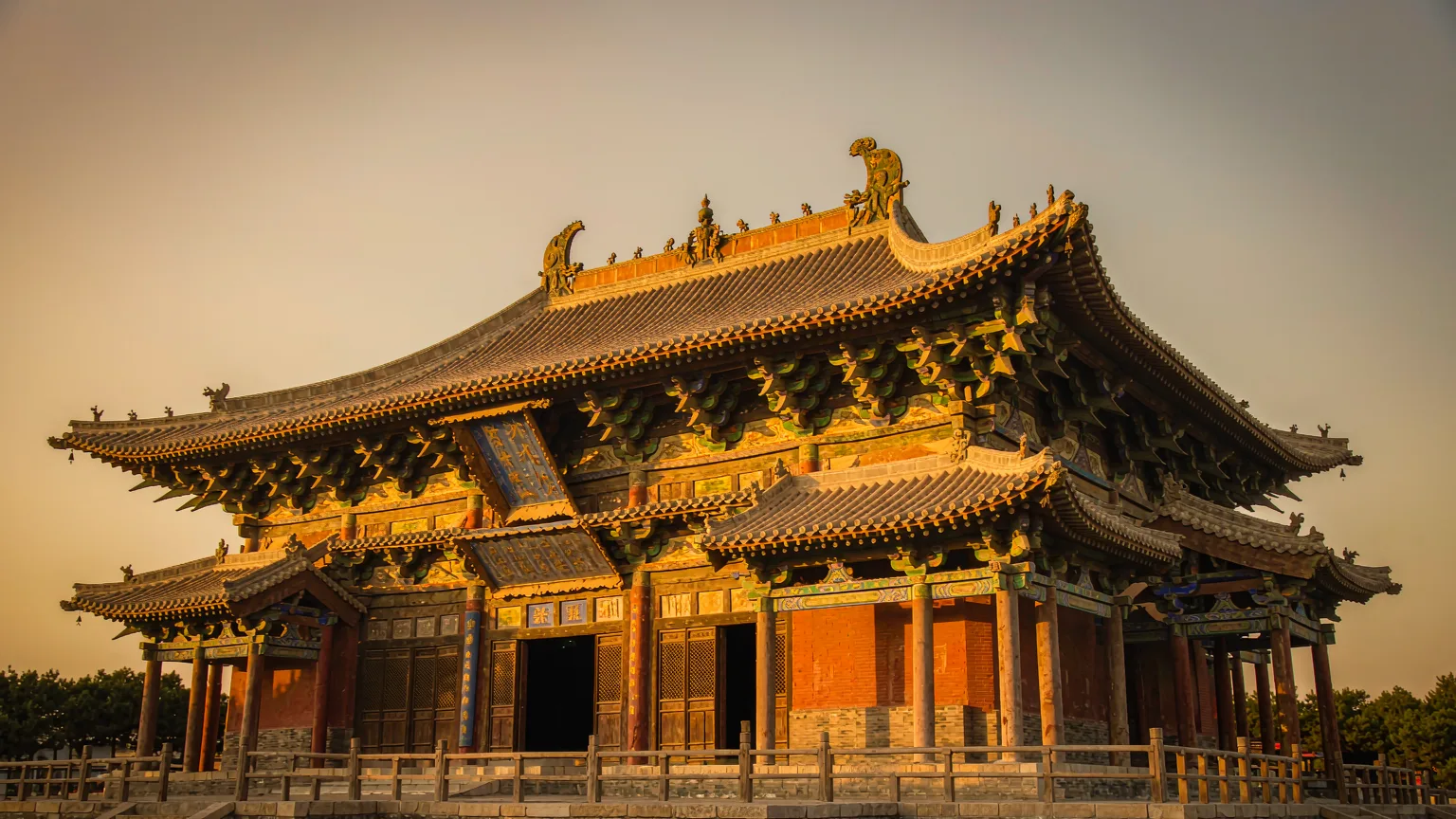
Day two's Liao-Jin line opens at Huayan. The upper Daxiongbao hall runs nine bays, among the largest surviving Liao-Jin Buddha halls; the lower repository is original Liao, its wall of celestial pavilions the piece Liang Sicheng called unique under heaven.
The palm-together smiling bodhisattva stands inside that hall. Enter at opening and give two hours to both halls, the frames and the figures, shared guides at the front gate.
The Nine-Dragon Screen and the Dai Palace: Ming Princely Order in the Flesh
Ten minutes on foot from Huayan stands the Nine-Dragon Screen, nine dragons in over four hundred glazed blocks, three centuries older than Beijing's Beihai screen, with morning sun square on the face.
The rebuilt Dai palace beside it shows its compound plan at posted prices. Screen plus palace together make Ming enfeoffment's physical form in a regional city legible at a glance.
Shanhua Temple: The Field Site for Liao-Jin Comparison
In the afternoon, reach Shanhua south of the center. Four Liao-Jin buildings stage themselves in phases across one yard, gate hall, Three Sages hall, Puxi pavilion and great hall, a standing case study in every architecture survey.
The twenty-four heavenly attendants in the great hall are the climax, answering Huayan's bodhisattva from the morning. With the dating eye now open, differences in roof pitch and bracket density read at a glance.
The Datong Museum: Putting Two Days behind Glass
Day three's morning is catch-up. After Yungang and the temples, the Pingcheng figure ranks, Silk Road relics and Liao-Jin units explain why Datong is Datong: nearly a century of Northern Wei capital history sits in the cases.
The processional army from the Sima Jinlong tomb anchors the museum. Two hours covers all, and arriving with two days of questions doubles the yield.
Wenying Lake Ecological Park: A Lake-Borne Rest on Museum Day
The afternoon softens. Wenying Lake is the eastern district's largest body of water, an easy hop from the museum, its free park flipping the new skyline into full reflection.
The loop runs five kilometers, half of it plenty. Riders, runners and birders each hold a stretch, the loosest afternoon of seven, banking strength for day four's climb.
Mount Heng: A Climbing Morning on the Northern Peak
Day four's physical peak opens at Heng. Set out at dawn for Hunyuan, where stone steps and pine wind carry you to the Hengzong hall, the giant cliff inscription the mountain's signature, the summit facing the Hunyuan basin.
The cableway erases most of the climb, a pure hiking round trip running four hours. Frontier temperament meets the Five Peaks pedigree on this one mountain, the widest view of the week.
The Hanging Temple: Fifteen Hundred Years on a Cliff
Ten minutes down from Heng lies the Jinlong gorge. The Hanging Temple clings halfway up Cuiping cliff, founded in the late Northern Wei, its posts and beams set into the rock, the Three-Religions Hall's shared altar a national rarity.
Walkways run capped and one-way, while the valley-floor view matches the climb for shock. On the deep week, climb it regardless: standing on the hanging boards over the Heng gorge is the trip's highlight memory.
Hunyuan Old Town: An Evening of Yong'an and Yuanjue
After the descent, enter Hunyuan's county seat. Yong'an's Yuan water-land murals carry ten great wrathful kings in the original Zhengfa hall, and ten minutes away the Jin brick pagoda of Yuanjue crowns its wind-vane bird.
Two hours covers both in soft evening light. Sleep in Hunyuan tonight over an authentic bowl of liangfen, since tomorrow's volcano line starts here, saving ninety minutes of driving.
The Volcano Field, Langwo Cone: Walking a Dead Volcano's Rim
Day five's geology opens in Yunzhou district. North China's largest Quaternary volcanic field scatters a dozen dead cones along the Sanggan valley, Langwo the biggest of them.
Boardwalks spiral from the base to the crater rim, an hour around; basalt rubble crunches underfoot, about ninety minutes by car from Hunyuan.
The Earth Forest: Loess Castles and Woods
In the afternoon, reach the earth forest at Duzhuang. Wind and water have carved the loess terraces into stands of pillars and walls like castles or woods, Datong's most unexpected geological scene.
Evening is the hour: slanted light draws every edge, silhouette and warm tone online at once. The loop takes an hour, photographers routinely staying through sunset, so enter by four.
Deshengbu Fort: The Gate of the Longqing Market Peace
Day six runs north to Xinrong district, an early start from Hunyuan or Datong. Deshengbu was a keystone of the Ming wall defense, and in 1571 the Longqing peace sealed here opened the horse market and a century of trade.
Gate, barbican and inner street survive whole, villagers still living beneath the walls; from the gate tunnel the north view takes in the wall line and the steppe beyond.
Shoukoubu Fort: Apricot Blossoms Framing the Wall
In the afternoon, run east to Shoukoubu in Yanggao. This Ming garrison plugs a mountain pass, walls joined to the Great Wall, with late-April apricot blossoms spilling along the rammed earth, a famous frame for Shanxi wall photography.
Out of season it keeps its desolation: bare loess ramparts and wind straight off the steppe. From the wall top the watchtowers march west to the horizon, and the fort day closes in evening light.
Fahua, Dongnanyi and Gulou East Street: The Old-Town Close
Day seven returns to the old town and gives the last day to its lanes. Start at Fahua Temple for the Yuan white stupa and a circuit around it, then drift into Dongnanyi's courtyards, reviewing a week of photos over courtyard coffee.
The evening's closing snacks on Gulou East Street, rabbit head, skewers and sea-buckthorn juice, sit beneath the Ming Drum Tower with seven days of grottoes and mountains at your back. The deep line closes its circle, and the train home leaves from Datong South.
| Getting around |
|
| Budget | Entries total about RMB 500-700; seven days with transport, meals and the Hunyuan night run RMB 2,800-3,800 per person. |
| Best time | May-June and September-October are best; the week also fits April's blossom season, and the museum day dodges Mondays. |
FAQs
Are seven days too long, with repetition?
No, each day owns a theme: two Northern Wei days, one Liao-Jin, one geological, one mountain, one wall-fort day, and a street-life close. The only repeat is returning to the old town, which doubles as the free nightly finale anyway.
Is the night in Hunyuan really necessary?
Strongly yes: returning to Datong after the springs and old town costs two extra hours of driving and real fatigue. Hunyuan rooms run just over a hundred yuan with breakfast, and day five reaches the volcano field directly, the week's best-value decision.
Who suits the wall-fort line?
It suits travelers with history or photography interests who accept blank public transport and thin supplies, and does not suit children under seven or anyone with limited mobility. The late-April blossom window is the line's visual peak, so photographers should target it first.
How do I hold the seven-day budget?
The big lines are charter and tickets: negotiate a four-day charter near six hundred yuan daily, cheapest split four ways; among entries only Yungang, Heng and the Hanging Temple are must-buys, the rest mostly free. With a budget old-town hotel plus the Hunyuan night, the whole week closes near RMB 2,800 a head.