
Seven days is not five plus two more sights but a different gait: one mountain trip sleeping two nights, villages split by theme into separate days, museums, craft and a show slotted as rain and fatigue backups. At this length you slow down, and only slowing reveals Huizhou's interior.
Structurally, days one and two warm up in Tunxi, three and four climb the mountain, five recovers through Emerald Valley and the springs, six and seven cover villages and the old town. Every day carries a rain alternative, so the week survives a full day of weather.
Itinerary at a glance
| 14:00 | Tunxi Old Street and Liyang Lane: Arrival Day |
| 19:30 | The Huishow: An Opening Overture |
| 09:00 | The China Huizhou Culture Museum: Framing Day |
| 14:00 | The Huashan Grottoes: An Unsolved Riddle by the River |
| 07:30 | The Yugu Cableway and Shixin Peak: Mountain Day One |
| 09:00 | Beihai and Brightness Summit: A Slow Ridgeline Day |
| 05:30 | Sunrise and the Yuping Descent: Goodbye to the Mountain |
| 09:30 | Emerald Valley: A Holiday for the Legs |
| 14:00 | The Huangshan Hot Spring: Reward for Two Days of Stone |
| 09:00 | Hongcun: A Morning of Water |
| 14:00 | Xidi: An Afternoon of Carving |
| 08:30 | Tachuan and Lu Village: The Autumn Unit |
| 13:00 | Huizhou Old Town and the Xu Guo Archway: A Prefecture Afternoon |
| 16:00 | The Yuliang Weir and Fish Lanterns: The Week's Last Light |
The route, stop by stop
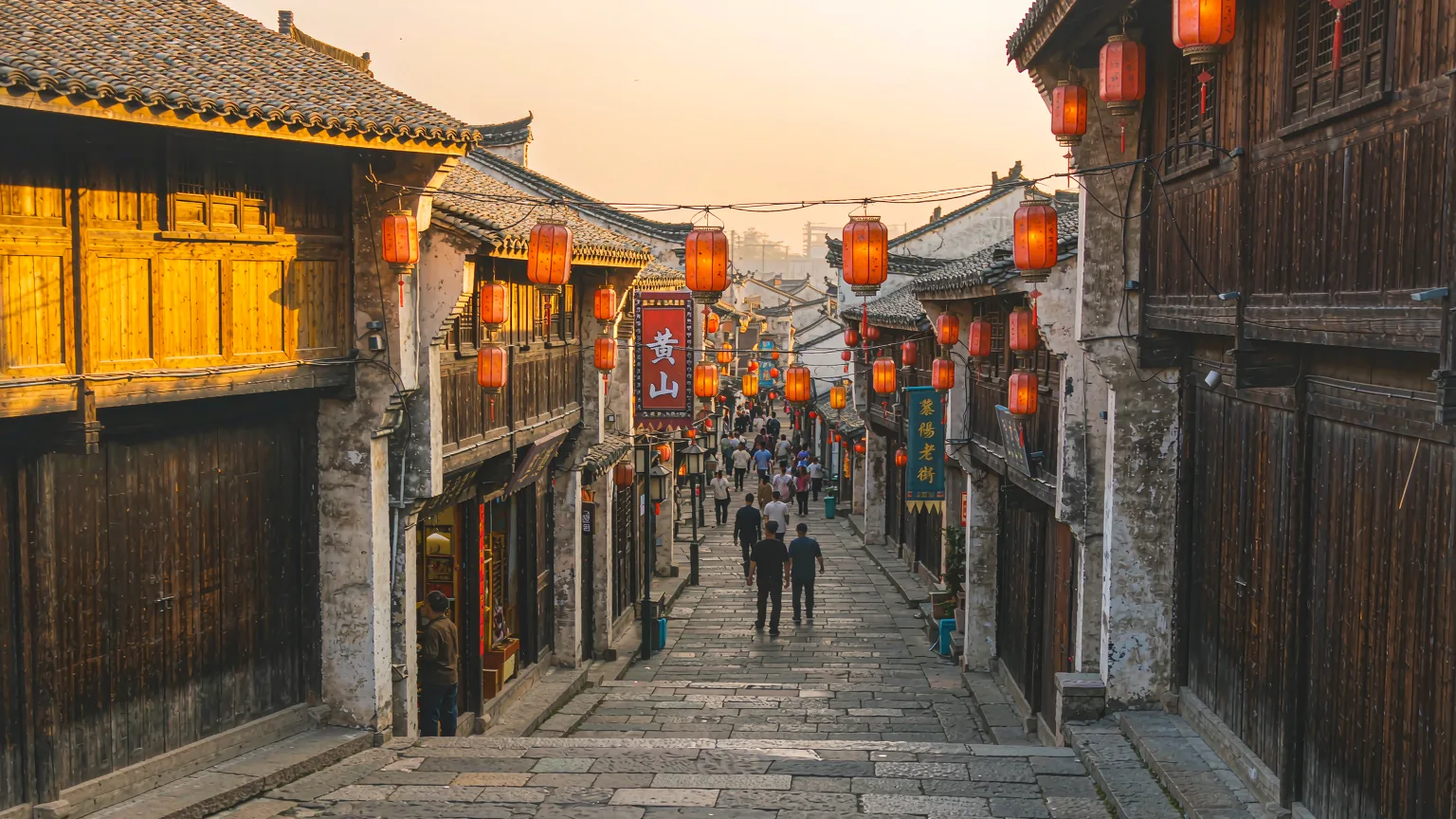
Tunxi Old Street and Liyang Lane: Arrival Day
Arrive in the afternoon and do exactly two things: check in, then wander the old street and Liyang slowly. Skip every ticketed sight and treat the ink shops, tea houses and bun stalls as lesson one, letting the eyes enter Huizhou before the feet.
Eat dinner on the old street and walk the riverside path to Zhenhai Bridge after. No show, no night tour on the first evening; an early night is an investment in the next six days.
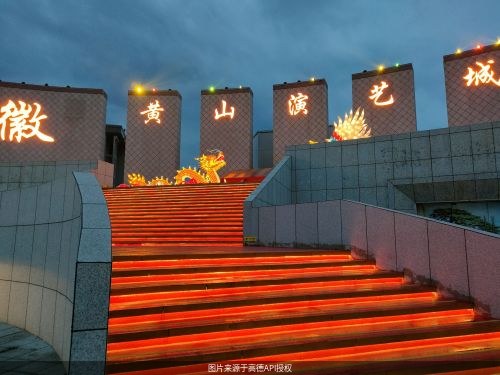
The Huishow: An Opening Overture
Placing the Huishow on night one rather than the last is deliberate: ninety minutes first to frame the stories of merchants, opera and folk custom, so the halls, archways and fish lanterns of the next six days arrive with their scripts attached.
The curtain falls early, leaving time to stretch back at the hotel. And if rain comes, the show is already the perfect indoor substitute.
The China Huizhou Culture Museum: Framing Day
Give the morning to the museum and complete the causal chain: scarce land, merchants at sea, homecoming fortunes, halls and genealogies. With that chain in hand, the next six days read as chapters of one story.
In fine afternoon weather, visit the Huashan grottoes, vast hand-cut caverns above the river whose purpose remains a puzzle; in rain, add the city art museum and the heritage hall. Day two carries the trip's widest flexibility.
The Huashan Grottoes: An Unsolved Riddle by the River
The Huashan grottoes are an ancient complex of hand-cut caverns above the Xin'an river, dozens surveyed, the largest hall roomy enough for a thousand people. The chisel marks stay crisp, yet no written record survives, and both date and purpose remain open questions.
Two or three core caves take about two hours on gentle paths. As a rain plan it is near perfect, and in sunshine it plants the pleasant illusion of how much the Huangshan earth still hides.
The Yugu Cableway and Shixin Peak: Mountain Day One
Enter the mountain on the third morning. Cable up to Bai'e Ridge, start with Shixin's pines, then run the level line through Beihai, the Qingliang terrace and the Monkey rock, luggage packed for two summit nights.
In the afternoon descend the West Sea Canyon, ride the funicular up to Tianhai and check in, then watch sunset from Cloud-Dispelling Pavilion. Keep day one's effort at seventy percent; tomorrow needs the reserve.
Beihai and Brightness Summit: A Slow Ridgeline Day
Day four refuses to rush: wake naturally, then climb from Beihai via Bai'e Ridge to Brightness Summit on a different stretch of ridge. The best cloud-sea odds sit before ten in the morning, summit cloud keeping a tidal timetable.
The afternoon flexes between a small loop toward Turtle-Fish Peak and doing nothing in place. Two nights buy weather margin: if one dawn fails the cloud, a second morning waits.
Sunrise and the Yuping Descent: Goodbye to the Mountain
On day five, pack after sunrise and descend via Turtle-Fish Peak and the Hundred-Step Ladder to the Greeting Pine, taking the Yuping cableway to Ciguang Pavilion. Two summit nights put sunset, sunrise and cloud sea all in hand, and you leave the mountain full.
Eat a proper lunch in Tangkou, soak your feet and stretch. Overnight in Tangkou, since tomorrow's valley and springs want relaxed legs.
Emerald Valley: A Holiday for the Legs
The sixth morning belongs to Emerald Valley's water. After two days of ridgeline, the gentle gorge path is medicine: green pools, talking bamboo, and flat ground rising through the soles, all part of recovery.
The core loop takes ninety minutes, and with no deadline the Color Pools deserve extra sitting. The afternoon runs to the hot springs, with the night in Tangkou or Tunxi by choice.
The Huangshan Hot Spring: Reward for Two Days of Stone
The afternoon soaks in the Huangshan springs, whose metasilicic water genuinely eases climbing muscles. Terraced pools with forest steam make winter the famous season, but autumn's thin crowds feel better.
This is the last stretch of doing nothing before day seven: lock the phone in the locker and spend ninety minutes reading no guides at all.
Hongcun: A Morning of Water
A full half day for Hongcun is the right call: place it on the seventh morning, when Moon Pond's mist justifies the early alarm.
Enter from South Lake and run one line through the painted bridge, Moon Pond and Chengzhi Hall, out by noon. After two nights of granite, white walls and water sound heal on another level.
Xidi: An Afternoon of Carving
The afternoon goes to Xidi, reading its house carving against Hongcun's water. Take the details in the three great halls, Dafu, Zhuimu and Jing'ai, then wander lanes, since the boat-shaped village's high walls look best in four-o'clock light.
Lodge back in Yixian or Tunxi at dusk, keeping the village days flexible: if the springs slowed day six, swap Xidi into the seventh morning and send Hongcun earlier.
Tachuan and Lu Village: The Autumn Unit
In autumn, convert the seventh morning to Tachuan plus Lu village: the tallow color and the carved mansions sit two kilometers apart, one for color and one for knife work, a high-yield pairing.
Outside autumn, run the old-town day directly. Tachuan's mist-and-light window lasts two hours, so finish shooting before ten, and the Lu village guide is worth hiring.
Huizhou Old Town and the Xu Guo Archway: A Prefecture Afternoon
The afternoon reaches the Huizhou old town in Shexian, starting at the Xu Guo archway for the prefecture yamen, the Yanghe gate and Doushan Street. The town is free, so spend on the yamen combo and a guide, since a prefecture's institutional scale never shows at village level.
Eat in the old town at dusk, hairy tofu and stone pancake stalls lining the main street. At night the Xu Guo archway lights up, more dimensional than by day.
The Yuliang Weir and Fish Lanterns: The Week's Last Light
Keep the last stretch for the Yuliang Weir. From the Ming stone crest, watch water slide through the joints while the old street's drying nets and cooking smoke close into one frame; the peaks, villages, archways and halls of the week find their geographic closure at this river's exit.
On weekends and festivals, the Yuliang fish lantern hall runs carry-your-own sessions, and a small handmade lantern travels home with you. From there, rail out via Shexian North or taxi back to Tunxi for the final night.
| Getting around |
|
| Budget | The full run costs about RMB 3200-5000 pp (summit nights and charters dominate), excluding long-distance transport. |
| Best time | Apr-Jun and Sep-Nov form the skeleton season; late autumn adds Tachuan color and drying racks, spring adds fields and river mist. |
FAQs
Is seven days too long, and what does it add over five?
The gap is depth and margin: the extra two days fund a recovery day, the old town and craft, and bad weather shifts the whole plan without sacrificing the core. If villages interest you only mildly, day seven runs slack and six days suffice; for building and folklore lovers, seven is exactly right.
Are two consecutive summit nights necessary?
Strongly yes: two nights mean two sunrise windows plus a sunset, nearly doubling cloud-sea odds, and no repeated cableway laps with luggage. The cost is doubled summit rent, but bunk beds and early booking keep the gap tolerable.
Is this route reliable in the rainy season?
The seven-day frame weathers rain naturally: museums, grottoes, springs, the show and the halls are indoor or sheltered, and losses concentrate in sunrises, cloud seas and Tachuan color. Avoid the June plum-rain stretch when summit visibility odds sink; scattered rain in other months actually breeds cloud seas.
How do I keep a seven-day budget in check?
Use three levers: split transport between buses and charters (saving five to six hundred), pair a summit bunk with chain hotels in town (saving near a thousand), and alternate one scenic-area meal with one town meal. The three untouchables are the summit night, the charter and the show ticket, since they set the trip's experience ceiling.