
The Hulunbuir northern loop is the classic steppe circuit: three days out of Hailar, first the curves of the Morigele, then the braided waters of the Ergun Wetland, then along the border Ergun River into the Russian-descended villages of Enhe and Shiwei, finally southwest past Hulun Lake to the border line at Manzhouli. Three to five hours of driving a day, paced walk-and-look.
Three keywords define the route: charter, one-way loop, and sleeping right. No public transport crosses the deep steppe, so chartering is the only answer; the plan runs clockwise with no backtracking; night one in an Enhe log house, night two in Manzhouli for the lights, with the lodging itself part of the scenery.
Itinerary at a glance
| 09:00 | Jinzhanghan and the Morigele River: The Steppe's First Lesson |
| 14:00 | Ergun Wetland: Reading the Formation of Waters |
| 17:30 | Enhe Russian Ethnic Township: Night One in a Log House |
| 09:00 | Shiwei Russian Ethnic Township and the Border River: Morning Light at the Frontier |
| 14:00 | The Heishantou Steppe Road: Into the Depth of the Hulunbuir Grassland |
| 19:00 | Matryoshka Square by Night: The Border City's Light Overture |
| 08:30 | Manzhouli National Gate Scenic Area: First Stop on the Border Line |
| 11:00 | Matryoshka Square by Day: Rides and the Cultural-Goods Catch-Up |
| 14:30 | Hulun Lake: Closing on the Northern Sea |
The route, stop by stop
Jinzhanghan and the Morigele River: The Steppe's First Lesson
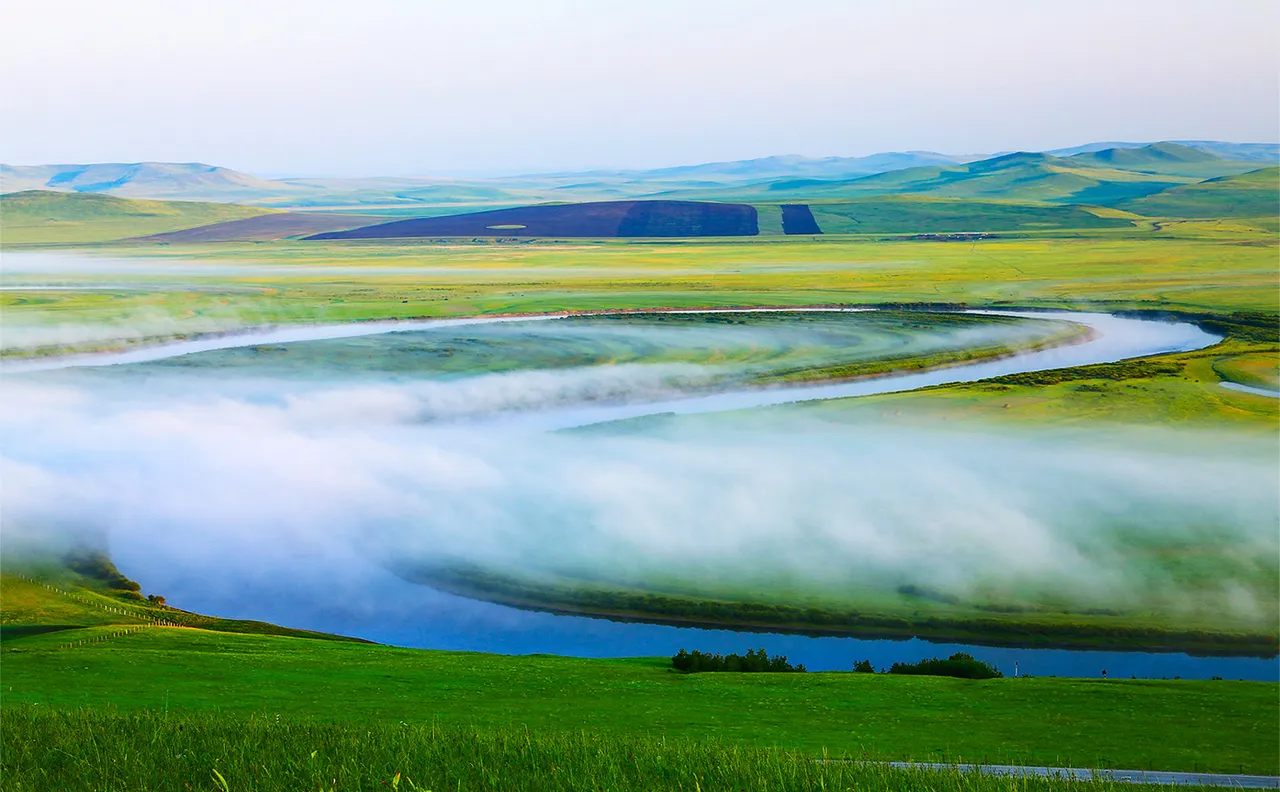
Half an hour out of Hailar you reach Jinzhanghan, and the first stop keeps an easy pace: climb the slope by the road and watch the Morigele loop itself into chain after chain of bends, the first-crooked-water image that fronts every Hulunbuir album. Morning light from the east gives the bends their best shadow layers.
The camp offers riding and archery, but skip the saddle on day one and save your legs for three days; drink a bowl of milk tea, look inside a ger, and sketch the outline of steppe life that later herder visits will fill in.
Ergun Wetland: Reading the Formation of Waters
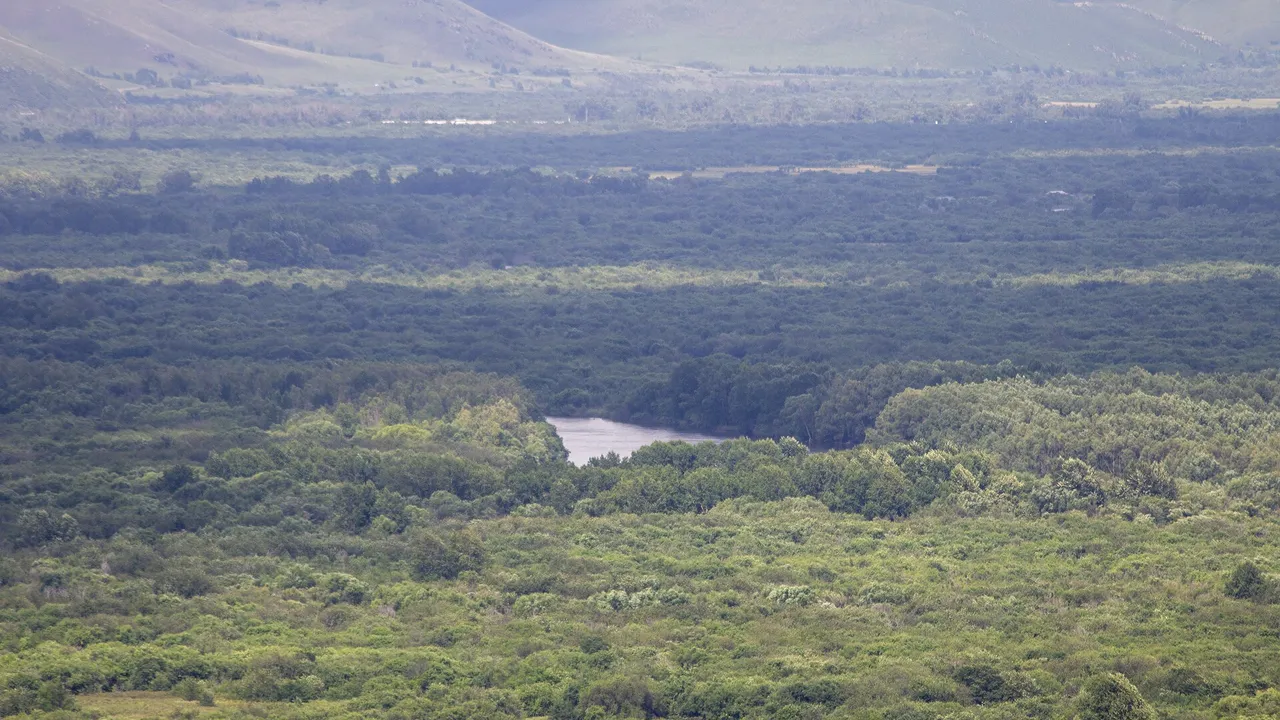
Lunch in Ergun town, then climb the wetland deck in the afternoon. The Genhe, Ergun and Hauer rivers spread into braided channels on the low ground, and from the summit the rivers read like an army changing formation, every channel slowly migrating; the real point of Asia's first wetland is not a still view but living geography.
The main deck takes forty minutes; photographers can give the lower platform another half hour. Afternoon light often runs against you, so if the shot matters, ask your driver to loop back for a morning pass another day.
Enhe Russian Ethnic Township: Night One in a Log House
You reach Enhe by early evening, a village quiet enough to hear hooves. Tonight's bed is a log house: stacked-trunk walls, moss in the seams, floral curtains, and a yard growing potatoes next to the bread oven. Dinner at the guesthouse, the mistress's Russian soup with lieba and blueberry jam, tastes of border-village home cooking.
After dinner walk the lanes, sunset on the ranks of log roofs and dogs at the gates. A couple of small Russian-folklore rooms in the village are worth a morning catch-up if time allows, completing the century of migration behind these houses.
Shiwei Russian Ethnic Township and the Border River: Morning Light at the Frontier
Day two heads north to Shiwei, an hour by car. The village faces Russia across the Ergun, the far bank visible to the naked eye. Early morning mist hangs on the border river while horses drink at the grassy edge, the quietest hour of the northern loop and a golden one for photographs.
Shiwei's river overlook and riverside path are free; twenty minutes of shoreline suffices. The log houses pack denser than Enhe, and the main-street bakery turns out its morning batch, one loaf making today's rations.
The Heishantou Steppe Road: Into the Depth of the Hulunbuir Grassland
Leaving Shiwei southward, the road bends toward Heishantou and its purest steppe driving: two hours with barely a village, only rolling rangeland, moving herds and the rare ger. Ask the driver to pull over at the widest stretch and walk beyond the roadbed to a slope open to horizons on every side.
Heishantou is also the loop's best riding country; ranches charge by the hour, experienced riders can take an hour deep into the grass, and novices settle for half an hour on flat ground. This is the one riding window the three days should keep.
Matryoshka Square by Night: The Border City's Light Overture
You reach Manzhouli right as Matryoshka Square and the main streets light up. Onion domes, doll-shaped buildings and gilded sculpture exaggerate better by night than day, a border town's kitsch worn proudly. The square's perimeter is free to enjoy, while the inner rides close and leave only the lighting.
Dinner at a downtown Russian restaurant, borscht and pot-braised beef; afterward walk Zhongsu Street back to your hotel and bank your sleep, since the National Gate comes early.
Manzhouli National Gate Scenic Area: First Stop on the Border Line
Day three opens at the National Gate before the tour vans arrive. Boundary marker No. 41 and the gate itself are the two must-shoots, the Russian yard at Zabaikalsk spread plainly across, and the low tremor of a crossing freight train tells you more about a land port than any placard.
The on-site exhibition hall covers a century of port history and can be skipped when time runs tight; keep the tower view and the marker, one hour in all, then slide conveniently on to Matryoshka Square.
Matryoshka Square by Day: Rides and the Cultural-Goods Catch-Up
Fifteen minutes from the Gate, the daytime session completes what night could not show: the rides, the details of the Russian building set and the cultural shops all reward a slower look. Only by day can you read the murals on the doll buildings, every panel a scene from Russian fairy tales.
This is the serious souvenir window: doll magnets, chocolate and kvass gift boxes in clear price tiers. If you already walked the lights last night, compress the day visit to an hour and bank the time for Hulun Lake.
Hulun Lake: Closing on the Northern Sea
The last stop returns the three days to water: Hulun Lake, Inner Mongolia's largest, spreads sea-wide with rows of waves pushing up the shingle. The viewing ground at Xiaohekou gives the widest reach, grass, lake and sky stacked in one line, and the wind bites harder than the steppe's, the moment your jacket finally earns its place.
Fish stewns by the shore serve lake fish with tofu, worth a taste rather than a meal. From there Hailar is about two hours back, so book evening departures from the airport or station for a calm finish.
| Getting around |
|
| Budget | Charter for three days runs RMB 1800-2400 per car, tickets RMB 250-350 combined, two nights RMB 300-600; the whole trip about RMB 1200-1800 pp sharing a car of two. |
| Best time | June to September; July greens hardest, August adds wheat fields and hay rolls to the frame, and after mid-September the golden grass and thin crowds suit photographers. |
FAQs
How do I find a three-day charter and negotiate the price?
Compare across three channels, lodging front desks, licensed fleets and online platforms: RMB 1800-2400 for three days in a sedan is the sane band, and any quote far below it needs a written no-shopping-stops, no-added-detours clause. Confirm fuel, tolls and the driver's board in the price, and write this clockwise loop with all its stops into the itinerary sheet.
Do the sights along the loop need advance booking?
The wetland runs about RMB 65, the National Gate about 70, Matryoshka Square 100-150, while most overlooks are free, all subject to posted prices. In July-August buy wetland and Matryoshka tickets online ahead; the Gate's walk-up queue is tolerable. What truly needs pre-booking is not tickets but experiences, the Enhe family visit and Heishantou riding, arranged through driver or guesthouse a day ahead.
Will three days mean nonstop driving? What to trim?
Three to five hours of driving a day is already the compact version of the loop. To loosen it further, either squeeze Manzhouli into a half day keeping only the Gate and the night lights with the lake en route, or drop the Heishantou riding and bank two roadside stops between Shiwei and Manzhouli. Do not cut Enhe or Shiwei, since the border-river villages are the northern loop's soul.
What clothing and gear serve three days on the steppe best?
Dress in layers, long sleeves over fleece with a windproof shell always at hand against ten-degree swings; carry the sun trio and a water bottle. QR payment works throughout with RMB 200 cash for herder homes and stalls. Save offline maps for weak-signal stretches, pack a power bank plus a car charger, and bring a spare camera battery since cold drains them fast.