
While most visitors squeeze three days into the main valley, a whole slower layer lives outside the gate: the Bon monastery at the Zharu trailhead, a rebuilt folk culture village, an ICH street where you can try thangka and incense making by hand, and the night market that lights up after dark. Nothing here rushes; walking plus short hired-car hops cover it at small-town strolling pace.
The line pairs best with the three-day ticket: day one owns the main valleys, and when legs fade on day two this becomes the recovery route, prayer wheels, tea, handicrafts, and fireworks of the edible kind at the night market. On a standalone day, swap the morning monastery for the village's early performance to avoid double runs to the gate.
Itinerary at a glance
| 09:00 | Zharu Monastery: The Bon Prayer Circuit |
| 11:00 | Jiuzhaigou Folk Culture Village: A Morning in Tibetan Courtyards |
| 14:30 | ICH Street: Make Something to Carry Home |
| 19:00 | Jiuzhai Night Market: Zhangzha Town's Smoky Finale |
The route, stop by stop
Zharu Monastery: The Bon Prayer Circuit
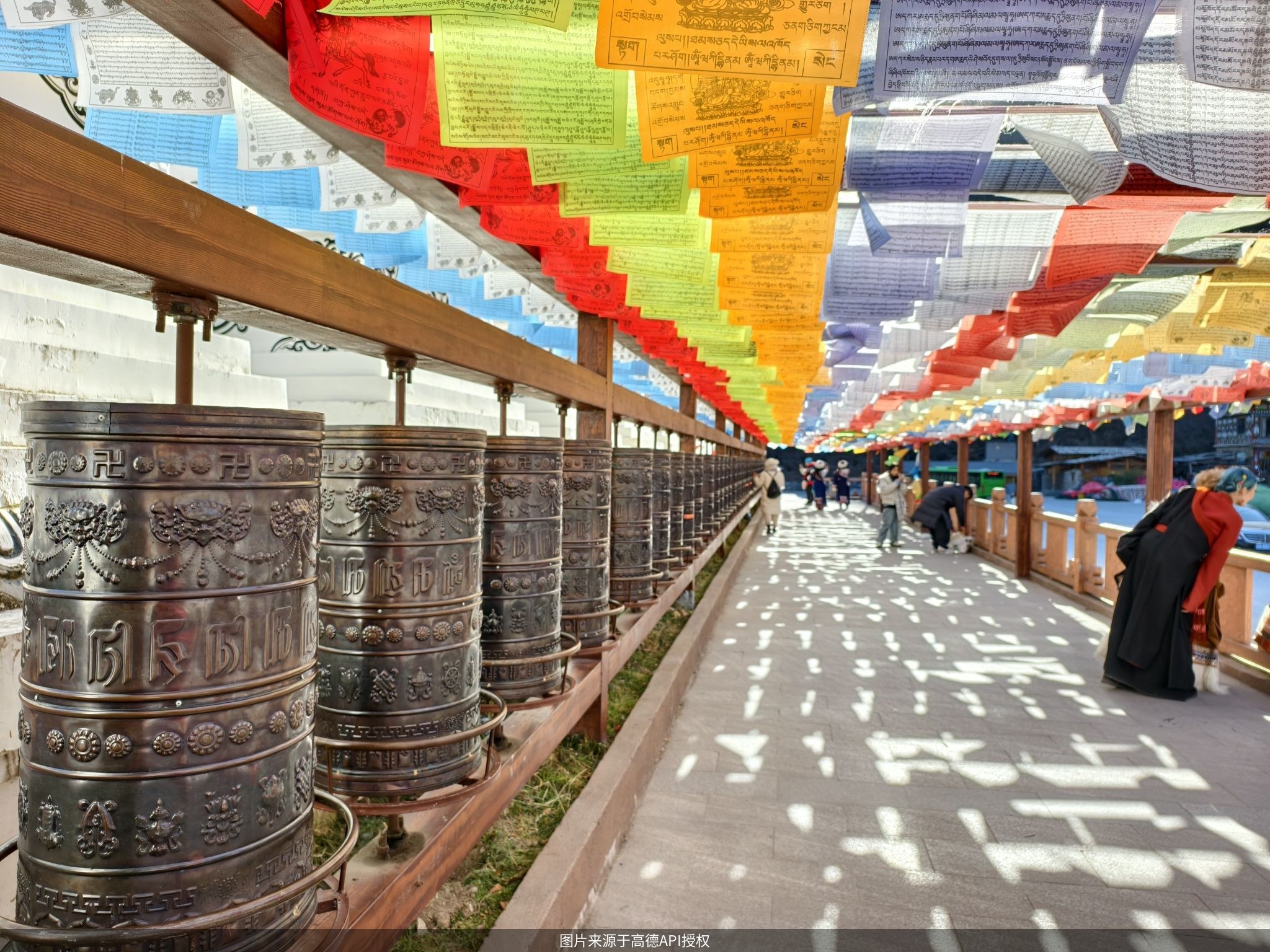
Zharu Monastery sits below the Mirror Cliff at the mouth of Zharu valley, a rare Bon school temple where details like the turning direction of prayer wheels run opposite to mainstream Tibetan Buddhism. The golden roof burns brightest in morning sun, and the hall murals narrate Bon creation stories; the signage is sparse, so slow looking beats fast walking.
The prayer circuit loops the hillside in about forty minutes, locals spinning the drums clockwise from dawn. Walk a stretch with them: the bells and chanting threaded with pine wind form a soundtrack the main valley never plays. Finish with a pot of butter tea at the teahouse by the gate.
Jiuzhaigou Folk Culture Village: A Morning in Tibetan Courtyards
Near the park gate, the folk culture village rebuilds Amdo-style timber courtyards, condensing the valley's old village life into a few browsable lanes. Around 11 am a small performance often starts, the guozhuang circle dance pulling visitors in; the steps repeat, so two laps make you fluent.
Courtyards demonstrate hand-churned butter tea and roasting highland barley, and the second-floor drying decks frame distant ridgelines. Commercialization stays moderate: most goods are locally made yak jerky, honey and barley products, honestly priced against the main-street stalls, a practical place to top up souvenirs.
ICH Street: Make Something to Carry Home
Inside the Jiuzhai Huamei resort area, ICH Street gathers workshops for thangka painting, incense making, Tibetan paper and silverwork. The point is not buying but doing: a two-hour thangka session fills a small outline canvas after a talk on mineral pigments, and the incense workshop takes you from grinding and kneading to rolling, finished sticks leaving with you.
Mid-afternoon is thinnest, when the old masters have time to explain the fine points. Experiences run RMB 50-150 by craft; your finished piece costs a bit more than a shelf item but carries your own warmth. Even empty-handed, a tour through thirty-odd spice aromas repays the trip.
Jiuzhai Night Market: Zhangzha Town's Smoky Finale
The market lives along Zhangzha's main road and truly wakes after dark: grilled yak skewers, Tibetan yogurt, barley flatbread, roast potatoes and little mushroom stews in one smoky row. Prices run fairer than the gate plaza, most vendors are local villagers, and scales are shown before weighing.
A solid dinner combo: a handful of yak skewers, yogurt with white sugar, a fresh griddled barley cake, closing with barley wine or butter tea. The craft stalls between food rows carry wool scarves and old beads, prices negotiable, though never negotiate after the barley wine.
| Getting around |
|
| Budget | The monastery is covered by the park ticket, craft workshops run RMB 50-150, and market meals RMB 40-70; budget RMB 150-250 pp for the day. |
| Best time | Year-round; keep the prayer circuit to the cool morning and save the market for after 7 pm when it livens up. |
FAQs
Can I do this town route without a park ticket?
The village, ICH street and night market need no park ticket; only Zharu Monastery sits inside the park and requires one. Ticketless, replace the morning with a Zhangzha stroll and distant views of the hillside temples, or simply start late from the village's noon performance.
Can an unused day of the three-day ticket be refunded, and what about shuttle fares?
Tickets are non-refundable once validated for the day, but re-entry within three days is free, which is exactly what makes this route pay. Shuttle fares bill separately from admission, purchased per entry, and even the Zharu branch requires that ride's ticket; check posted fares and validity at the gate.
Do four stops scatter the day too much, and what to cut?
All hops sit within twenty minutes of each other, so the day holds together. The real trade is the afternoon: if hands-on is not your thing, compress the ICH street to a half-hour browse and give the hours to the village show and night market; craft lovers can spend the whole afternoon on thangka and happily drop the village.
Any etiquette for photos and shopping in the village and market?
Three rules: ask before photographing monks, courtyards or hearths, most will nod; never pose with your back to prayer flags or wheels; and buy crafts by posted prices and visible scales, treating old beads as decoration rather than investment unless you truly know them. QR payment works everywhere; keep a hundred yuan in cash for backup.