
Five days is Kashgar's classic span: days one and two exhaust the old town and city, ceremony, mosque, teahouse, Xiangfei Garden, museum and night market; days three and four climb the Pamir for White Sand Lake, Karakul, the Golden Grass Beach and the Dragon-Spine Road, with a night in Tashkurgan; day five rides home via the Yengisar potters, takes Dawakun in the afternoon, and closes at a city night market.
The structure is town, mountains, sand: the city the base color, the mountains the climax, the sand the coda. The two Pamir days are the trip's essence, worth sacrificing city hours, never them; Dawakun sits last by design, the desert's lightness balancing the plateau's weight.
Itinerary at a glance
| 09:30 | The Kashgar Old Town: Opening Ceremony and the East Lanes |
| 12:30 | Id Kah Mosque and the Old Bazaar |
| 15:00 | The Century-Old Teahouse: The Second Floor at Noon |
| 20:00 | The Han Bazaar Night Market: Closing Night One |
| 12:30 | White Sand Lake: The Pamir Overture |
| 14:30 | Karakul Lake: The Mirror of Muztagh Ata |
| 18:00 | The Stone City and Golden Grass Beach: Dusk in Tashkurgan |
| 11:30 | The Dragon-Spine Road: Six Hundred Curves Before Noon |
| 17:00 | Xiangfei Garden: Back in Town by Late Afternoon |
| 10:00 | The Yengisar Pottery Village: Day Five Morning |
| 14:00 | Dawakun Desert Scenic Area: The Five-Day Line's Sand |
The route, stop by stop
The Kashgar Old Town: Opening Ceremony and the East Lanes
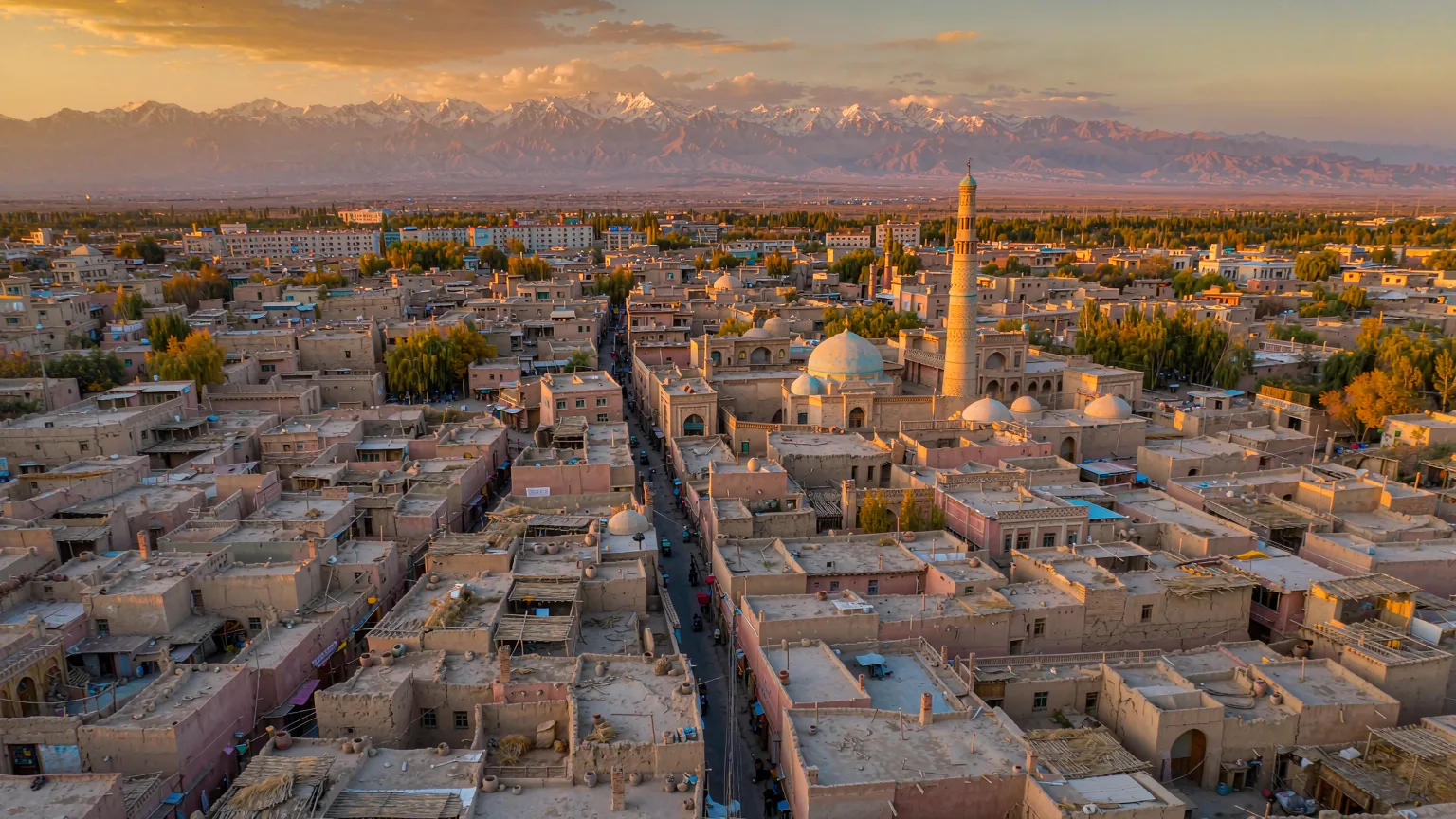
Five days open with the east-gate ceremony. After drums and dance, walk the east quarter's lanes through the morning: earthen architecture, carved doors and windows, flowers at thresholds and sunning elders; the goal is orientation and rhythm, groundwork for days ahead.
Five days buy patience in the old town: skip checklists and instead duck into one unwalked lane each passing, until the town becomes your own map by day five.
Id Kah Mosque and the Old Bazaar
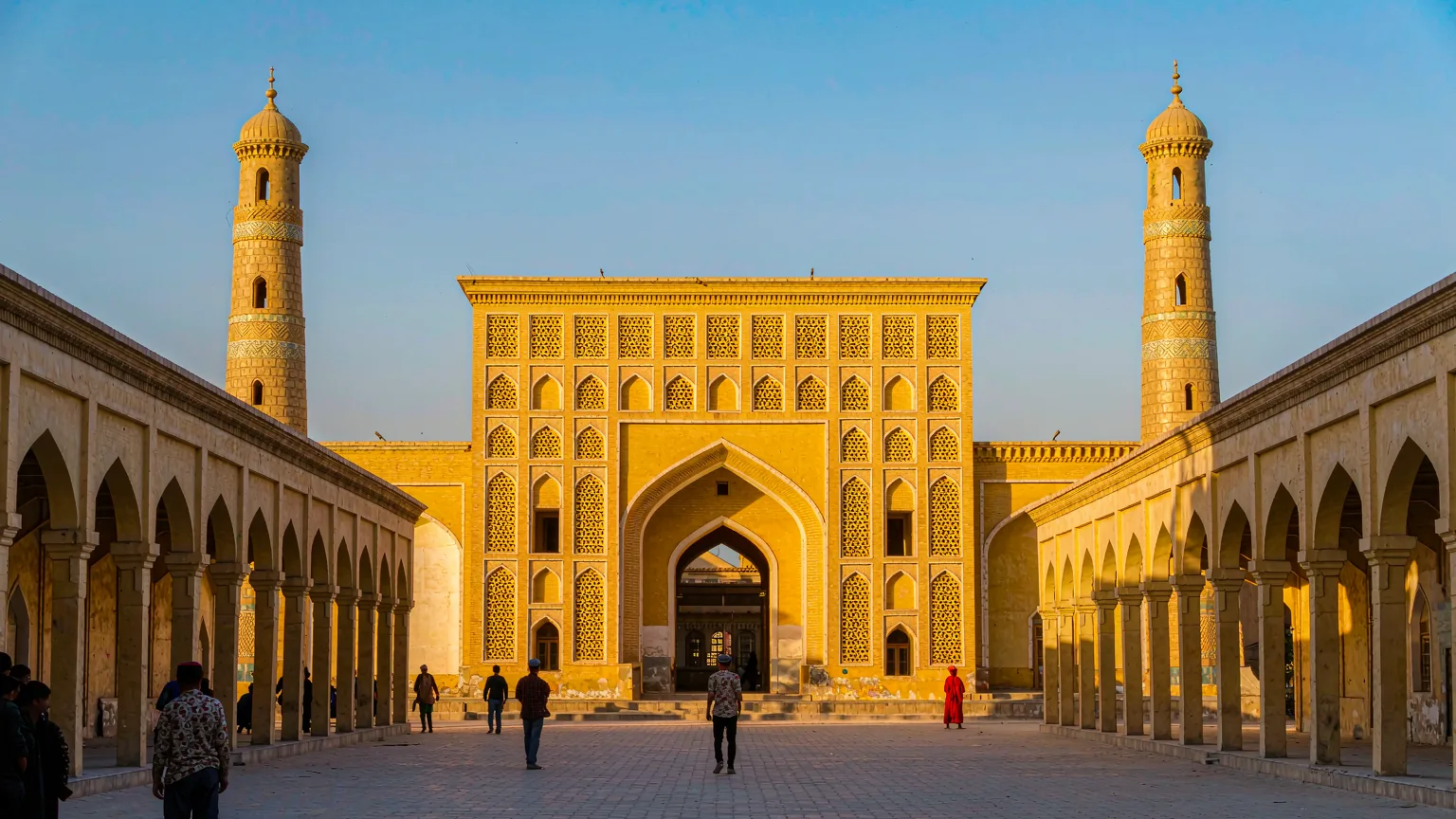
Around noon, Id Kah Mosque, entering outside prayer times, the solemnity of halls and courtyard one wall from the square's bustle; then walk deeper through the craft bazaar, coppersmiths, woodworkers and potters mid-stride.
Lunch lands bazaar-side, polo or samsa both correct; the afternoon belongs to the old teahouse, hiding from the midday sun.
The Century-Old Teahouse: The Second Floor at Noon
At noon the old teahouse is the town's lounge: a pot of brick tea, a naan, a rawap phrase, watching the lane parade from the timber second floor; a five-day plan should spend its first afternoon here, surrendering jet lag to tea.
The teahouse doubles as the old town's hub, Gaotai and the night market both within walking reach; drink till three, and the evening program picks you up at the door.
The Han Bazaar Night Market: Closing Night One
Night one feasts at the Han Bazaar: whole roast lamb, gangzi stew, roasted eggs, yogurt shaved ice, half portions each, eating until you lean on something. The market's smoke is Kashgar's first embrace.
No shows, no bars on night one; walk home after the market and sleep early, two plateau days waiting from tomorrow.
White Sand Lake: The Pamir Overture
Day two climbs the China-Pakistan Friendship Highway early, the border permit checked at the first station out of town; by noon, White Sand Lake, silver dunes pressed to blue-green water, all of it from the roadside deck in half an hour.
Keep the ascent slow: past three thousand meters move gently and drink steadily; from the lake the road runs on toward Karakul.
Karakul Lake: The Mirror of Muztagh Ata
Afternoon at Karakul is the Pamir's signature: at 3600 meters the lake faces Muztagh Ata above 7500, snowpeak mirrored on still days, Kyrgyz yurts and camels at the shore; a short boardwalk loop captures the reflection.
Stay till around four to reach Tashkurgan before sunset; shore winds run hard, tie your hat, and slow your steps at altitude.
The Stone City and Golden Grass Beach: Dusk in Tashkurgan
Dusk in Tashkurgan: first the Stone City ruins of the ancient Puli kingdom, then down to the Golden Grass Beach wetland, boardwalks threading meadow and snowpeak into one sunset frame, the two Pamir days' most unhurried evening.
After sunset, yak hotpot in town with rooms booked ahead; the county's nights are quiet enough to hear wind, and early sleep banks strength for the Dragon-Spine.
The Dragon-Spine Road: Six Hundred Curves Before Noon
Day four's morning takes the Dragon-Spine: six hundred curves braided black, the viewpoint's slogan its soul, having walked every crooked road today so life runs straight hereafter; the small loop exits in an hour, surface smooth, bends tight.
Descend to the Bandir blue lake en route, its fathomless indigo the counterweight to Karakul's open blue; the afternoon runs home to Kashgar, with a possible second call at White Sand Lake.
Xiangfei Garden: Back in Town by Late Afternoon
Back from the mountains, Xiangfei Garden buffers the pace: the green-glazed family tomb, scriptorium and garden waterways, guides separating the Fragrant Concubine legend from family history; after two plateau days, garden color reads doubly soothing.
Two unhurried hours, then old-town polo at night; day five's desert needs no early prep, so a later bedtime is safe.
The Yengisar Pottery Village: Day Five Morning
Day five's morning runs to Yengisar, about ninety minutes out; the pottery village keeps traditional kilns, showing the full arc from kneading to loading, with glazing a blank as the standard hands-on, fired pieces shipped home.
Glance at the knife shops in Yengisar town en route, buying by shipping only; laghman in the county town before noon, then the afternoon turns to Dawakun.
Dawakun Desert Scenic Area: The Five-Day Line's Sand
The afternoon reaches Dawakun in Yopurga: a lake cradled by dunes, sand sledding, camels, buggies and lakeside boardwalks laid out, with post-noon light turning golden, prime desert shooting hours; the dune-ridge view of lake and sand in one frame is the five-day line's closing image.
The site is compact, three hours plenty; return to Kashgar by evening in about two hours, dinner at a night market, and five days end in the smoke of grilling skewers.
| Getting around |
|
| Budget | Tickets total about RMB 300-400 pp across the trip, five days of charter RMB 2500-3500 with the two Pamir days the bulk, and meals and beds RMB 800-1500. |
| Best time | June-October is prime; process the border permit in Kashgar city ahead; give the Pamir two days including one night in Tashkurgan rather than cramming the plateau into a single day. |
FAQs
Which part of the five days is least deletable?
The two Pamir days. Cities offer cousins of the old town and the desert, but lake-and-snowpeak framing of White Sand and Karakul exists only here. Compressing to four, cut Dawakun and keep both Pamir nights; to three, one city night plus two on the plateau.
Is the Tashkurgan night mandatory?
Strongly yes. A day return means twenty minutes per lake, abandoning the Dragon-Spine, and ten-plus hours in the car, an experience collapse; one Tashkurgan night splits it into a humane rhythm, and the grass beach's dusk plus morning wetland come free with it.
What if the border permit is lost or there is no time to process it?
Lost permits reissue quickly at the processing point with ID; missing time is rare, since processing finishes same day. If truly cornered, swap the Pamir and city days and process the permit on the freed morning. Never attempt the mountains without it, checkpoints refuse everyone.
Where does the five-day budget concentrate?
Charter and lodging are the twin peaks: five days of car near RMB 2500-3500, five nights RMB 800-1500. Two levers: four-person pooling cuts per-head car costs to a third, and comfort-tier over luxury rooms everywhere, since plateau sleep depends on bedding and quiet, not price.