
Jiangxi's history wears two faces. One is buried: the twenty-thousand-piece Haihun marquis hoard and the Shang bronze of Dayangzhou set a Han noble's life and the region's own bronze civilization before you. The other is written on the street: the shots of August 1, 1927 scattered among the sites around Zhongshan Road. Seeing both in one day is the shortest path to this city.
The day hinges on one word: reservations. The provincial museum and the uprising memorial are free but book by real name, both closed Mondays; the satellite sites take walk-up registration, the pavilion sells on site. Order the day by booking difficulty and nothing jams.
Itinerary at a glance
| 09:00 | Jiangxi Provincial Museum: Haihun Gold and Dayangzhou Bronze |
| 13:00 | August 1 Uprising Memorial: Gunshots and the Historical Record |
| 15:30 | Zhu De's Residence and He Long's Headquarters: The Uprising Off the Main Hall |
| 17:30 | Tengwang Pavilion: The Dusk Climb |
The route, stop by stop
Jiangxi Provincial Museum: Haihun Gold and Dayangzhou Bronze
The new building sits on the Gan riverbank in Honggutan. The unmissable holdings come from the tomb of Liu He, the Haihun marquis: horse-hoof and unicorn-nose gold ranked in rows, bamboo slips and chime bells transplanting a Han noble's life intact. The Shang bronzes of Dayangzhou, with their tiger motifs unlike central-plain styles, prove a homegrown Jiangxi bronze culture.
Galleries run by theme: take the flagship antiquities line first, then loop back for ceramics and natural history; three hours covers it properly. The Haihun section pairs with the site museum, so seeing both deepens each.
August 1 Uprising Memorial: Gunshots and the Historical Record
In the afternoon, return to the old town's uprising memorial, housed in the former Jiangxi Grand Hotel that served as the uprising's headquarters. The command room's original furniture, period firearms and unit charts lay out the days around August 1, 1927 with total clarity.
The museum runs larger than expected; prioritize the restored headquarters and the campaign galleries. The audio guide earns its fee, denser than the panels, and ninety minutes covers the highlights if pressed.
Zhu De's Residence and He Long's Headquarters: The Uprising Off the Main Hall
The uprising's story exceeds one museum. Zhu De's residence at Huayuanjiao was a key pre-dawn stronghold, while He Long's headquarters on Zigu Road keeps its wartime command room, bullet scars still in the walls. Both open free, nearly empty, so quiet you hear the old floorboards speak.
The pair chains in about an hour, west along Zhongshan Road from one to the other. The buildings themselves outshine the displays: courtyards, stairwells and period battle maps all in place, best read slowly.
Tengwang Pavilion: The Dusk Climb
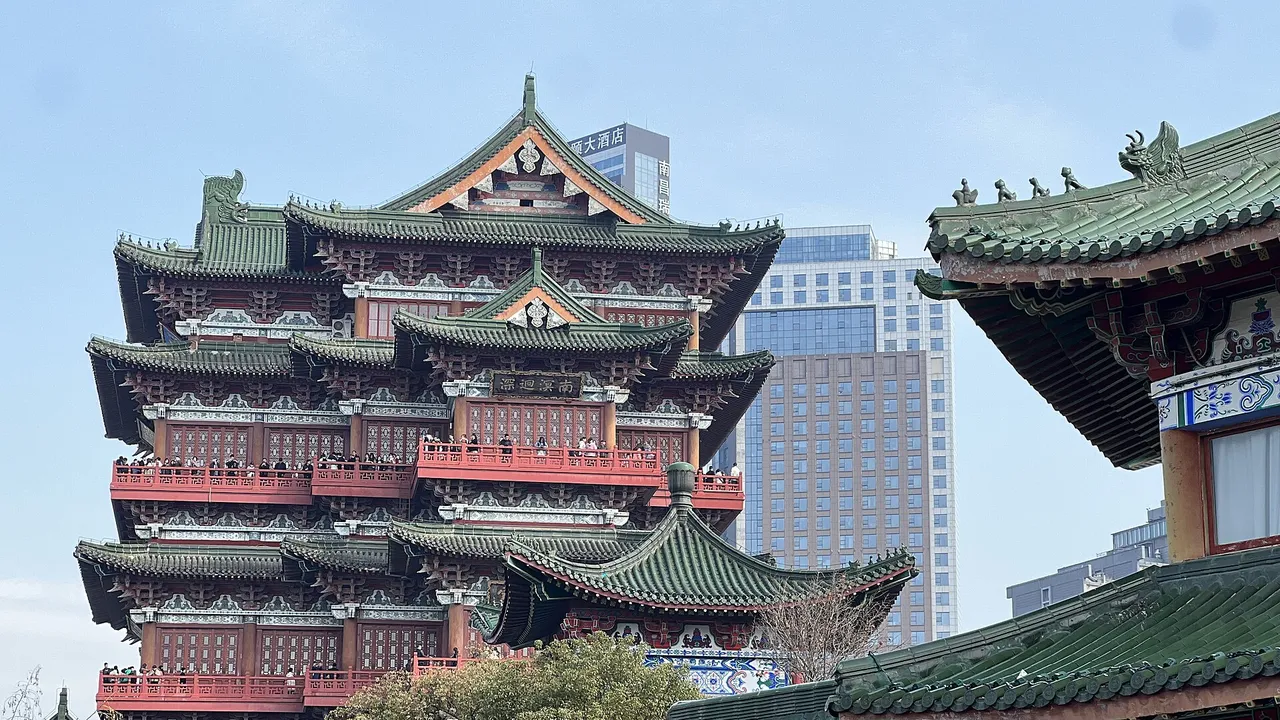
Give the finale to Tengwang Pavilion. At dusk the light turns soft, the Gan River gilds below, and Wang Bo's line about sunset clouds and a lone duck describes exactly this hour. Work the murals and displays floor by floor and the top arrives just as the city lights come on.
Reciting the full preface earns a free climb, limited slots daily, so rehearse the long lines first. Descend and walk a stretch of the riverside path as both banks light up in sequence, the day's true closing image.
| Getting around |
|
| Budget | Built mostly on free booked museums; budget about RMB 100-200 pp including the RMB 70 pavilion ticket and meals. |
| Best time | Works year-round with climate-controlled halls; both museums close Mondays, so keep the day clear of them. |
FAQs
Is bouncing between Honggutan and the old town too much for one day?
Not really. The metro crosses in about twenty minutes, and the old-town sites plus pavilion chain on foot. The one caution is closure days: place the provincial museum on a non-Monday, or half the day's structure collapses.
What if provincial museum slots are gone?
Slots release days ahead on the official account, with evening retries most successful; walk-up ID scans sometimes catch cancellations on weekdays. The memorial works the same way under an independent system, so book separately. Special exhibitions occasionally sell single tickets as a fallback channel.
Are four culture stops in one day too rushed?
The museum is the only heavyweight: give it three hours with an alarm. Ninety minutes covers the memorial, an hour the two sites. The pavilion is the flexible valve, compressible to forty minutes for the top view alone if you overrun, or expandable with the riverside walk if you run early.
Any advice for bringing seniors on this line?
Wheelchairs rent inside both museums; the satellite sites have many narrow stairs, so mind the handrails. The day is mostly indoors, comfortable in summer and winter alike. Lunch along Zhongshan Road avoids backtracking, and a midday hotel or cafe hour restores the afternoon considerably.