
Nanjing's past is not one line but three stacked layers: the misted poise of the Six Dynasties, the imperial air of the early Ming, the churn of the Republic. This three-day route reads the strata in order: day one belongs to Purple Mountain, two imperial tombs, one villa and one grand museum; day two returns to the historic core, palace to Six Dynasties to Chaotian; day three descends to the old south for wall, temple ruins and lanes.
The skeleton is metro plus scenic shuttles, with every distant stop on one line. Book the reservation venues, the mausoleum, the palace, the museum, the night before arrival. Only the mountain day taxes the legs, so keep the last two loose and the rhythm stays kind.
Itinerary at a glance
| D1 08:30 | Sun Yat-sen Mausoleum: Opening with 392 Steps |
| D1 10:30 | Ming Xiaoling and the Stone Elephant Road: Source of Ming Rites |
| D1 13:30 | Meiling Palace: The Jewel on the Necklace |
| D1 15:30 | Nanjing Museum: Handing the Survey to Day One's End |
| D2 08:30 | The Presidential Palace: Starting Day Two with a Century |
| D2 11:00 | Six Dynasties Museum: The Wei-Jin Air in Celadon |
| D2 14:00 | Chaotian Palace: The Grandest Old Complex South of the River |
| D2 16:00 | The Gan Xi Residence: Dusk in Ninety-Nine and a Half Rooms |
| D3 09:00 | Zhonghua Gate and Dabao'en Temple: Opening the Wall Day |
| D3 13:00 | Laomendong and Sanying: Closing in the Lanes |
The route, stop by stop
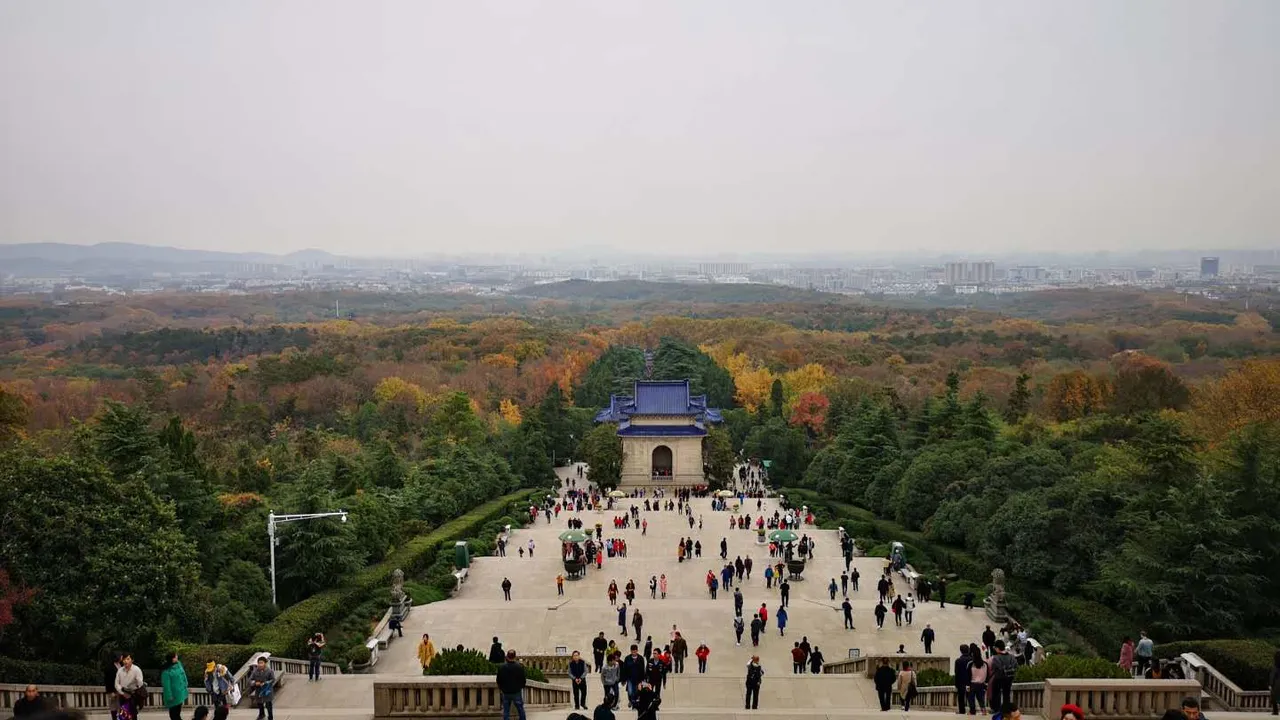
Sun Yat-sen Mausoleum: Opening with 392 Steps
Open the three days at the mausoleum, entering at the gate so the terrace before the hall stays quiet for ten minutes. Savor the axis at scale: Fraternity Gate, tomb gate, stele pavilion and hall rising in sequence, the 392 steps echoing the seats of the era's national assembly; from the top, green waves of Purple Mountain run to the skyline.
Descend by the eastern avenue and call at the Music Stage, whose semicircular echo wall and pigeon flocks make the gentlest corner of the compound. The morning's physical investment pays off, since the sacred way of Ming Xiaoling deserves an unhurried afternoon.
Ming Xiaoling and the Stone Elephant Road: Source of Ming Rites
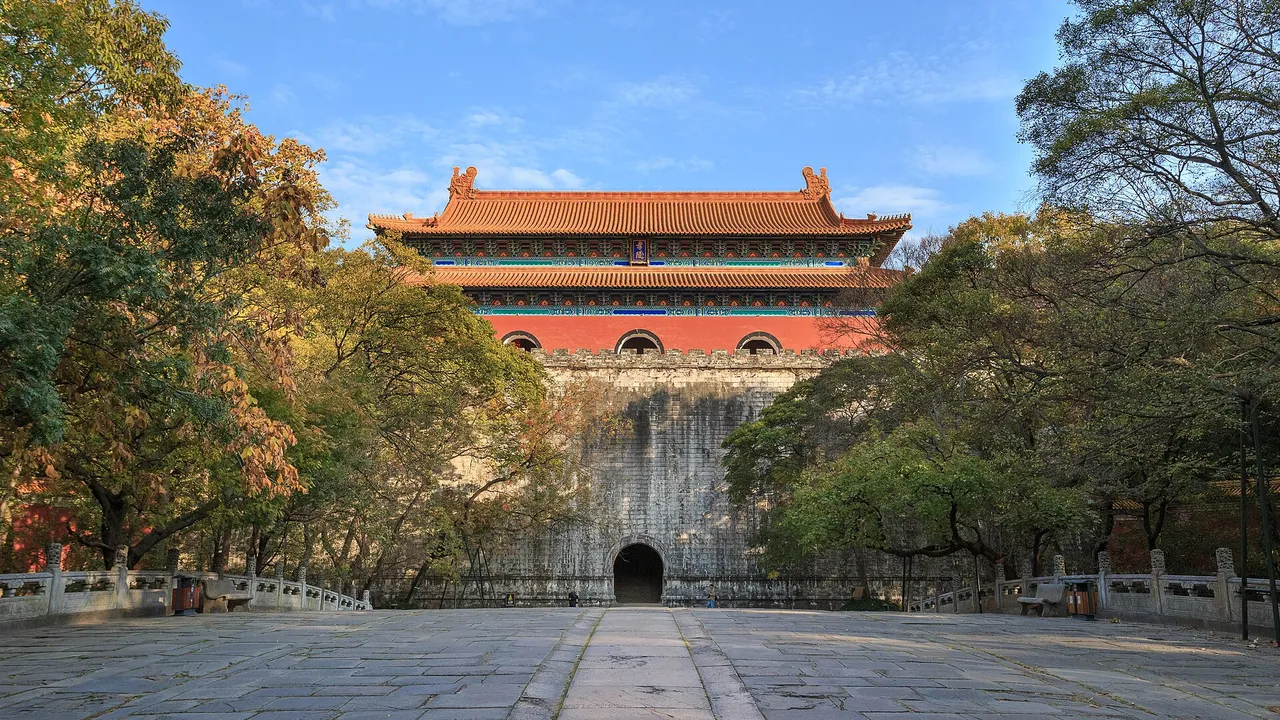
Ming Xiaoling holds Zhu Yuanzhang and Empress Ma in joint burial, and every later Ming and Qing imperial tomb borrowed its grammar. On the sacred way, read the logic of the beasts, one pair standing, one crouching for each kind, voicing yin-yang and day-night, with six centuries of weather leaving a warm patina.
Past the way's end the route turns to the sacrificial hall and the Square City; climb the Ming Tower to survey the whole tomb plan. In autumn the tallow and ginkgo of the Stone Elephant Road peak, and two hundred meters can absorb half an hour, the most photographed stretch in the city.
Meiling Palace: The Jewel on the Necklace
From Ming Xiaoling walk the ring road to Meiling Palace, the villa at the center of the plane-tree necklace in autumn aerials. Interiors keep their 1930s face: Song Meiling's painting room, the Chiang-Song dining table, and below, boiler rooms and escape passages, detail enough for an hour.
The master bedroom and study upstairs catch fine light, with painted glass and blue casements the photography magnets. The house tells history's most private chapter, a perfect counterpoint to the grand narratives of the first two stops.
Nanjing Museum: Handing the Survey to Day One's End
Give day one's afternoon to the museum, where a tired pace suits the galleries. The History Hall surveys Jiangsu from deep antiquity to the Qing, with the gold beast and the Seven Sages brick mural obligatory; when time and legs run short, take the History and Republic halls only, the meal and the dessert.
The Republic Hall's underground street closes the day gently, a 1930s post office and rail station for a brief time slip. Dine around Zhonghua Gate after exiting, noodle houses and duck shops alike, no return downtown needed.
The Presidential Palace: Starting Day Two with a Century
Day two returns downtown, entering the palace at opening. In the calmest hour the stairwell of Zichao Tower and the stone barge of Xu Garden can be savored; the central axis walks a century from gatehouse to tower, while the side wings hold the viceroy's offices and Taiping remnants.
Dense sights, simple flow, two hours suffices. Across Changjiang Road wait the Six Dynasties and Yunjin brocade museums, forming a museum street where the afternoon unfolds.
Six Dynasties Museum: The Wei-Jin Air in Celadon
Facing the palace across the street, the Six Dynasties Museum is the trip's most refined stop, its Pei-team spaces giving every object a stage, with the celadon lotus vase loveliest in daylight. The basement's rammed-earth wall is the thesis of the whole building: proof of a capital lying underfoot.
The museum is compact, ninety minutes thorough. Lunch nearby at Daxinggong, where Changjiang Road strings noodle houses and duck-vermicelli shops without end.
Chaotian Palace: The Grandest Old Complex South of the River
Cross the Qinhuai in the afternoon to Chaotian Palace, the largest ancient complex in the Jiangnan region, its red walls and glazed Lingxing Gate a beloved local backdrop. Once a Confucian temple and prefectural school, it now houses the city museum with strong bronze and Six Dynasties displays.
The forecourt stages local life, exercisers, chess players, strolling families, and photographing the red wall needs no queue. Clabber Hill behind reveals the whole complex's axial symmetry, deeply satisfying to the eye.
The Gan Xi Residence: Dusk in Ninety-Nine and a Half Rooms
Close day two at the Gan Residence, when slanted light enters the courtyards and horse-head walls cast long shadows. The Qing-era mansion blends Hui refinement with Nanjing restraint, its ring corridors and fire walls rewarding a slow walk.
The folk museum's craft displays thin out by evening, and the velvet-flower and brocade counters invite a word with the artisans. Ten-odd minutes on foot reaches the Confucius Temple, folding dinner and night views neatly into the day's close.
Zhonghua Gate and Dabao'en Temple: Opening the Wall Day
Day three descends to the old south. Zhonghua Gate is the most complete barbican castle surviving, three enclosed courts and twenty-seven soldier caches, and from the top the three-dimensional logic of ancient defense reads clearly. Morning wind and light are generous, with the new pagoda of Dabao'en visible eastward.
Outside the gate lies the Dabao'en Temple ruins park, where the gem-encrusted Ashoka stupa unearthed from the crypt appears in rotation (displays lean on replicas and site remains). The park is modern and restrained, a neat contrast to the wall's roughness.
Laomendong and Sanying: Closing in the Lanes
The last stop of three days is Laomendong. Lunch in the lanes, duck-fat biscuits, red-bean pudding, small wontons, portions modest enough to try several. Then push into the depth of the Sanying lanes, where restored courtyards house cafes, bookshops and velvet-flower studios.
As the wall lights come on at dusk, look back toward Zhonghua Gate's bricks from the lane mouths, and three days of history settle into daily life. If energy remains, the lit exam museum is en route for one final glance.
| Getting around |
|
| Budget | Three days of tickets run RMB 250-350 pp before meals and lodging, with metro costs near RMB 30 for the stay. |
| Best time | Spring and autumn suit best; autumn glorifies the mountain and the sacred way, while summer favors museum-heavy pacing. |
FAQs
Is the three-day physical pacing sensible?
Yes, deliberately tapering: day one carries the most steps, day two stands in museums, day three strolls quarters. If rain hits day one, swap with day two, since the mountain in sunshine beats the mountain in rain. Booking next day's tickets nightly removes morning schedule panic.
Which sights need booking, and what if slots vanish?
The mausoleum, the palace and the Nanjing Museum require real-name booking, with peak slots gone two to three days ahead. Fallbacks: the museum via paid special-exhibit channels, the mausoleum day swapped to a ring-road ride or the Music Stage, and the palace replaced by the Six Dynasties plus brocade museum pairing, no real cultural loss.
Do three days cover Nanjing? What's missing?
The core city fits three days; what waits outside are the suburbs, Niushou's Buddhist palace, Qixia's autumn leaves and Tangshan's springs each worth half a day. With a fourth day, Niushou contrasts most with the urban line. Xuanwu Lake and Yihe Road slip into free hours without dedicated time.
Where should I stay for this route?
First choice is Xinjiekou or Daxinggong, where lines 1, 2 and 3 meet and every stop lands within half an hour; second, the Confucius Temple area, convenient for night views and breakfast but price-inflated on holidays. Avoid lodging at scenic-area gates, costly and roundabout; veteran chains downtown give better value.