
Putuoshan is the bodhimanda of Guanyin, ranking with Wutai, Emei and Jiuhua among China's four sacred Buddhist mountains, famed as the Buddhist isle of sea and sky. A one-day route keeps its face and heart on the island's southeast: open at the 33-meter South Sea Guanyin, explain the origin of it all at Zizhulin and the Guanyin Who Refused to Leave, then go deep at the great temples Puji and Fayu.
The island admits you only by ferry: ten minutes from Zhujiajian's Kengzhi-wharf at Wugongzhi, tickets sold real-name and best bought online ahead in season. No private cars run here, so scenic buses and walking link the sights, and comfortable shoes outrank everything.
Itinerary at a glance
| 08:00 | The South Sea Guanyin: 33 Meters between Sea and Sky |
| 09:30 | Zizhulin and the Guanyin Who Refused to Leave: Where It All Began |
| 13:00 | Puji Temple: The First Monastery by the Sea-Print Pond |
| 15:00 | Fayu Temple: The Nine-Dragon Coffer and Qianbu Sands |
The route, stop by stop
The South Sea Guanyin: 33 Meters between Sea and Sky
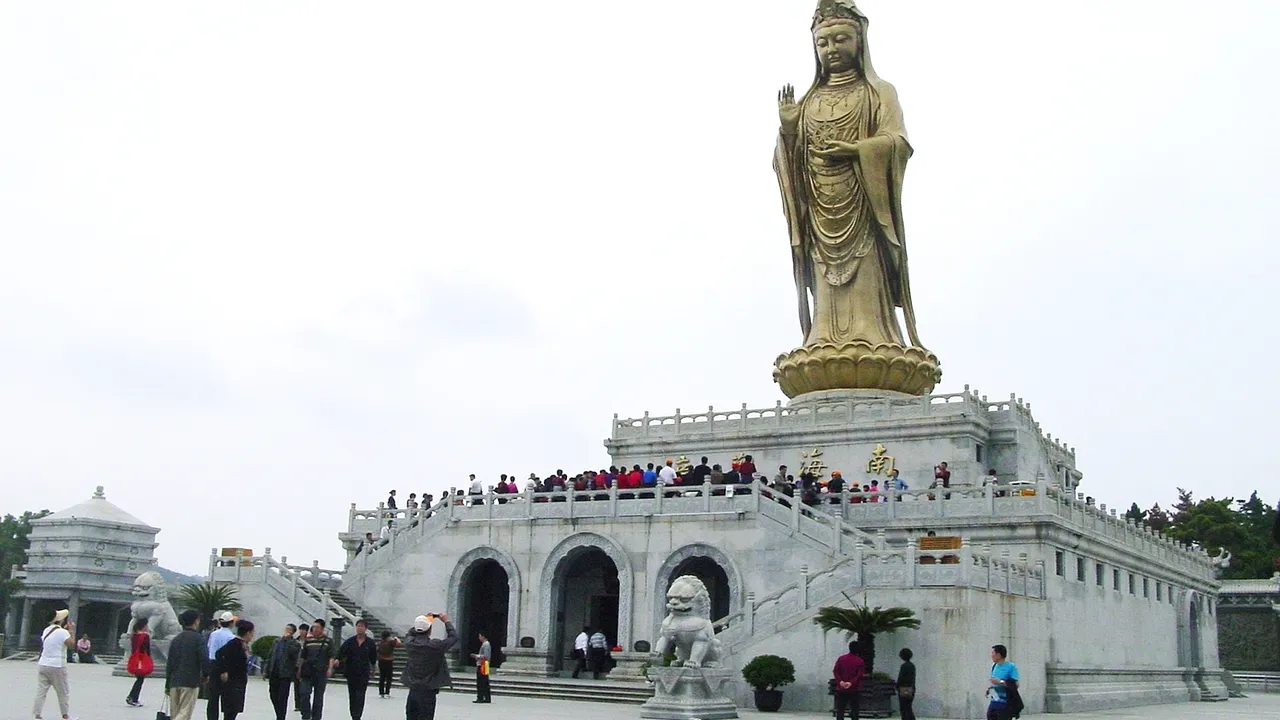
Open the day at the South Sea Guanyin. Cast in bronze and completed in 1997, the statue stands 33 meters tall atop Shuangfeng hill facing the Lotus Sea, visible far out at sea on clear days. From the plaza, sea wind, temple bells and distant container ships share one frame, the widest view on the island.
Guanyin faces the water, minding the suffering that crosses it. Morning light bounces off the sea to trace every fold of the bronze robe; circle the statue clockwise, for the expression shifts subtly from each angle.
Zizhulin and the Guanyin Who Refused to Leave: Where It All Began
Walk a quarter hour from the statue to Zizhulin, site of the Guanyin Who Refused to Leave: the Tang monk Egaku of Japan, carrying a Guanyin statue home from Wutai, found his ship becalmed on the Lotus Sea and understood that Guanyin would not cross east; he left the sacred image on the island, residents gave their homes to house it, and Putuoshan became the Guanyin bodhimanda.
Beside the hall, the Chaoyin Cave booms like thunder as tides surge in; in old times devotees leapt from it seeking Guanyin until officials erected prohibition steles. Listen from behind the railing's safe zone. Bamboo, sea cliffs, a small hall: the source image of every Putuoshan poster.
Puji Temple: The First Monastery by the Sea-Print Pond
Come afternoon to Puji, the principal monastery of Guanyin on the island. The Sea-Print Pond before it fills with lotus in summer, Yongshou Bridge crosses the water, and the imperial stele pavilion records generations of emperors' dealings with this house. Inside the Great Round Compassion Hall, Guanyin sits enthroned; the custom here differs from elsewhere, so join palms and voice your intention before entering.
The incense coupon costs only five yuan, and the polychrome and stonework inside and out repay a slow pass. A lane behind runs to Baibu Beach; after incense, trade it for ten minutes of salted wind at the sea.
Fayu Temple: The Nine-Dragon Coffer and Qianbu Sands
Close the day at Fayu, whose treasure hides inside the Round Compassion Hall: the nine-dragon coffer, dismantled from the Ming imperial palace in Nanjing and reassembled here, eight dragons coiling the well's walls and one hanging at its crown, an imperial extravagance rarely met in Buddhist halls.
The temple climbs the hill, rising from the Heavenly Kings hall to the Jade Buddha hall, with steps behind leading to Qianbu Sands. By evening the sands empty, and surf gently closes the day. Legs remaining, the stone steps behind Fayu form Xiangyun Road to Huiji on Foding hill, the route saved for those staying one more night.
| Getting around |
|
| Budget | Island entry RMB 160 in season, great-temple coupons RMB 5 each, ferry about RMB 50-60 return; around RMB 300-450 pp with meals. |
| Best time | April-May and September-October are kindest, sea winds mild; the Guanyin festival around the lunar second-month nineteenth is most atmospheric but doubles the crowds. |
FAQs
What is the easiest way to reach Putuoshan?
Most come via Ningbo: rail or coach to Zhujiajian, then the ten-minute ferry from Wugongzhi wharf onto the island. Direct coaches also run from Hangzhou and Shanghai. Drivers can park at the wharf lots, but no vehicles cross, so the island runs on buses and foot.
How do I buy the island ticket and ferry ticket? Any booking?
Island entry runs RMB 160 in season, lower in off months and higher around festivals, bought real-name via official online channels for QR entry. Ferry tickets are also real-name; in season walk-up lines drag, so buy return trips online ahead. The three great temples add five-yuan coupons paid on site.
Can one day cover the statue, Zizhulin, Puji and Fayu?
Yes, but order decides: statue and Zizhulin at dawn, Puji and Fayu in the afternoon, six to seven hours across buses and foot. During festivals or holidays every stop stretches half an hour or more, so cut Zizhulin to protect the two temples, or honestly switch to two days.
What etiquette applies to worshiping Guanyin here?
Hat off in halls, no photos, no loud talk; keep clothing past the knee and slippers outside. Use the eco incense temples provide, since outside incense may not enter hall areas, and never burn paper indoors. Vows are made sincerely and repaid faithfully, and one circles statues and stupas clockwise. At the sea, stay inside safety railings when watching the tide.