
Dukezong, the old town on the tea-horse road, rewards measuring by foot across a day. The route's radius stays inside two kilometers: Sifang Street's square, the summit prayer wheel on Guishan, in-town workshops where thangka is painted and incense rolled, and the everyday shops of Chibuka, all within walking reach.
The trick to a highland citywalk is treating the itinerary as rest: every half hour, sit somewhere with a pot of butter tea or pu-erh. Sunning yourself idle is not wasted time but the correct way to take the altitude. About six thousand steps all day, with the hill the only real climb.

Itinerary at a glance
| 09:00 | Sifang Street, Dukezong: The Old Town's Zero Point |
| 11:00 | Guishan Park and the Buddha Temple: The Wheel and the Panorama |
| 14:30 | Old-Town Crafts: A Thangka and Incense Afternoon |
| 17:00 | Chibuka Pedestrian Street: The Everyday and the Dusk |
The route, stop by stop
Sifang Street, Dukezong: The Old Town's Zero Point
Sifang Street is quiet in the morning, flagstones freshly polished by the light. This was the square where caravan men unloaded and traded on the tea-horse road; now sweet-tea houses and craft shops line the ground floors of white Tibetan houses, and local elders circling the square in prayer outnumber the visitors.
The lanes radiating from the square each keep a character: toward North Gate Street the old residential quarter holds the most lived-in alleys, while Cangfang Street runs the restored inns and boutiques. Start with a pot of sweet tea at the square's edge and unfold the day's map as slowly as the tea steeps.
Guishan Park and the Buddha Temple: The Wheel and the Panorama
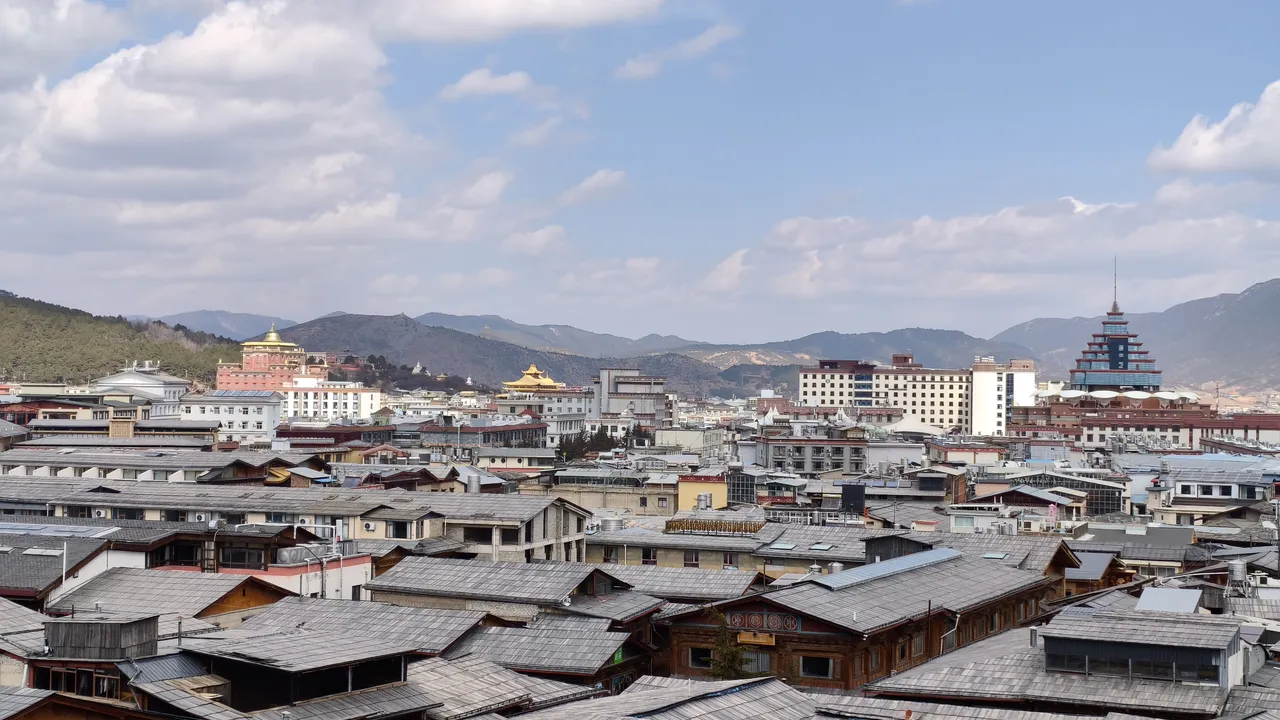
Ten minutes on foot from Sifang Street climbs Guishan. The summit Buddha temple's prayer wheel stands some twenty-one meters tall, needing seven or eight hands to turn and widely held to be the world's largest. Three clockwise circuits, the drum's sutras and gilding at their brightest before and after noon.
The summit platform frames the whole town: white walls, shingle roofs and far meadows in one sweep. The highland morning sky runs blue without impurity, an hour that satisfies both camera and eye.
Old-Town Crafts: A Thangka and Incense Afternoon
After lunch, back into the lanes and hand the hours to living crafts. In thangka studios painters fill color stroke by stroke with mineral pigments, a small piece taking months; in incense workshops cedar and thirty-odd herbs are rolled into sticks and set to dry on wooden racks.
Most workshops welcome visitors and short sessions: one brushstroke of thangka or one handful of rolled incense outlasts any purchased souvenir. Buy from shops run by the painters or makers themselves; museum-style displays tend toward the clearest pricing.
Chibuka Pedestrian Street: The Everyday and the Dusk
At dusk, reach Chibuka Pedestrian Street, the locals' shopping strip, more everyday than the old town: Tibetan dress shops, butter and cheese counters, small supermarkets and fruit stalls sharing ground, busiest at off-work hours, the best cross-section of local life.
Walking back into the old town as lights come on, the prayer wheel's illumination and Sifang's lanterns kindle in turn. Dinner in the old town, then the highland night so quiet you can hear the wind on the way home, the day ending inside that sound.
| Getting around |
|
| Budget | The old town wanders free; food and craft sessions run RMB 100-250 pp, with thangka pieces and incense priced apart. |
| Best time | Year-round; wheel-turning mornings and indoor crafts after lunch dodge the harshest ultraviolet, while winter lanes sunbathe best. |
FAQs
Is a citywalk suitable on the first day at altitude?
Very suitable: low walking intensity with seats always near beats climbing on arrival day. The rule is slowness, stopping for hot water at any head pressure or breathlessness, and the route can shrink anytime, since the old town's radius is small anyway.
Can thangka and incense travel by air or across borders?
Framed thangka flies checked, scrolls travel safer in cabin, and pricier pieces deserve a purchase receipt from the shop. Incense checks through, but some countries restrict plant products at entry, so clear destination customs rules before flying out.
Why does the prayer wheel need so many people to turn?
At some twenty-one meters tall, the drum and its inner sutra scrolls weigh tonnes, beyond any single pusher, which is exactly why it takes many hands together, part of what makes it the world's largest. Turning it clockwise in company is itself a shared act of blessing.
How cold is an old-town walk in winter?
Daytime sun works hard, sunlit lanes reaching the low teens, but shade and night drop below zero. Dress in layers: thermal base, fleece mid, windproof shell, shedding in the tea houses and redoning at the door.