
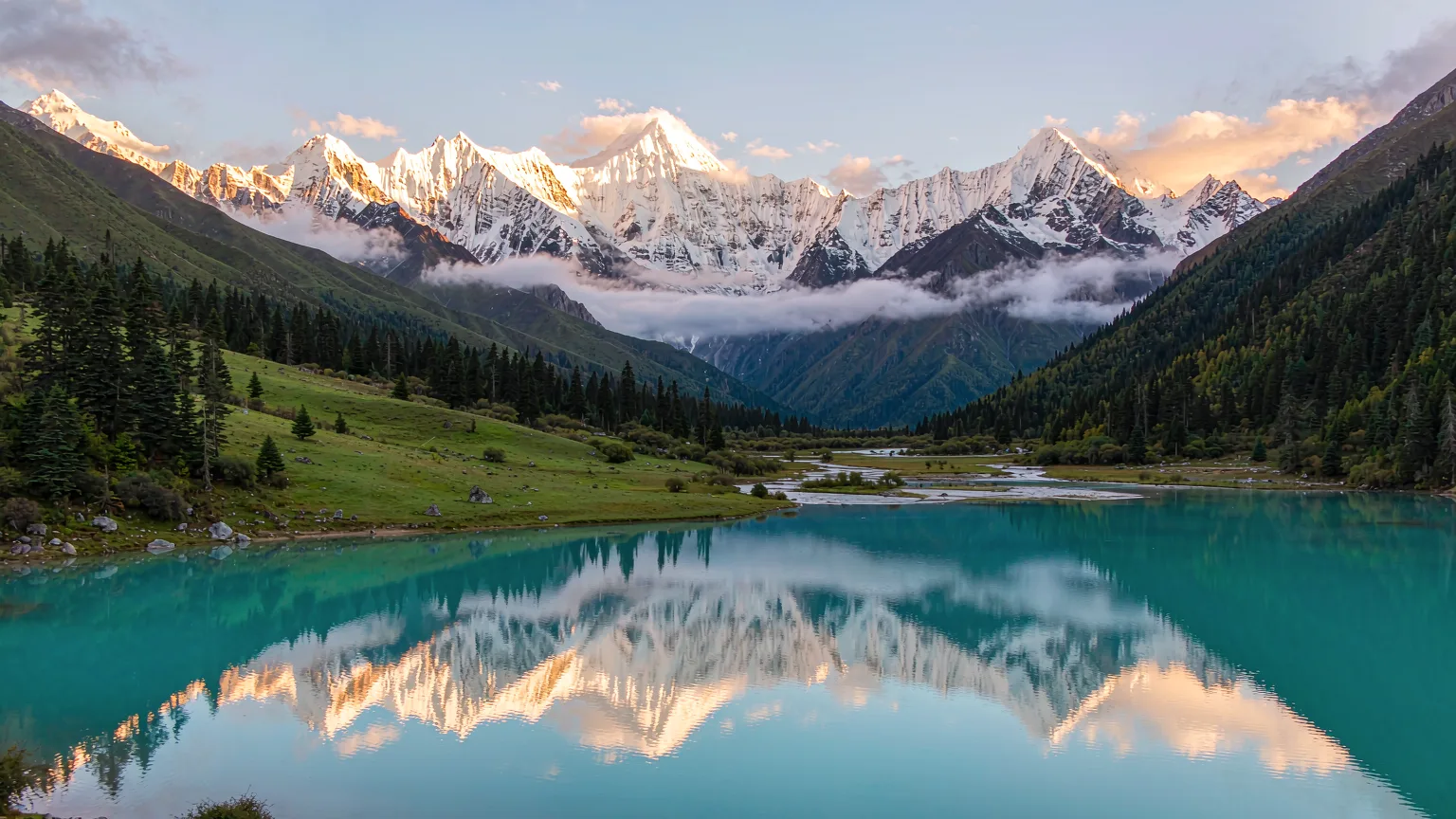
Shangri-La's nature stratifies by altitude: Napa Lake near 3,300 meters where grassland trades with water, Potatso's primeval forest and alpine lakes above 3,500, and Baishuitai under Haba Snow Mountain, springs depositing carbonate into terraces of white jade. Three days run low to high, near to far.
Acclimatization is the route's hidden spine: Potatso waits until a day or two in town, and higher ground only after it. About ten thousand steps daily, all plateau trails taken slowly, stopping whenever breath shortens.
Itinerary at a glance
| 08:30 | Shudu Lake: Potatso's First Water |
| 12:30 | Militang Pasture: The Highland Meadow |
| 14:30 | Bita Lake: The Lake Deep in the Forest |
| 09:00 | Napa Lake's Yila Grassland: Day Two on the Grass |
| 13:30 | Shika Snow Mountain: Four Thousand Meters by Cableway |
| 17:00 | Lamuyangcuo Lake: Songzanlin's Mirror |
| 08:00 | Xiaozhongdian Pasture |
| 09:30 | Baishuitai: Terraces of Travertine |
| 15:00 | Upper Tiger Leaping Gorge: The Jinsha Roars |
The route, stop by stop
Shudu Lake: Potatso's First Water
Day one belongs to Potatso National Park entire. Shudu Lake is most visitors' first water inside, boardwalks running the shore through spruce and fir, the surface an unpolished mirror until morning fog lifts. Yaks graze the lakeside pastures, the scene almost too quiet.
A stretch of the shore loop takes the essence in about ninety minutes. The morning forest's air feels genuinely different, and deep breathing here is no figure of speech but the body's own report.
Militang Pasture: The Highland Meadow
Before noon, Militang's subalpine pasture opens between forests, wildflowers flooring the meadow in summer and gilding it in autumn. The viewing deck takes meadow, treeline and far ridge into one frame, the park's most open stretch.
Openings and extents follow daily notices. Should the pasture be closed, the forest road between Shudu and Bita already pays back the other half of the ticket.
Bita Lake: The Lake Deep in the Forest
Bita Lake runs deeper into the forest than Shudu, its water wrapped in dense woods, the name meaning a lake still as a hair-felt blanket. A small isle sits offshore in legend a site of offering, and squirrels along the boardwalk's end beg from visitors, feeding banned though the squirrels remain unconvinced.
The shore loop takes ninety minutes at a slow walk. Potatso's day ends on a lakeside bench: forest, water and chimney smoke from a far pasture, all three present at once.
Napa Lake's Yila Grassland: Day Two on the Grass
Day two's morning reaches Napa Lake, a seasonal water that is lake in summer-autumn and pasture in winter-spring, the Yila side where grass meets water and horses scatter. The circuit road runs forty kilometers, with horse rides and walks entering the grassland from this side.
Herdsmen work the morning grassland, greeting before shooting. Look toward Shika Snow Mountain: the ridge to be climbed this afternoon lines the grassland's end, and the route's call-and-answer starts here.
Shika Snow Mountain: Four Thousand Meters by Cableway
The afternoon rides the Shika cableway, two stages to a summit near 4,500 meters. The top walkway runs unobstructed: Napa Lake spreads below, and on clear days the snow peaks toward Meili and Haba string across the horizon.
Keep the summit stay to forty minutes or an hour, walking easy, no running, descending immediately at any real headache. Four and a half thousand meters is not for bravado but for folding the whole plateau into one view.
Lamuyangcuo Lake: Songzanlin's Mirror
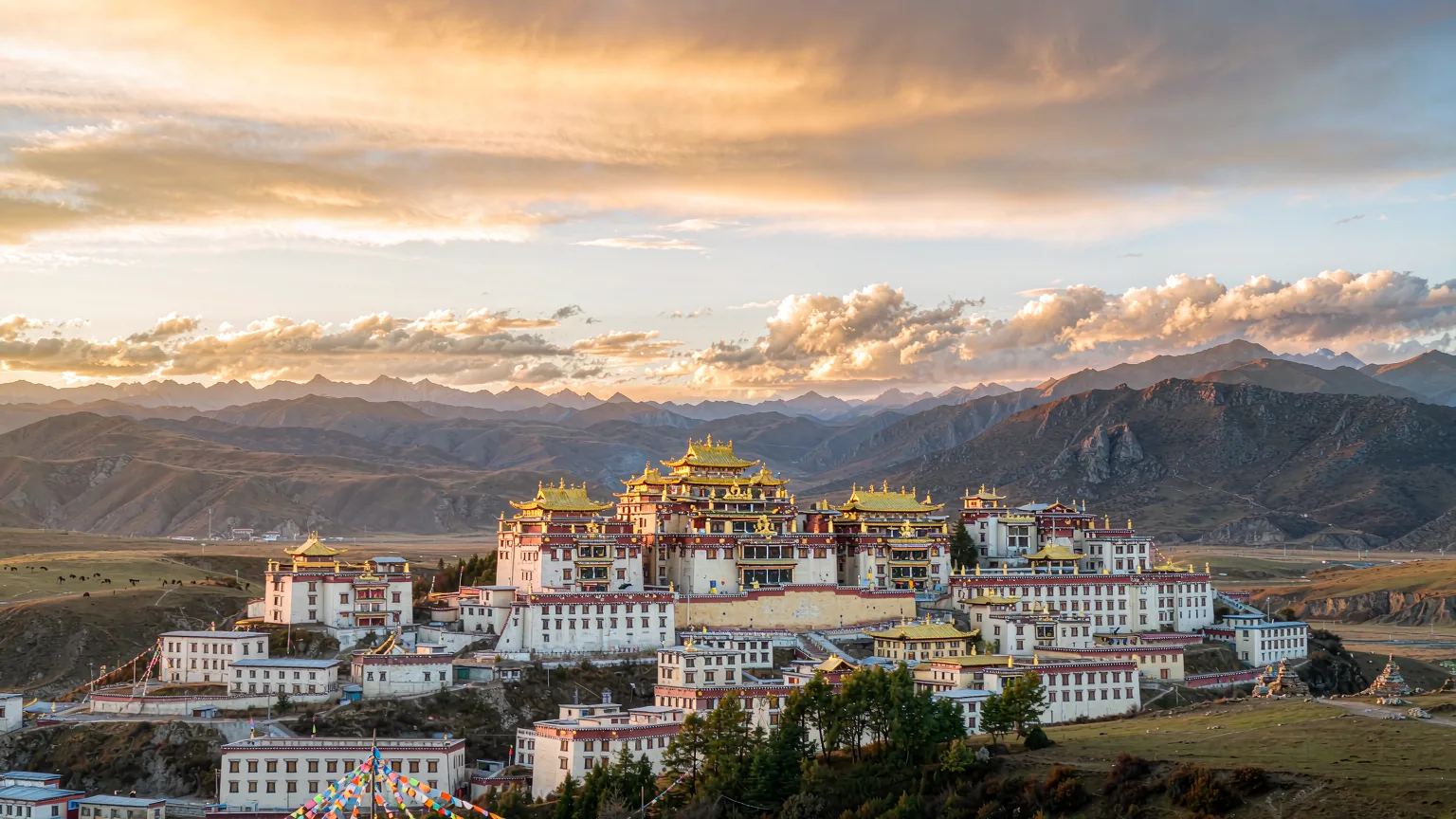
Down from the mountain by evening, reach Lamuyangcuo Lake before Songzanlin. The holy lake catches the monastery whole, and when faint evening chanting drifts over, wind sometimes shatters the reflection and stitches it slowly back, the cheapest and most unforgettable stop of the route.
Walk the lakeside prayer path clockwise, where local elders will smile at you. If you can rise early, morning light on the reflection is the better edition.
Xiaozhongdian Pasture
Heading east on the highway, the first stop is Xiaozhongdian. This high-altitude pasture sits around 3,200 meters, covered by azaleas in May and June, and turns deep red with globe flowers in September and October.
The pasture is managed by local villages for rotational grazing, so take photos from outside the roadside fence. Yield to yak herds crossing the road, and wait for light on the barley racks and Tibetan farmhouses.
Baishuitai: Terraces of Travertine
Day three drives about two and a half hours to Baishuitai. Mineral-rich springs have deposited for a thousand years into stacked ivory terraces on the hillside, water sliding down the surfaces with a pale blue sheen; among China's largest travertine platforms, it is also a birthplace of Naxi Dongba culture.
Take the boardwalk to the terrace top, where barefoot zones let you feel the spring water per on-site guidance. The surfaces are slick, so no walking backward for the camera.
Upper Tiger Leaping Gorge: The Jinsha Roars
On the way back, enter the upper Tiger Leaping Gorge. The Jinsha River narrows to a dozen meters of fury between two snow mountains, the Tiger Leaping Rock midstream, the roar arriving in the chest at the viewing decks, the nature route closing on its loudest voice.
The viewing walk takes forty minutes, stepped but gentle. Hold the rail at the water, hat in hand when the wind rises; then about two hours back to Shangri-La, three days of water, grass, mountain and river filed in one evening.
| Getting around |
|
| Budget | Three days of tickets (Potatso, the Shika cableway, Baishuitai) plus charters and meals run about RMB 900-1500 pp. |
| Best time | May-Jun for azalea blooms, Sep-Oct for autumn color and migrants; acclimatize in town a day or two before Potatso. |
FAQs
Potatso or Napa Lake, how to choose?
Season and legs decide: forests, boardwalks and full ecological immersion pick Potatso, higher effort and price; openness, pastoral scenes and free-stop photography pick Napa, lower threshold. With time, take both, two entirely different plateaus.
Is the Shika cableway worth it, and what about bad altitude sickness?
Worth it under clear skies, the route's highest viewpoint with ranked snow peaks and the Napa panorama. Hard-hit visitors have substitutes: stage one only to the mid station, or skip entirely, taking Napa and Lamuyangcuo as the high points instead; the scenic loss is contained, the safety priceless.
Baishuitai is far, is a dedicated day justified?
Yes, especially for photographers and geology lovers: the travertine terraces stand alone in China, and the road crosses Dongba culture's home country. Pairing it with the gorge as one return day is the best value, two major sights in one.
Which day can swap or shrink?
Day three flexes most, Baishuitai and the gorge merging or dropping one; keep day one's Potatso, the route's ecological lead; day two's Shika rides on weather, while Napa and Lamuyangcuo are the immovable base.