
Draw a hundred-kilometer circle around Taiyuan and you have the heartland of the Jin merchants: Qinglong Town in Yangqu, a stage-post town on the Ming-Qing trade roads; the Chang Family Manor in Yuci, billed as China's first house of scholar-merchants; and the Qiao compound and Pingyao in Qi county, the twin glories of the draft-bank age.
The three days group by compass: one day in Taiyuan's near suburbs, then one day per direction. Public transport reaches everything but thinly; the calmest play is high-speed rail plus local taxis, or one chartered car per line.
Itinerary at a glance
| Day 1 · 09:00 | Qinglong Ancient Town: A Morning on the Old Trade Road |
| Day 1 · 14:00 | Taiyuan Ancient County Town: A Ming County inside the Phoenix City |
| Day 2 · 09:30 | Chang Family Manor: The Gardens of China's First Scholar-Merchant House |
| Day 2 · 14:00 | Hougou Ancient Village: A Farming Specimen on the Loess Plateau |
| Day 2 · 17:00 | Yuci Old Town: Dusk before the City-God Temple |
| Day 3 · 09:00 | The Qiao Family Compound: Six Courtyards of the Zaizhong Hall |
| Day 3 · 13:30 | Pingyao's City Wall: From the Upper East Gate to the South Gate |
| Day 3 · 15:00 | Rishengchang: The Counter of China's First Draft Bank |
| Day 3 · 16:30 | Pingyao County Yamen: Closing before the Hall of Benevolent Rule |
The route, stop by stop
Qinglong Ancient Town: A Morning on the Old Trade Road
Qinglong Town lies in Yangqu county on Taiyuan's northern edge, a key stage on the Ming-Qing trade road running south to Taiyuan and north to Datong. The town spreads with the slope, a five-li main street stacking courtyards up the hillside, gate forts, opera stage and ancestral halls keeping a market town's full skeleton.
The morning town is quiet, residents still shopping and playing chess on the old street. Look for the brick carving and gatehouses: merchant homes wear screen walls and pier details more domestic than the grand estates, dense with photographic detail.
Taiyuan Ancient County Town: A Ming County inside the Phoenix City
In the afternoon head south to Jinyuan district. Founded in the Ming Hongwu era atop the ruins of ancient Jinyang, the county town spreads like a phoenix with spread wings, its cross of streets dividing four complete quarters, offices and temples all in place.
The restored walls close a full ring, and half a circuit takes an hour. At dusk the moat reflections and corner towers hit the golden photographic minute, with light shows and markets after dark.
Chang Family Manor: The Gardens of China's First Scholar-Merchant House
Day two swings southeast to Che village in Yuci, where the Chang Family Manor is the largest of the Jin merchant estates. The Changs made their fortune in tea, yet gave most of the ground to gardens: the water and pavilions of Jingyuan open with a spaciousness rare in northern manors.
The Shiyunxuan academy and its treasured model-calligraphy corridor carry the family's scholarly line, with gatehouse brickwork finely cut to the eave tips. The estate is vast and two hours covers only the essentials, so take a map at the gate.
Hougou Ancient Village: A Farming Specimen on the Loess Plateau
After lunch, drive forty minutes east of Yuci to Hougou village in Dongzhao township. Built into loess ravines, the village keeps every element of dryland farming intact: cave dwellings, an old opera stage, a Guanyin hall and terraced fields, dubbed a living specimen of northern farming civilization.
The drainage works along the gully have prevented floods for centuries. A loop takes ninety minutes with wide views off the earthen lanes, and autumn brings real harvest-drying scenes rather than staged ones.
Yuci Old Town: Dusk before the City-God Temple
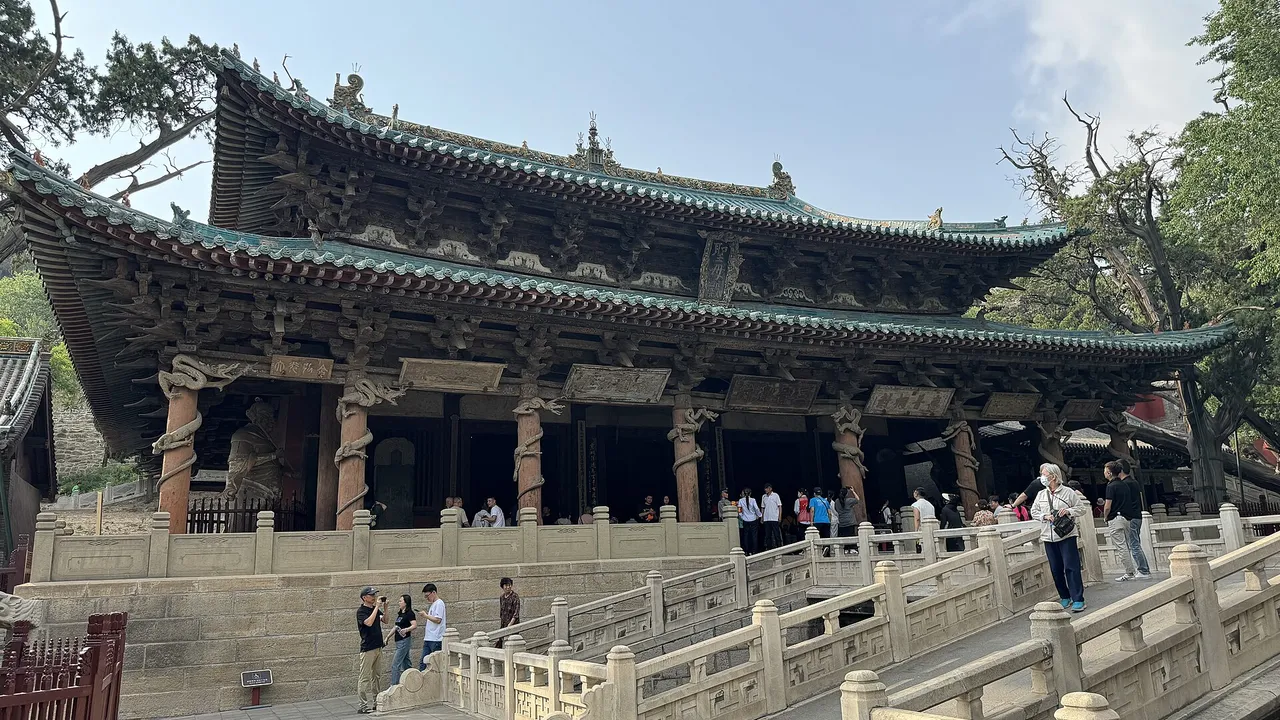
Close day two back in Yuci Old Town. The city-god temple is a nationally protected building whose Xuanjian tower shows its coffered ceiling and glazing best in slanting light; the county yamen and Qingxu pavilion line the same streets in a compact architectural set.
The restored quarter opens free in the evening as local night markets spread along the streets, and a bowl of Yuci liangchang or tixian noodles gives the rural day a proper homecoming.
The Qiao Family Compound: Six Courtyards of the Zaizhong Hall
Day three heads south to Qi county. The Qiao compound's fame arrived via film and television, but its real worth is architecture: six great courtyards face off north and south, gateway after gateway stepping along the central lane, with brick carving, woodwork and painting denser than any peer among merchant mansions.
The saying that folk homes peak at Qiao overstates things, yet walking the galleries under six joined rooflines, you grasp why the compound is called the specimen of northern domestic architecture.
Pingyao's City Wall: From the Upper East Gate to the South Gate
Arrive in Pingyao after lunch. This county town is China's most complete surviving walled city, the whole town inscribed by UNESCO in 1997. Climbing the wall is step one of understanding it: six point four kilometers of ramparts ringing the tortoise-shell plan.
Walk the stretch from the upper east gate to the south gate as battlements and towers unfold and the grey-tiled courtyards grid below like a chessboard. The south gate barbican is the most complete, and descending there starts the town walk perfectly.
Rishengchang: The Counter of China's First Draft Bank
Off the wall and into West Street, Rishengchang is Pingyao's heart. Founded around 1823 and called China's first bank, its three courtyards keep the counting room, letter room and underground vault as found.
The displays decode the draft system entire: a cipher scheme of verses encoded amounts and dates, letting one sheet of paper draw silver across the empire. Standing at the counter with the clerks' ledgers teaches financial history faster than any textbook.
Pingyao County Yamen: Closing before the Hall of Benevolent Rule
Pingyao's county yamen is the largest surviving county-level government seat in China, six courts deep from the main hall through the inner residence, with prison and granary still in place. The scheduled magistrate's court performance is showmanship, but the architecture's official grade is entirely real.
Leaving the yamen as dusk falls, the lanterns of the Ming-Qing street come on in sequence. Day three closes here: taxi to the rail station back to Taiyuan, or stay the night and finish night Pingyao properly.
| Getting around |
|
| Budget | Entries total about RMB 400-500, the Pingyao pass the biggest item; three days with transport run RMB 900-1,400 per person. |
| Best time | April-May blossoms and the September-October harvest season are best; Pingyao crowds peak on weekends, so dodge Saturdays. |
FAQs
Is chartering a car necessary for the three days?
For two or more, charter at least one day: bus connections to Hougou and the manor are weak, and a car compresses day two under eight hours. Day one's near suburbs and day three's rail line manage fine on public transport.
Can Pingyao be done in one day?
The essentials yes: one wall stretch, Rishengchang, the yamen and Ming-Qing Street in four hours. For the city-god temple, armed escort museums and night lights, stay over; the pass stays valid three days with no re-entry fee, so the marginal cost of a night is tiny.
Is this rural line worth it in winter?
Worth it, with a special angle: snow on earthen walls and grey tiles is peak photography and crowds thin to echo level. The cost is cold interiors and shortened hours, so confirm each site before setting out and dress for minus ten.
Do three old towns blur together?
No, they do different jobs: the county town shows Ming administrative planning, Yuci shows city-god faith and street life, Pingyao shows draft-bank finance and wall integrity. Narrate them to yourself as plan, faith and commerce, and fatigue turns into the pleasure of comparison.