
Taiyuan's standing architecture spans Song, Jin, Yuan and Ming, yet clusters in three tight lines: Jinci to the southwest, the temple-and-palace line of the old city, and the twin-pagoda edge to the southeast. Three days, three lines, walking from the Northern Song to the Ming.
The theme here is original fabric: the wooden coiled dragons of the Holy Mother Hall, Chongshan's early-Ming hall, the century-old government compound, all survivors rather than rebuilds. Slot the museum for the second morning; seeing objects before labels slashes the effort of understanding.
Itinerary at a glance
| Day 1 · 08:00 | Jinci's Holy Mother Hall and Flying Bridge: Northern Song Originals |
| Day 1 · 10:30 | The Never-aging Spring and the Zhou Cypress: Jinci's Other Wonders |
| Day 1 · 14:00 | Taiyuan Ancient County Town: The Ming County's Cross Streets |
| Day 2 · 09:00 | Shanxi Museum: A Catch-Up Morning of Bronzes and Tablets |
| Day 2 · 14:00 | Chunyang Palace: A Ming Taoist Compound in Nine Palaces |
| Day 2 · 15:30 | Chongshan Temple: The Early-Ming Hall and the Thousand-Armed Guanyin |
| Day 2 · 16:30 | Taiyuan Confucian Temple: The Archaeology Museum behind the Lingxing Gate |
| Day 3 · 09:00 | The Jinshang Museum: Reading the Merchants inside the Governor's Seat |
| Day 3 · 11:30 | The Changjing Tower: Where Imperial Exam Results Were Proclaimed |
| Day 3 · 14:00 | Yongzuo Twin Pagodas: The High Point of Three Heritage Days |
The route, stop by stop
Jinci's Holy Mother Hall and Flying Bridge: Northern Song Originals
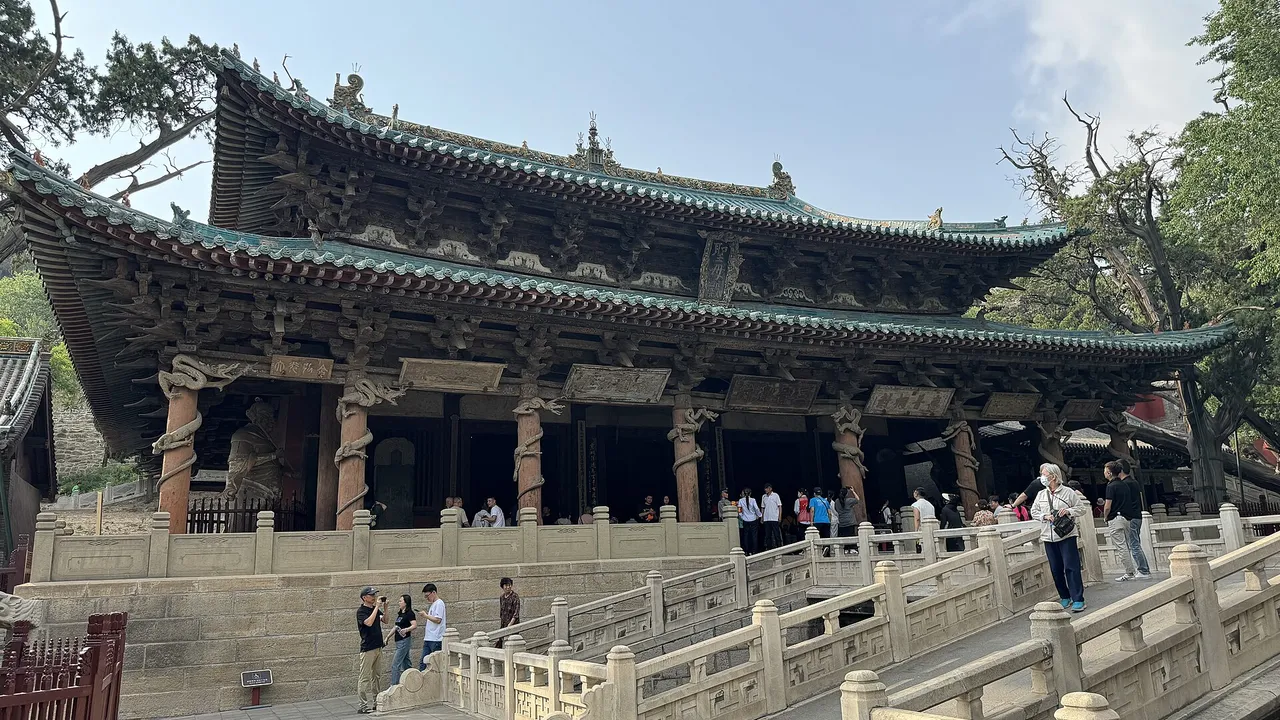
At opening, walk the axis to its end. Rebuilt in the Northern Song Tiansheng era, the Holy Mother Hall commands Jinci: eight carved wooden dragons coil around the front columns, and the forty-plus Song clay attendants inside repeat neither gesture nor expression, hailed as the summit of ancient Chinese figure sculpture.
Before it, the Flying Bridge crosses the square pool on a cruciform deck that Liang Sicheng pronounced unique in China. At eight the grounds hold almost no groups, and under the eaves you can hear the timberwork breathe in the wind, the golden hour for architecture lovers.
The Never-aging Spring and the Zhou Cypress: Jinci's Other Wonders
Return mid-axis for the other two wonders. The Never-aging Spring feeds the Jin river from a source that never runs dry, its name lifted from the Odes promising agelessness; beside it the Zhou cypress, said to be planted in the Western Zhou, sprawls like a dragon propped for centuries by a descendant tree.
The Offering Hall, a Jin-dynasty structure open on all sides like a pavilion, once displayed sacrificial offerings. Sitting here watching visitors stream up the axis is Jinci's best rest, banking leg strength for the afternoon.
Taiyuan Ancient County Town: The Ming County's Cross Streets
In the afternoon, return to Jinyuan district and the Ancient County Town. Founded in the Ming Hongwu era on the soil of old Jinyang city, its plan spreads like a phoenix's wings, the cross of main streets dividing four quarters with the yamen, Confucian temple and city-god temple still in place.
Reopened after full restoration, the walls are climbable, and at dusk the corner towers and moat compose complete pictures. Crowds run far thinner than Pingyao, ideal for a slow circuit of the ramparts.
Shanxi Museum: A Catch-Up Morning of Bronzes and Tablets
Day two returns to the museum line. With yesterday's Song figures fresh, shift focus to deeper strata: in the Shang-Zhou bronze halls, the bells and ritual vessels from the Jin marquis cemetery display in sets, pairing directly with the sacrificial tradition seen in the hall.
Crouch at the Houma covenant tablets: more than five thousand cinnabar-inscribed stone slips record oaths among late-Jin grandees, the strokes fine as gnat legs, while the Yu Hong sarcophagus in the Northern Dynasties hall swings the view toward the Silk Road.
Chunyang Palace: A Ming Taoist Compound in Nine Palaces
Back in the old city by afternoon, Chunyang Palace beside Wuyi Square builds the Taoist cosmos into architecture: five courtyards laid on the nine-palace, eight-trigram scheme, the final octagonal pavilion perched atop four spiraling stair passages, climbing it like walking a maze.
As the Shanxi Art Museum, the yards line up stone sculpture by era, Tang bodhisattvas sharing the compound with the Taoist Zhenwu. Mid-afternoon is the emptiest, and art students from the local academy often sketch in the fourth court.
Chongshan Temple: The Early-Ming Hall and the Thousand-Armed Guanyin
Once the Jin princely temple of the Ming, Chongshan now keeps its Dabei Hall as original early-Ming fabric, the space under green glazed tiles astonishingly tall. The three colossal figures inside top eight meters, the thousand-armed Guanyin holding a ritual object in every palm, an hour of close looking well spent.
Incense has burned here six hundred years without pause, and copyists sit along the cloister. For architecture, study the reduced-column plan and the roof trusses overhead, more rewarding than any censer.
Taiyuan Confucian Temple: The Archaeology Museum behind the Lingxing Gate
Three minutes on foot from Chongshan stands the Confucian Temple, its screen wall, Lingxing Gate and Dacheng Hall stretched along one axis, among Shanxi's best-preserved prefectural Confucian compounds. It now operates as the Shanxi Archaeology Museum, exhibiting the province's major digs.
The courtyards outshine the galleries: pan pond, old cypresses and stelae corridors slow the pace, and the closing-hour light raking the brackets of Dacheng Hall is the quietest moment in the old city.
The Jinshang Museum: Reading the Merchants inside the Governor's Seat
Day three starts on Fudong Street at the Jinshang Museum. From the Song and Jin onward this compound was Shanxi's seat of power, the warlord Yan Xishan's governor headquarters in the Republican era, and since 2020 a museum whose mixed Chinese-Western buildings are exhibits in themselves.
The displays lay out the merchants' underlying logic: from salt and frontier provisioning to draft banks clearing across the empire, with Rishengchang's anti-forgery techniques reading like ancient financial cryptography. Two hours covers the whole site; take a guide.
The Changjing Tower: Where Imperial Exam Results Were Proclaimed
South from the museum into Gulou Street, the Changjing Tower hides on the corner: a Ming timber tower built as the annex of Shanxi's examination hall, where results were proclaimed aloud, a survivor of extreme rarity nationwide.
The structure is small, but its two-story cross-hipped roof stands out sharply against the old street's skyline. Stand below and imagine the names ringing out, the most concrete single stop for understanding the examination system, half an hour ample.
Yongzuo Twin Pagodas: The High Point of Three Heritage Days
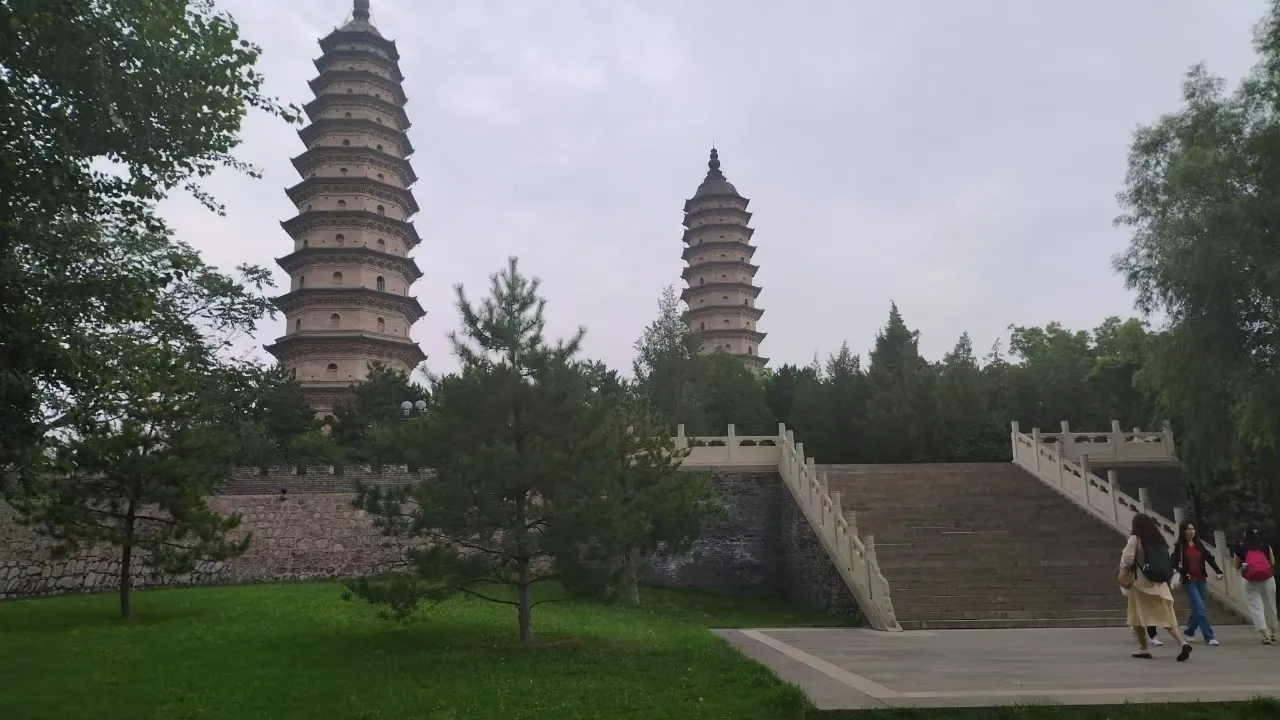
Give the trip's last hour to the twins. Both Ming brick constructions, the pagodas grind every timber detail out of brick; climb the spiral stair and watch Taiyuan's skyline slide from old to new through the window slots.
The Song hall, Ming temples, Taoist palace and governor's compound of three days all spread below. In late April, the Zixiaxian peonies framing the pagodas give the heritage line its softest ending.
| Getting around |
|
| Budget | Entries total about RMB 200-300, Jinci the biggest line; three days with transport and meals run RMB 800-1,200 per person. |
| Best time | April-June and September-October are best; museums close Mondays, and the county town's night lights deserve one evening. |
FAQs
Are all three days genuine historic structures?
Mostly yes: the Holy Mother Hall is Northern Song fabric, the Offering Hall Jin, the Dabei Hall early Ming, the tower Ming. The county town is a full restoration, best valued for its plan and night lights, which is why it sits on the first afternoon.
Is this route manageable for elderly travelers?
Largely friendly: Jinci and the museum offer carts and wheelchair loans, and the county walls can be sampled in a short stretch. The strain points are pagoda and palace stairs, both skippable in favor of courtyard viewing, with no route changes needed.
How should rain reshuffle the three days?
Prioritize indoor stops, pushing Jinci and the county town to clear days. Light rain suits heritage oddly well, eaves dripping and bricks darkened, so proceed with umbrella and grip shoes; only heavy rain forces a swap.
Where should I base all three nights?
Base around Zhonglou Street and Liuxiang: direct metro line 2, a straight run toward Jinci, and walking access to the Food Street and Fen nights. Every day-two and day-three start lands within twenty minutes by car, no hotel changes.